
Multiblock copolymer nanoparticles RAFT emulsion polymerization: incorporation of a fluorine-containing functional monomer

IF 3.9 2区 化学 Q2 POLYMER SCIENCE
Murtaza Khan,Thiago R. Guimarães,Pierre-Yves Dugas,Per B. Zetterlund
{"title":"Multiblock copolymer nanoparticles RAFT emulsion polymerization: incorporation of a fluorine-containing functional monomer","authors":"Murtaza Khan,Thiago R. Guimarães,Pierre-Yves Dugas,Per B. Zetterlund","doi":"10.1039/d6py00590j","DOIUrl":null,"url":null,"abstract":"Multiblock copolymers provide a versatile platform for tailoring nanoscale organization and combining functional properties that are difficult to achieve with conventional polymer architectures. Here, we report the synthesis of fluorine-rich multiblock copolymer nanoparticles via one-pot surfactant-free RAFT emulsion polymerization in water using an amphiphilic macroRAFT agent. Sequential monomer additions enabled efficient chain extension and formation of well-defined multiblock architectures comprising n-butyl methacrylate (nBMA) and fluorinated statistical blocks of 2,2,3,4,4,4-hexafluorobutyl methacrylate (HFMA) and benzyl methacrylate (BzMA) in a one-pot system. Multiblock copolymer nanoparticles with high molecular weight were obtained with high monomer conversion in each polymerization cycle, controlled molecular weight distributions, and progressive particle growth without evidence of secondary nucleation. Cryogenic TEM confirmed controlled nanoparticle growth, while EDX-STEM elemental mapping verified successful incorporation of fluorinated segments within the nanoparticles. These results demonstrate that aqueous RAFT emulsion polymerization provides a robust and scalable route to fluorinated multiblock nanoparticles, enabling nanoscale confinement of highly incompatible fluorinated domains and opening opportunities for advanced functional materials.","PeriodicalId":100,"journal":{"name":"Polymer Chemistry","volume":"6 1","pages":""},"PeriodicalIF":3.9000,"publicationDate":"2026-08-11","publicationTypes":"Journal Article","fieldsOfStudy":null,"isOpenAccess":false,"openAccessPdf":"","citationCount":"0","resultStr":null,"platform":"Semanticscholar","paperid":null,"PeriodicalName":"Polymer Chemistry","FirstCategoryId":"92","ListUrlMain":"https://doi.org/10.1039/d6py00590j","RegionNum":2,"RegionCategory":"化学","ArticlePicture":[],"TitleCN":null,"AbstractTextCN":null,"PMCID":null,"EPubDate":"","PubModel":"","JCR":"Q2","JCRName":"POLYMER SCIENCE","Score":null,"Total":0}
引用次数: 0

Abstract

Multiblock copolymers provide a versatile platform for tailoring nanoscale organization and combining functional properties that are difficult to achieve with conventional polymer architectures. Here, we report the synthesis of fluorine-rich multiblock copolymer nanoparticles via one-pot surfactant-free RAFT emulsion polymerization in water using an amphiphilic macroRAFT agent. Sequential monomer additions enabled efficient chain extension and formation of well-defined multiblock architectures comprising n-butyl methacrylate (nBMA) and fluorinated statistical blocks of 2,2,3,4,4,4-hexafluorobutyl methacrylate (HFMA) and benzyl methacrylate (BzMA) in a one-pot system. Multiblock copolymer nanoparticles with high molecular weight were obtained with high monomer conversion in each polymerization cycle, controlled molecular weight distributions, and progressive particle growth without evidence of secondary nucleation. Cryogenic TEM confirmed controlled nanoparticle growth, while EDX-STEM elemental mapping verified successful incorporation of fluorinated segments within the nanoparticles. These results demonstrate that aqueous RAFT emulsion polymerization provides a robust and scalable route to fluorinated multiblock nanoparticles, enabling nanoscale confinement of highly incompatible fluorinated domains and opening opportunities for advanced functional materials.

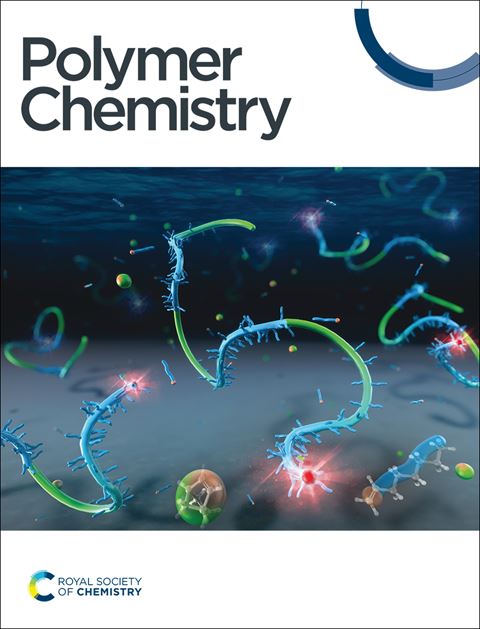
Abstract Image

多嵌段共聚物纳米颗粒RAFT乳液聚合:含氟功能单体的掺入
多嵌段共聚物为定制纳米级结构和结合传统聚合物结构难以实现的功能特性提供了一个通用的平台。在这里,我们报道了用两亲性的macroRAFT试剂在水中通过一锅无表面活性剂的RAFT乳液聚合合成富氟多嵌段共聚物纳米颗粒。顺序的单体添加使得高效的链延伸和形成明确的多嵌段结构,包括甲基丙烯酸正丁酯(nBMA)和2,2,3,4,4,4-六氟甲基丙烯酸丁酯(HFMA)和甲基丙烯酸苄酯(BzMA)的氟化统计嵌段。高分子量的多嵌段共聚物纳米颗粒在每个聚合循环中单体转化率高,分子量分布可控,颗粒生长无二次成核。低温透射电镜证实了纳米颗粒的生长受到控制,而EDX-STEM元素图谱证实了纳米颗粒中氟化段的成功结合。这些结果表明,水性RAFT乳液聚合为氟化多嵌段纳米颗粒提供了一条稳健且可扩展的途径,使高度不相容的氟化结构域能够在纳米尺度上得到限制,并为先进的功能材料开辟了机会。
本文章由计算机程序翻译,如有差异,请以英文原文为准。
求助全文
约1分钟内获得全文 求助全文
来源期刊
Polymer Chemistry
Polymer Chemistry POLYMER SCIENCE-
CiteScore
8.60
自引率
8.70%
发文量
535
审稿时长
1.7 months
期刊介绍: Polymer Chemistry welcomes submissions in all areas of polymer science that have a strong focus on macromolecular chemistry. Manuscripts may cover a broad range of fields, yet no direct application focus is required.

×
引用
GB/T 7714-2015
复制
MLA
复制
APA
复制
导出至
BibTeX EndNote RefMan NoteFirst NoteExpress
×
提示
您的信息不完整,为了账户安全,请先补充。
现在去补充
×
提示
您因"违规操作"
具体请查看互助需知
我知道了
×
提示
确定
请完成安全验证×
copy
已复制链接
快去分享给好友吧!
我知道了
右上角分享
点击右上角分享
0
联系我们:info@booksci.cn Book学术提供免费学术资源搜索服务,方便国内外学者检索中英文文献。致力于提供最便捷和优质的服务体验。 Copyright © 2023 布克学术 All rights reserved.
京ICP备2023020795号-1
ghs 京公网安备 11010802042870号
Book学术文献互助
Book学术文献互助群
群 号:604180095
Book学术官方微信
小红书


