
Sustainable bio-based polyesters organocatalyzed ring-opening alternating copolymerization and their adhesive applications

IF 3.9 2区 化学 Q2 POLYMER SCIENCE
Chaoxi Sun,Zhizhuang Li,You Xie,Yiwen Luo,Weihong Zeng,Fumin Liao,Yunjia Wang,Heng Li,He-Lou Xie
{"title":"Sustainable bio-based polyesters organocatalyzed ring-opening alternating copolymerization and their adhesive applications","authors":"Chaoxi Sun,Zhizhuang Li,You Xie,Yiwen Luo,Weihong Zeng,Fumin Liao,Yunjia Wang,Heng Li,He-Lou Xie","doi":"10.1039/d6py00568c","DOIUrl":null,"url":null,"abstract":"Ring-opening alternating copolymerization (ROAP) of the bio-derived monomer 3,4-dihydrocoumarin (DHC) with epoxides represents a promising route to sustainable aromatic polyesters. However, existing catalytic systems often suffer from limited monomer scope and insufficient molar mass control due to undesired transesterification side reactions. Herein, we report a two-component organocatalytic system composed of organobases and triethylborane for the ROAP of DHC with various epoxides. This strategy affords well-defined aromatic polyesters with perfectly alternating sequences, relatively high molar masses (up to 10 kg mol−1), and narrow molar mass distributions (Đ < 1.25). The catalytic system exhibits broad monomer compatibility, enabling the copolymerization of DHC with propylene oxide, 1,2-butylene oxide, styrene oxide, allyl glycidyl ether, glycidyl methacrylate, cyclohexene oxide, and 4-vinylcyclohexene oxide. Furthermore, block copolymers with (AB)nCm and (AB)n(CB)m architectures are synthesized in a one-pot manner via sequential monomer addition following the ROAP stage. The resulting bio-based polyesters exhibit excellent thermal stability and undergo facile degradation under mild conditions. Moreover, a crosslinked formulation based on P(DHC-alt-AGE) demonstrates adhesive performance comparable to or surpassing that of commercial adhesives. This work provides an efficient platform for the controlled synthesis of DHC-based aromatic polyesters and highlights their potential as sustainable adhesive materials.","PeriodicalId":100,"journal":{"name":"Polymer Chemistry","volume":"10 1","pages":""},"PeriodicalIF":3.9000,"publicationDate":"2026-08-11","publicationTypes":"Journal Article","fieldsOfStudy":null,"isOpenAccess":false,"openAccessPdf":"","citationCount":"0","resultStr":null,"platform":"Semanticscholar","paperid":null,"PeriodicalName":"Polymer Chemistry","FirstCategoryId":"92","ListUrlMain":"https://doi.org/10.1039/d6py00568c","RegionNum":2,"RegionCategory":"化学","ArticlePicture":[],"TitleCN":null,"AbstractTextCN":null,"PMCID":null,"EPubDate":"","PubModel":"","JCR":"Q2","JCRName":"POLYMER SCIENCE","Score":null,"Total":0}
引用次数: 0

Abstract

Ring-opening alternating copolymerization (ROAP) of the bio-derived monomer 3,4-dihydrocoumarin (DHC) with epoxides represents a promising route to sustainable aromatic polyesters. However, existing catalytic systems often suffer from limited monomer scope and insufficient molar mass control due to undesired transesterification side reactions. Herein, we report a two-component organocatalytic system composed of organobases and triethylborane for the ROAP of DHC with various epoxides. This strategy affords well-defined aromatic polyesters with perfectly alternating sequences, relatively high molar masses (up to 10 kg mol−1), and narrow molar mass distributions (Đ < 1.25). The catalytic system exhibits broad monomer compatibility, enabling the copolymerization of DHC with propylene oxide, 1,2-butylene oxide, styrene oxide, allyl glycidyl ether, glycidyl methacrylate, cyclohexene oxide, and 4-vinylcyclohexene oxide. Furthermore, block copolymers with (AB)nCm and (AB)n(CB)m architectures are synthesized in a one-pot manner via sequential monomer addition following the ROAP stage. The resulting bio-based polyesters exhibit excellent thermal stability and undergo facile degradation under mild conditions. Moreover, a crosslinked formulation based on P(DHC-alt-AGE) demonstrates adhesive performance comparable to or surpassing that of commercial adhesives. This work provides an efficient platform for the controlled synthesis of DHC-based aromatic polyesters and highlights their potential as sustainable adhesive materials.

Abstract Image

可持续生物基聚酯的有机催化开环交替共聚及其粘接应用
生物衍生单体3,4-二氢香豆素(DHC)与环氧化物的开环交替共聚(ROAP)是一种有前途的可持续芳香族聚酯途径。然而,由于不期望的酯交换副反应,现有的催化体系往往存在单体范围有限和摩尔质量控制不足的问题。本文报道了一种由有机碱和三乙基硼烷组成的双组分有机催化体系,用于DHC与各种环氧化合物的ROAP反应。这种策略提供了良好定义的芳香聚酯,具有完美的交替序列,相对较高的摩尔质量(高达10 kg mol−1)和窄的摩尔质量分布(Đ < 1.25)。该催化体系具有广泛的单体相容性,可使DHC与环氧丙烷、1,2-环氧丁烯、环氧苯乙烯、烯丙基缩水甘油醚、甲基丙烯酸缩水甘油酯、环氧环己烯和4-乙烯基环氧环己烯共聚。此外,具有(AB)nCm和(AB)n(CB)m结构的嵌段共聚物在ROAP阶段之后通过顺序添加单体以一锅方式合成。所得的生物基聚酯具有优异的热稳定性,在温和的条件下易于降解。此外,基于P(DHC-alt-AGE)的交联配方显示出与商用粘合剂相当或超过商用粘合剂的粘合性能。这项工作为控制合成dhc基芳香族聚酯提供了一个有效的平台,并突出了其作为可持续粘合材料的潜力。
本文章由计算机程序翻译,如有差异,请以英文原文为准。
求助全文
约1分钟内获得全文 求助全文
来源期刊
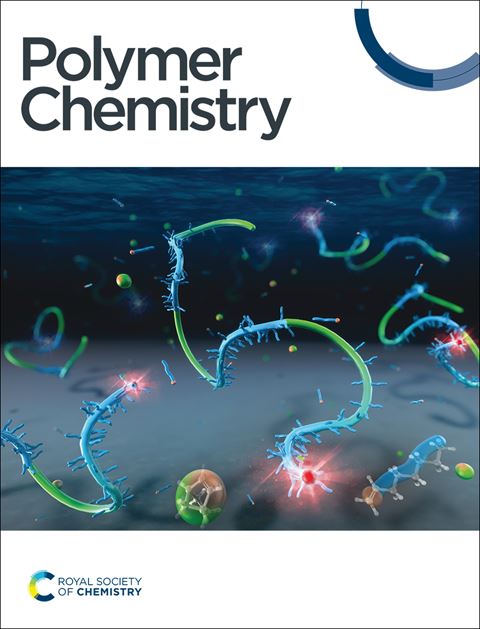
Polymer Chemistry
Polymer Chemistry POLYMER SCIENCE-
CiteScore
8.60
自引率
8.70%
发文量
535
审稿时长
1.7 months
期刊介绍: Polymer Chemistry welcomes submissions in all areas of polymer science that have a strong focus on macromolecular chemistry. Manuscripts may cover a broad range of fields, yet no direct application focus is required.

×
引用
GB/T 7714-2015
复制
MLA
复制
APA
复制
导出至
BibTeX EndNote RefMan NoteFirst NoteExpress
×
提示
您的信息不完整,为了账户安全,请先补充。
现在去补充
×
提示
您因"违规操作"
具体请查看互助需知
我知道了
×
提示
确定
请完成安全验证×
copy
已复制链接
快去分享给好友吧!
我知道了
右上角分享
点击右上角分享
0
联系我们:info@booksci.cn Book学术提供免费学术资源搜索服务,方便国内外学者检索中英文文献。致力于提供最便捷和优质的服务体验。 Copyright © 2023 布克学术 All rights reserved.
京ICP备2023020795号-1
ghs 京公网安备 11010802042870号
Book学术文献互助
Book学术文献互助群
群 号:604180095
Book学术官方微信
小红书


