
Robust Generation of Topological Biphoton Mode via Adiabatic Passage
IF 6.8
2区 物理与天体物理
Q1 MATERIALS SCIENCE, MULTIDISCIPLINARY
引用次数: 0
Abstract
Topological waveguide arrays support robust mode propagation in the presence of fabrication imperfections, providing a significant advantage for on-chip quantum information processing. However, this robustness does not fully extend to nonlinear biphoton generation. Structural disorder can enhance the excitation of non-topological biphoton modes during nonlinear interactions, which degrades the quantum properties of the generated state. To overcome this limitation, we propose an adiabatic passage that connects an isolated site to a topological defect array. By initiating the nonlinear process in a strongly isolated regime, nonlinear coupling to unwanted modes is effectively suppressed, thereby preserving the Schmidt number of the generated state. The subsequent adiabatic connection facilitates the high fidelity transfer of the generated biphoton into the topological biphoton mode. Our numerical simulations demonstrate that, unlike conventional topological structures, the adiabatic scheme maintains both high biphoton fidelity and a unit Schmidt number in the presence of waveguide gap disorder. Furthermore, we show that this robustness extends to path entangled NOON states, achieving a near-unity quantum interference visibility. Our approach provides a practical design strategy for disorder-tolerant integrated quantum photonic devices.

绝热通道拓扑双光子模式的鲁棒生成
拓扑波导阵列在存在制造缺陷的情况下支持鲁棒模式传播,为片上量子信息处理提供了显着优势。然而,这种鲁棒性并不能完全扩展到非线性双光子产生。在非线性相互作用过程中,结构失序会增强非拓扑双光子模式的激发,从而降低生成态的量子特性。为了克服这一限制,我们提出了一个绝热通道,将一个孤立的位置连接到拓扑缺陷阵列。通过在强隔离状态下启动非线性过程,有效地抑制了与不需要模式的非线性耦合,从而保持了生成状态的施密特数。随后的绝热连接有助于将生成的双光子高保真地转移到拓扑双光子模式。我们的数值模拟表明,与传统的拓扑结构不同,绝热方案在波导间隙无序存在的情况下保持高双光子保真度和单位施密特数。此外,我们证明了这种鲁棒性扩展到路径纠缠的NOON状态,实现了近统一的量子干涉可见性。我们的方法为容错集成量子光子器件提供了一种实用的设计策略。
本文章由计算机程序翻译,如有差异,请以英文原文为准。
求助全文
约1分钟内获得全文
求助全文
来源期刊
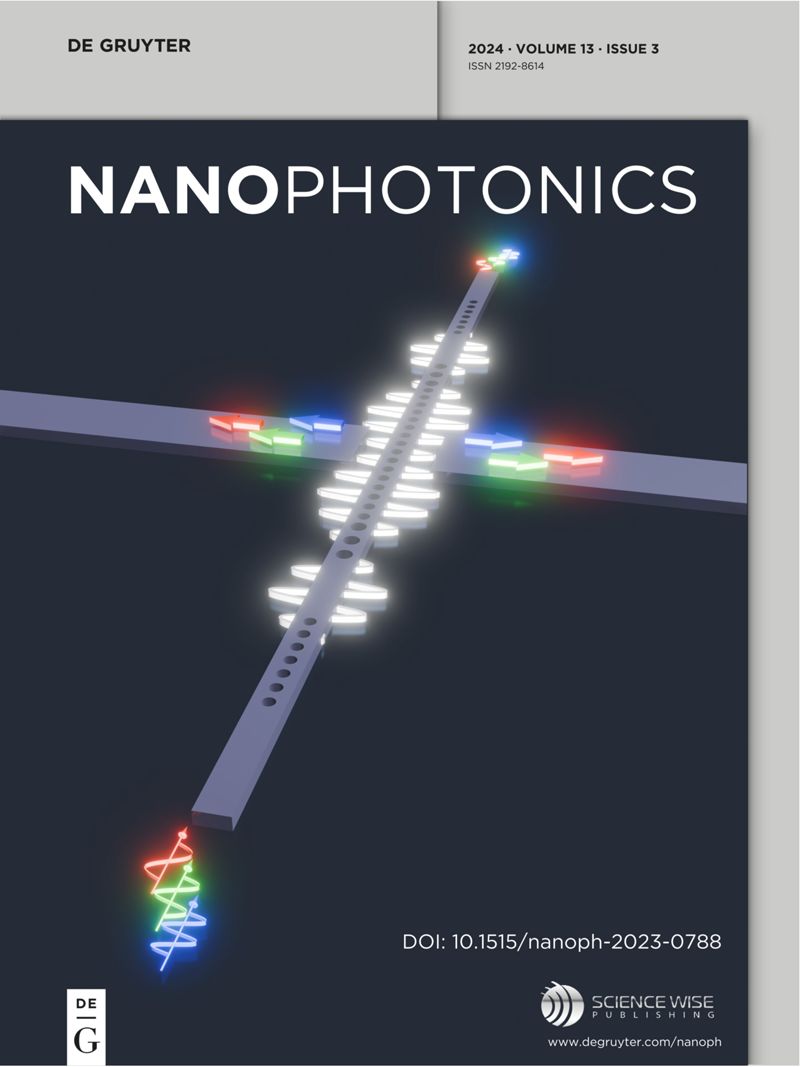
Nanophotonics
NANOSCIENCE & NANOTECHNOLOGY-MATERIALS SCIENCE, MULTIDISCIPLINARY
CiteScore
13.50
自引率
6.70%
发文量
358
审稿时长
7 weeks
期刊介绍:
Nanophotonics, published in collaboration with Sciencewise, is a prestigious journal that showcases recent international research results, notable advancements in the field, and innovative applications. It is regarded as one of the leading publications in the realm of nanophotonics and encompasses a range of article types including research articles, selectively invited reviews, letters, and perspectives.
The journal specifically delves into the study of photon interaction with nano-structures, such as carbon nano-tubes, nano metal particles, nano crystals, semiconductor nano dots, photonic crystals, tissue, and DNA. It offers comprehensive coverage of the most up-to-date discoveries, making it an essential resource for physicists, engineers, and material scientists.
 求助内容:
 应助结果提醒方式:


 京公网安备 11010802042870号


