
Highly efficient in vivo uranium clearance achieved by carboxyl functionalized nanocages

IF 9.8 1区 化学 Q1 CHEMISTRY, MULTIDISCIPLINARY
Jiakai Liu, Shiyu Qing, Tianen Zhu, Zongyi Li, Yuqing Jiang, Yaqi Jin, Dehan Cao, Longxiang Wang, Sheng Hong, Ximeng Li, Lei Bi, Xueqing Yang, Bin Chen, Juan Diwu, Shuao Wang
{"title":"Highly efficient in vivo uranium clearance achieved by carboxyl functionalized nanocages","authors":"Jiakai Liu,&nbsp;Shiyu Qing,&nbsp;Tianen Zhu,&nbsp;Zongyi Li,&nbsp;Yuqing Jiang,&nbsp;Yaqi Jin,&nbsp;Dehan Cao,&nbsp;Longxiang Wang,&nbsp;Sheng Hong,&nbsp;Ximeng Li,&nbsp;Lei Bi,&nbsp;Xueqing Yang,&nbsp;Bin Chen,&nbsp;Juan Diwu,&nbsp;Shuao Wang","doi":"10.1007/s11426-025-3397-1","DOIUrl":null,"url":null,"abstract":"<div><p>Effective <i>in vivo</i> uranium clearance and mitigation of its radiation damage are crucial for the safety of uranium-exposed workers and residents, yet remain challenging. Current small-molecule drugs suffer from rapid metabolism and poor organ targeting, limiting their effectiveness in both preventive and long-term exposure scenarios. Nano decorporation agents, despite their prolonged <i>in vivo</i> retention due to nanoscale size and physico-chemical properties, encounter limitations such as restricted long channels and mismatched coordination geometry of chelating sites, which impede rapid and selective uranyl binding under physiological conditions. This study employs discrete metal-organic polyhedra (MOPs) to achieve a dense grafting and flexible arrangement of carboxylic acid chains, aiming to attain collaborative coordination of uranyl ions on the faces of tetrahedral structures. These MOPs selectively capture uranyl at low concentrations <i>in vitro</i> and show superior <i>in vivo</i> removal efficiency compared to clinical drugs and currently reported nano agents in both prophylactic and delayed treatments, where higher grafting density of carboxyl chains leads to greater decorporation efficiency. This work underscores the potential of MOPs in advancing nanomedicine for nuclear emergencies.</p><div><figure><div><div><picture><source><img></source></picture></div></div></figure></div></div>","PeriodicalId":772,"journal":{"name":"Science China Chemistry","volume":"69 8","pages":"4343 - 4348"},"PeriodicalIF":9.8000,"publicationDate":"2026-07-09","publicationTypes":"Journal Article","fieldsOfStudy":null,"isOpenAccess":false,"openAccessPdf":"","citationCount":"0","resultStr":null,"platform":"Semanticscholar","paperid":null,"PeriodicalName":"Science China Chemistry","FirstCategoryId":"1","ListUrlMain":"https://link.springer.com/article/10.1007/s11426-025-3397-1","RegionNum":1,"RegionCategory":"化学","ArticlePicture":[],"TitleCN":null,"AbstractTextCN":null,"PMCID":null,"EPubDate":"","PubModel":"","JCR":"Q1","JCRName":"CHEMISTRY, MULTIDISCIPLINARY","Score":null,"Total":0}
引用次数: 0

Abstract

Effective in vivo uranium clearance and mitigation of its radiation damage are crucial for the safety of uranium-exposed workers and residents, yet remain challenging. Current small-molecule drugs suffer from rapid metabolism and poor organ targeting, limiting their effectiveness in both preventive and long-term exposure scenarios. Nano decorporation agents, despite their prolonged in vivo retention due to nanoscale size and physico-chemical properties, encounter limitations such as restricted long channels and mismatched coordination geometry of chelating sites, which impede rapid and selective uranyl binding under physiological conditions. This study employs discrete metal-organic polyhedra (MOPs) to achieve a dense grafting and flexible arrangement of carboxylic acid chains, aiming to attain collaborative coordination of uranyl ions on the faces of tetrahedral structures. These MOPs selectively capture uranyl at low concentrations in vitro and show superior in vivo removal efficiency compared to clinical drugs and currently reported nano agents in both prophylactic and delayed treatments, where higher grafting density of carboxyl chains leads to greater decorporation efficiency. This work underscores the potential of MOPs in advancing nanomedicine for nuclear emergencies.
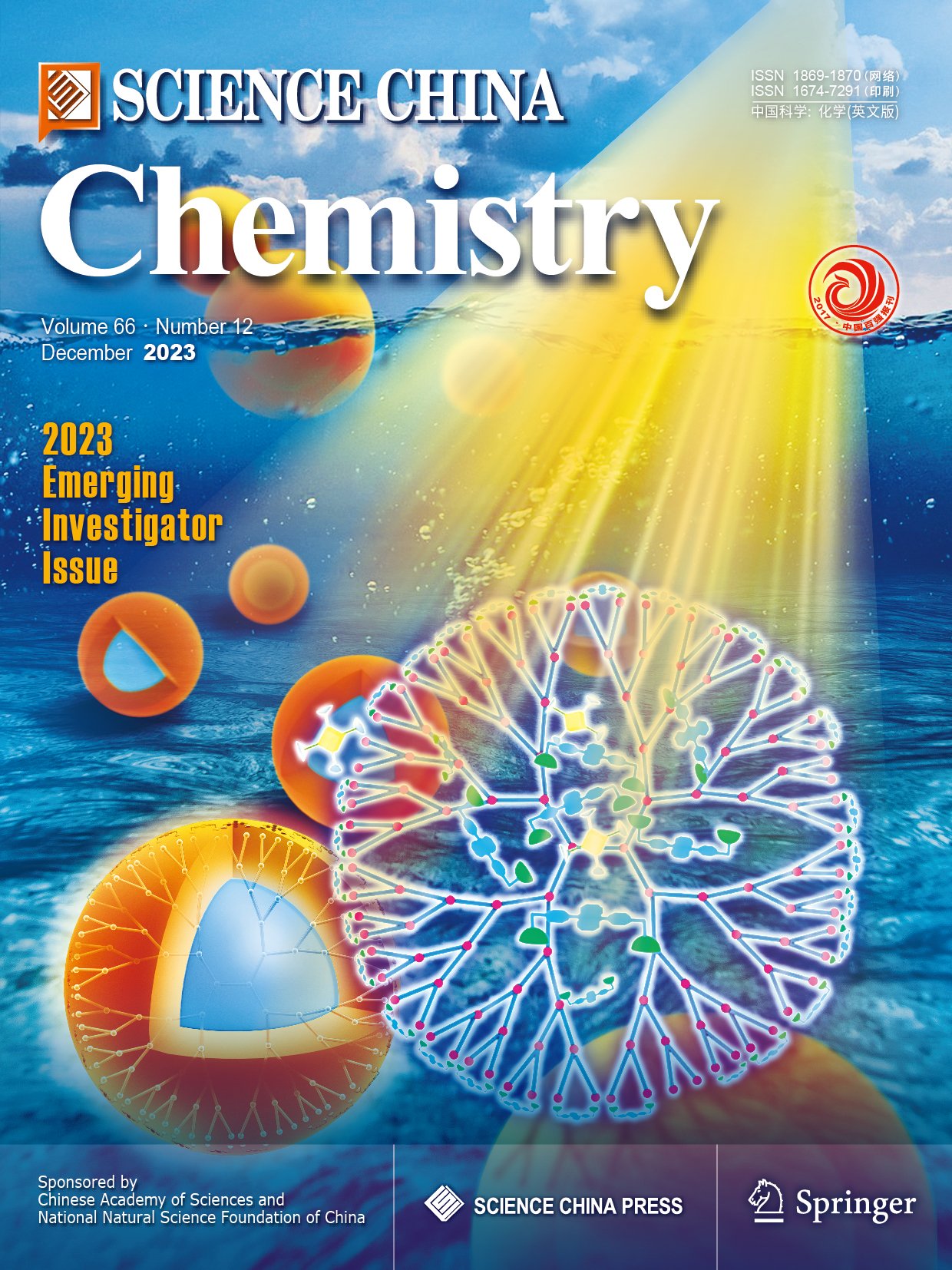

羧基功能化纳米笼实现了高效的体内铀清除
有效的体内铀清除和减轻其辐射损害对接触铀的工人和居民的安全至关重要,但仍然具有挑战性。目前的小分子药物代谢速度快,器官靶向性差,限制了它们在预防和长期暴露情况下的有效性。由于纳米尺寸和物理化学性质,纳米脱配剂在体内的滞留时间较长,但由于螯合位点的长通道限制和配位几何不匹配,阻碍了生理条件下铀酰的快速和选择性结合。本研究采用离散金属-有机多面体(MOPs)实现羧酸链的密集接枝和柔性排列,旨在实现铀酰离子在四面体结构表面的协同配位。这些MOPs在体外选择性地捕获低浓度的铀酰,与临床药物和目前报道的纳米药物相比,在预防和延迟治疗中表现出更好的体内去除效率,其中更高的羧基链接枝密度导致更高的脱孔效率。这项工作强调了MOPs在推进核应急纳米医学方面的潜力。
本文章由计算机程序翻译,如有差异,请以英文原文为准。
求助全文
约1分钟内获得全文 求助全文
来源期刊
Science China Chemistry
Science China Chemistry CHEMISTRY, MULTIDISCIPLINARY-
CiteScore
14.40
自引率
7.30%
发文量
3787
审稿时长
2.2 months
期刊介绍: Science China Chemistry, co-sponsored by the Chinese Academy of Sciences and the National Natural Science Foundation of China and published by Science China Press, publishes high-quality original research in both basic and applied chemistry. Indexed by Science Citation Index, it is a premier academic journal in the field. Categories of articles include: Highlights. Brief summaries and scholarly comments on recent research achievements in any field of chemistry. Perspectives. Concise reports on thelatest chemistry trends of interest to scientists worldwide, including discussions of research breakthroughs and interpretations of important science and funding policies. Reviews. In-depth summaries of representative results and achievements of the past 5–10 years in selected topics based on or closely related to the research expertise of the authors, providing a thorough assessment of the significance, current status, and future research directions of the field.
×
引用
GB/T 7714-2015
复制
MLA
复制
APA
复制
导出至
BibTeX EndNote RefMan NoteFirst NoteExpress
×
提示
您的信息不完整,为了账户安全,请先补充。
现在去补充
×
提示
您因"违规操作"
具体请查看互助需知
我知道了
×
提示
确定
请完成安全验证×
copy
已复制链接
快去分享给好友吧!
我知道了
右上角分享
点击右上角分享
0
联系我们:info@booksci.cn Book学术提供免费学术资源搜索服务,方便国内外学者检索中英文文献。致力于提供最便捷和优质的服务体验。 Copyright © 2023 布克学术 All rights reserved.
京ICP备2023020795号-1
ghs 京公网安备 11010802042870号
Book学术文献互助
Book学术文献互助群
群 号:604180095
Book学术官方微信
小红书


