
Persistence of Arctic Ocean acidification under negative emissions
IF 26.9
1区 地球科学
Q1 ENVIRONMENTAL SCIENCES
引用次数: 0
Abstract
Although net negative emissions of carbon dioxide (CO2) are essential to meet climate targets, little is known about how declining atmospheric CO2 levels will affect ocean acidification. Here, by analysing the acidity ([H+]) and corrosivity to aragonite (ΩArag) in eight Earth system models that made simulations under rising then falling CO2 levels, we identify the Arctic as a hotspot for delayed reversibility of ocean acidification. Under falling CO2, Arctic surface waters remain comparatively more acidic, and aragonite-corrosive conditions (ΩArag < 1) persist until atmospheric CO2 drops ~120 ppm below the threshold at which they first appeared under rising CO2. This hysteresis arises from the erosion of the natural surface-layer deficit in dissolved inorganic carbon, initially maintained by sea ice limiting air–sea gas exchange and not fully restored as sea ice recovers during CO2 decline. Thus, the Arctic Ocean experiences not only the greatest acidification but also the most delayed benefits from negative emissions. Changes in the Earth system may persist long after atmospheric CO2 levels decline. This study examines ocean acidification and how it will persist in ocean regions globally, with the Arctic identified as the area that experiences relief from acidification the latest under negative emissions.
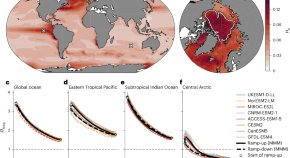
负排放条件下北冰洋酸化的持续性
尽管二氧化碳的净负排放对于实现气候目标至关重要,但人们对大气中二氧化碳水平下降将如何影响海洋酸化知之甚少。在这里,通过分析八个地球系统模型中的酸度([H+])和对文石的腐蚀性(ΩArag),这些模型在二氧化碳水平上升和下降的情况下进行了模拟,我们确定北极是海洋酸化延迟可逆性的热点。在二氧化碳下降的情况下,北极地表水保持相对较强的酸性,文石腐蚀条件(ΩArag < 1)持续存在,直到大气二氧化碳下降到120 ppm,低于它们在二氧化碳上升时首次出现的阈值。这种迟滞是由于溶解无机碳的天然表层亏空的侵蚀造成的,这种亏空最初是由海冰维持的,海冰限制了海气交换,但在二氧化碳下降期间海冰恢复,亏空并没有完全恢复。因此,北冰洋不仅经历了最严重的酸化,而且还从负排放中获得了最迟的好处。
本文章由计算机程序翻译,如有差异,请以英文原文为准。
求助全文
约1分钟内获得全文
求助全文
来源期刊
Nature Climate Change
ENVIRONMENTAL SCIENCES-METEOROLOGY & ATMOSPHERIC SCIENCES
CiteScore
40.30
自引率
1.60%
发文量
267
审稿时长
4-8 weeks
期刊介绍:
Nature Climate Change is dedicated to addressing the scientific challenge of understanding Earth's changing climate and its societal implications. As a monthly journal, it publishes significant and cutting-edge research on the nature, causes, and impacts of global climate change, as well as its implications for the economy, policy, and the world at large.
The journal publishes original research spanning the natural and social sciences, synthesizing interdisciplinary research to provide a comprehensive understanding of climate change. It upholds the high standards set by all Nature-branded journals, ensuring top-tier original research through a fair and rigorous review process, broad readership access, high standards of copy editing and production, rapid publication, and independence from academic societies and other vested interests.
Nature Climate Change serves as a platform for discussion among experts, publishing opinion, analysis, and review articles. It also features Research Highlights to highlight important developments in the field and original reporting from renowned science journalists in the form of feature articles.
Topics covered in the journal include adaptation, atmospheric science, ecology, economics, energy, impacts and vulnerability, mitigation, oceanography, policy, sociology, and sustainability, among others.
 求助内容:
求助内容: 应助结果提醒方式:

 京公网安备 11010802042870号


