
Numerical Investigation of Natural Gas Pipeline Physical Explosions with a Compressibility-Factor-Based Non-Ideal Initial State Correction
IF 7.9
2区 环境科学与生态学
Q1 ENGINEERING, CHEMICAL
引用次数: 0
Abstract
Long-distance high-pressure natural gas pipelines underpin low-carbon energy supply, and rupture of an in-service segment radiates an overpressure wave whose impact radius governs safety-distance determination. Current assessment relies on the TNT-equivalence method, whose point-source geometry, instantaneous energy deposition, and ideal-gas treatment contradict the cylindrical source, finite-rate efflux, and non-ideal initial state of an actual rupture, leaving safety distances systematically biased. An Arbitrary Lagrangian-Eulerian (ALE) fluid-structure interaction model coupling crack propagation with gas release is constructed in LS-DYNA, in which the initial gas state is corrected using the compressibility factor基于压缩系数非理想初始状态修正的天然气管道物理爆炸数值研究
长距离高压天然气管道是低碳能源供应的基础,在役管道的破裂会辐射出超压波,其影响半径决定着安全距离的确定。目前的评估依赖于tnt等效方法,该方法的点源几何形状、瞬时能量沉积和理想气体处理与圆柱形源、有限速率射流和实际破裂的非理想初始状态相矛盾,导致安全距离系统性偏差。在LS-DYNA中建立了裂纹扩展与气体释放耦合的任意拉格朗日-欧拉(ALE)流固耦合模型,该模型采用压缩系数Z对初始气体状态进行修正,代表了非理想初始状态修正,而不是完全实气体状态方程。以P4全尺寸X90爆破为基准,ALE框架在10m处和50m处分别再现了4.6%和29.0%的实测峰值超压,而TNT模拟在10m处超过了24.5%,在50m处低于了69.4%。仅z值修正就能在10m处产生9.7%的峰值隆升,为改进管道安全距离规定提供了物理上一致的基础。
本文章由计算机程序翻译,如有差异,请以英文原文为准。
求助全文
约1分钟内获得全文
求助全文
来源期刊
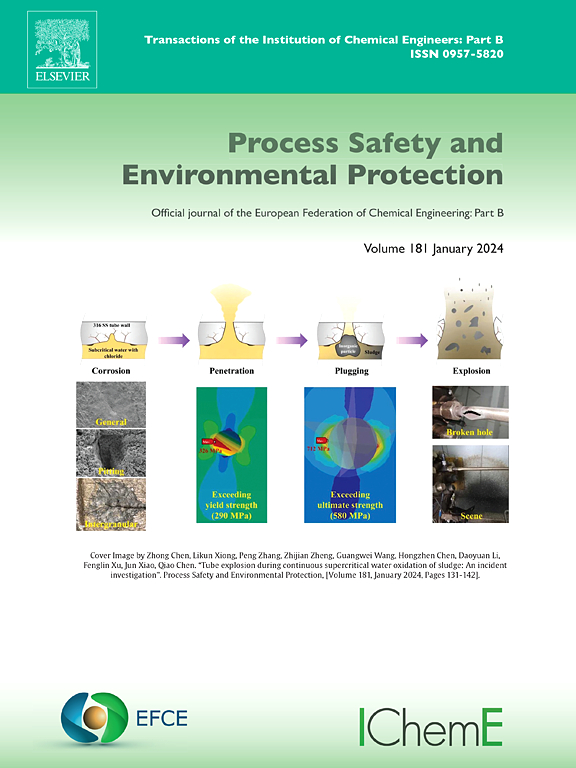
Process Safety and Environmental Protection
环境科学-工程:化工
CiteScore
11.40
自引率
15.40%
发文量
929
审稿时长
8.0 months
期刊介绍:
The Process Safety and Environmental Protection (PSEP) journal is a leading international publication that focuses on the publication of high-quality, original research papers in the field of engineering, specifically those related to the safety of industrial processes and environmental protection. The journal encourages submissions that present new developments in safety and environmental aspects, particularly those that show how research findings can be applied in process engineering design and practice.
PSEP is particularly interested in research that brings fresh perspectives to established engineering principles, identifies unsolved problems, or suggests directions for future research. The journal also values contributions that push the boundaries of traditional engineering and welcomes multidisciplinary papers.
PSEP's articles are abstracted and indexed by a range of databases and services, which helps to ensure that the journal's research is accessible and recognized in the academic and professional communities. These databases include ANTE, Chemical Abstracts, Chemical Hazards in Industry, Current Contents, Elsevier Engineering Information database, Pascal Francis, Web of Science, Scopus, Engineering Information Database EnCompass LIT (Elsevier), and INSPEC. This wide coverage facilitates the dissemination of the journal's content to a global audience interested in process safety and environmental engineering.
 求助内容:
 应助结果提醒方式:


 京公网安备 11010802042870号


