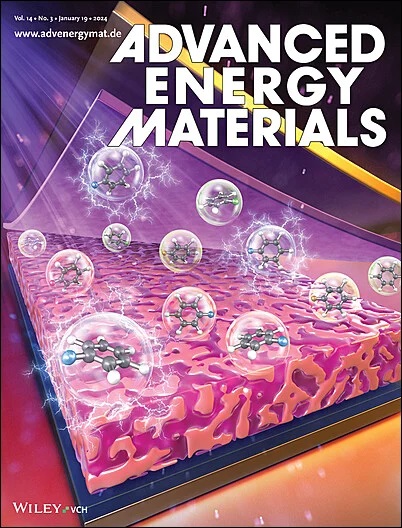
Lijun Gao, Li Su, Gang Sun, Ming Liu, Xuan He, Qingjun Zhu, Xiaokang Ju, Yunshan Jiang, Xulei Sui, Guangjie Shao, Zhenbo Wang
{"title":"Achieving Synergistic Kinetics and Stability in Li‐Rich Mn‐Based Oxides via AlPO 4 ‐Assisted Multi‐Scale Regulation","authors":"Lijun Gao, Li Su, Gang Sun, Ming Liu, Xuan He, Qingjun Zhu, Xiaokang Ju, Yunshan Jiang, Xulei Sui, Guangjie Shao, Zhenbo Wang","doi":"10.1002/aenm.71400","DOIUrl":null,"url":null,"abstract":"Realizing the full potential of Li‐rich Mn‐based oxides (LRMOs) is contingent upon overcoming the intrinsic conflict between sluggish anionic redox kinetics and structural instability. Conventional modification approaches often fail to harmonize kinetic enhancement with cycling longevity. Herein, we report an AlPO <jats:sub>4</jats:sub> ‐assisted high‐temperature lithiation strategy to achieve multi‐scale synergistic regulation of LRMOs. This innovative approach simultaneously optimizes particle morphology, stabilizes the surface/interface chemistry, and reinforces the bulk lattice integrity: The well‐controlled moderate‐sized primary particles effectively shorten the Li <jats:sup>+</jats:sup> diffusion path to boost kinetics; the Al‐rich near‐surface barrier and in situ formed Li <jats:sub>3</jats:sub> PO <jats:sub>4</jats:sub> coating synergistically construct a highly stable interface against electrolyte corrosion; the bulk Al/P co‐doping optimizes the electronic structure and stabilizes the lattice oxygen framework; meanwhile, the quasi‐ordered superlattice enables precise tailoring of interlayer stacking and mitigates cycling‐induced lattice strain. Benefiting from this synergistic modification, the optimized LRMO delivers a high capacity of ∼ 240 mAh g <jats:sup>−1</jats:sup> at 1 C with 82.5% retention over 500 cycles at 25°C. It also exhibits robust high‐temperature performance (∼ 270 mAh g <jats:sup>−1</jats:sup> , 82.3% retention after 200 cycles at 50°C). Notably, a 1 Ah pouch cell maintains 68.4% capacity after 1000 cycles, validating the practical feasibility of this strategy for advanced high‐energy batteries.","PeriodicalId":111,"journal":{"name":"Advanced Energy Materials","volume":"13 1","pages":""},"PeriodicalIF":25.5000,"publicationDate":"2026-08-04","publicationTypes":"Journal Article","fieldsOfStudy":null,"isOpenAccess":false,"openAccessPdf":"","citationCount":"0","resultStr":null,"platform":"Semanticscholar","paperid":null,"PeriodicalName":"Advanced Energy Materials","FirstCategoryId":"88","ListUrlMain":"https://doi.org/10.1002/aenm.71400","RegionNum":1,"RegionCategory":"材料科学","ArticlePicture":[],"TitleCN":null,"AbstractTextCN":null,"PMCID":null,"EPubDate":"","PubModel":"","JCR":"Q1","JCRName":"CHEMISTRY, PHYSICAL","Score":null,"Total":0}
引用次数: 0
Abstract
Realizing the full potential of Li‐rich Mn‐based oxides (LRMOs) is contingent upon overcoming the intrinsic conflict between sluggish anionic redox kinetics and structural instability. Conventional modification approaches often fail to harmonize kinetic enhancement with cycling longevity. Herein, we report an AlPO 4 ‐assisted high‐temperature lithiation strategy to achieve multi‐scale synergistic regulation of LRMOs. This innovative approach simultaneously optimizes particle morphology, stabilizes the surface/interface chemistry, and reinforces the bulk lattice integrity: The well‐controlled moderate‐sized primary particles effectively shorten the Li + diffusion path to boost kinetics; the Al‐rich near‐surface barrier and in situ formed Li 3 PO 4 coating synergistically construct a highly stable interface against electrolyte corrosion; the bulk Al/P co‐doping optimizes the electronic structure and stabilizes the lattice oxygen framework; meanwhile, the quasi‐ordered superlattice enables precise tailoring of interlayer stacking and mitigates cycling‐induced lattice strain. Benefiting from this synergistic modification, the optimized LRMO delivers a high capacity of ∼ 240 mAh g −1 at 1 C with 82.5% retention over 500 cycles at 25°C. It also exhibits robust high‐temperature performance (∼ 270 mAh g −1 , 82.3% retention after 200 cycles at 50°C). Notably, a 1 Ah pouch cell maintains 68.4% capacity after 1000 cycles, validating the practical feasibility of this strategy for advanced high‐energy batteries.
实现富锂锰基氧化物(LRMOs)的全部潜力取决于克服缓慢的阴离子氧化还原动力学和结构不稳定性之间的内在冲突。传统的修改方法往往不能协调动能增强与循环寿命。在此,我们报告了一种AlPO - 4辅助的高温锂化策略,以实现LRMOs的多尺度协同调节。这种创新的方法同时优化了颗粒形态,稳定了表面/界面化学,并增强了体晶格的完整性:控制良好的中等大小的初级颗粒有效地缩短了Li +扩散路径,提高了动力学;富铝近表面屏障和原位形成的li3po4涂层协同构建了一个高度稳定的界面,防止电解质腐蚀;Al/P共掺杂优化了电子结构,稳定了晶格氧框架;同时,准有序超晶格可以精确剪裁层间堆叠并减轻循环引起的晶格应变。得益于这种协同修饰,优化后的LRMO在1℃下可提供约240 mAh g - 1的高容量,在25℃下进行500次循环,保留率为82.5%。它还具有强大的高温性能(~ 270 mAh g - 1,在50°C下200次循环后保持82.3%)。值得注意的是,1 Ah的袋状电池在1000次循环后仍保持68.4%的容量,验证了该策略在先进高能电池中的实际可行性。
期刊介绍:
Established in 2011, Advanced Energy Materials is an international, interdisciplinary, English-language journal that focuses on materials used in energy harvesting, conversion, and storage. It is regarded as a top-quality journal alongside Advanced Materials, Advanced Functional Materials, and Small.
With a 2022 Impact Factor of 27.8, Advanced Energy Materials is considered a prime source for the best energy-related research. The journal covers a wide range of topics in energy-related research, including organic and inorganic photovoltaics, batteries and supercapacitors, fuel cells, hydrogen generation and storage, thermoelectrics, water splitting and photocatalysis, solar fuels and thermosolar power, magnetocalorics, and piezoelectronics.
The readership of Advanced Energy Materials includes materials scientists, chemists, physicists, and engineers in both academia and industry. The journal is indexed in various databases and collections, such as Advanced Technologies & Aerospace Database, FIZ Karlsruhe, INSPEC (IET), Science Citation Index Expanded, Technology Collection, and Web of Science, among others.