
Synthesis of pH-responsive statistical polyampholytes by PET-RAFT polymerization of protected monomers

IF 3.9 2区 化学 Q2 POLYMER SCIENCE
Hadley A. Johnston,Genevieve C. Thomas,Tianyu Zhang,Conner H. Chee,Jennifer E. Laaser
{"title":"Synthesis of pH-responsive statistical polyampholytes by PET-RAFT polymerization of protected monomers","authors":"Hadley A. Johnston,Genevieve C. Thomas,Tianyu Zhang,Conner H. Chee,Jennifer E. Laaser","doi":"10.1039/d6py00400h","DOIUrl":null,"url":null,"abstract":"Synthetic polymers have emerged as powerful models for investigating drivers of liquid–liquid phase separation in biological materials. However, synthesizing polymers with “protein-like” distributions of cationic, anionic, hydrophilic, hydrophobic, and aromatic sidechains has remained a significant challenge. Here, we demonstrate that this problem can be addressed by polymerizing protected amine- and acid-functionalized monomers, along with a wide variety of nonionic comonomers, under photoinduced electron/energy transfer reversible addition–fragmentation chain transfer polymerization (PET-RAFT) conditions. We show that PET-RAFT enables controlled polymerization of tert-butyl (2-acrylamidoethyl)carbamate (Boc-AEAm) and tert-butyl acryloylglycinate (tBu-AG). Copolymerization of these monomers proceeds with reactivity ratios close to one, and deprotection with trifluoroacetic acid yields polyampholytes with pH-dependent phase behavior consistent with expected changes in the polymers’ isoelectric points as the cation : anion ratio is varied. We further show that a 50 : 50 mixture of these monomers can be copolymerized with hydrophilic (acrylamide, hydroxyethyl acrylamide), hydrophobic (n-butyl acrylamide), and aromatic (benzyl acrylamide) comonomers, which in turn significantly impact the pH-dependent phase behavior of the materials. This approach is both high-throughput and scalable, and promises to offer new opportunities both for understanding composition–property relationships in polyampholyte materials and for preparing polyampholytes with targeted properties and functions for a wide range of applications.","PeriodicalId":100,"journal":{"name":"Polymer Chemistry","volume":"6 1","pages":""},"PeriodicalIF":3.9000,"publicationDate":"2026-08-04","publicationTypes":"Journal Article","fieldsOfStudy":null,"isOpenAccess":false,"openAccessPdf":"","citationCount":"0","resultStr":null,"platform":"Semanticscholar","paperid":null,"PeriodicalName":"Polymer Chemistry","FirstCategoryId":"92","ListUrlMain":"https://doi.org/10.1039/d6py00400h","RegionNum":2,"RegionCategory":"化学","ArticlePicture":[],"TitleCN":null,"AbstractTextCN":null,"PMCID":null,"EPubDate":"","PubModel":"","JCR":"Q2","JCRName":"POLYMER SCIENCE","Score":null,"Total":0}
引用次数: 0

Abstract

Synthetic polymers have emerged as powerful models for investigating drivers of liquid–liquid phase separation in biological materials. However, synthesizing polymers with “protein-like” distributions of cationic, anionic, hydrophilic, hydrophobic, and aromatic sidechains has remained a significant challenge. Here, we demonstrate that this problem can be addressed by polymerizing protected amine- and acid-functionalized monomers, along with a wide variety of nonionic comonomers, under photoinduced electron/energy transfer reversible addition–fragmentation chain transfer polymerization (PET-RAFT) conditions. We show that PET-RAFT enables controlled polymerization of tert-butyl (2-acrylamidoethyl)carbamate (Boc-AEAm) and tert-butyl acryloylglycinate (tBu-AG). Copolymerization of these monomers proceeds with reactivity ratios close to one, and deprotection with trifluoroacetic acid yields polyampholytes with pH-dependent phase behavior consistent with expected changes in the polymers’ isoelectric points as the cation : anion ratio is varied. We further show that a 50 : 50 mixture of these monomers can be copolymerized with hydrophilic (acrylamide, hydroxyethyl acrylamide), hydrophobic (n-butyl acrylamide), and aromatic (benzyl acrylamide) comonomers, which in turn significantly impact the pH-dependent phase behavior of the materials. This approach is both high-throughput and scalable, and promises to offer new opportunities both for understanding composition–property relationships in polyampholyte materials and for preparing polyampholytes with targeted properties and functions for a wide range of applications.

Abstract Image

保护单体PET-RAFT聚合法制备ph响应统计型多两性聚合物
合成聚合物已经成为研究生物材料中液-液相分离驱动因素的强大模型。然而,合成具有正离子、阴离子、亲水、疏水和芳香侧链“类蛋白质”分布的聚合物仍然是一个重大挑战。在这里,我们证明了这个问题可以通过在光诱导电子/能量转移可逆加成-破碎链转移聚合(PET-RAFT)条件下聚合受保护的胺和酸功能化单体,以及各种非离子单体来解决。我们发现PET-RAFT可以控制叔丁基(2-丙烯酰胺乙基)氨基甲酸酯(Boc-AEAm)和叔丁基丙烯酰甘氨酸(tBu-AG)的聚合。这些单体的共聚反应比接近于1,用三氟乙酸脱保护得到的多两性聚合物具有ph依赖的相行为,与阳离子:阴离子比变化时聚合物等电点的预期变化一致。我们进一步表明,这些单体的50:50混合物可以与亲水性(丙烯酰胺,羟乙基丙烯酰胺),疏水性(正丁基丙烯酰胺)和芳香(苯丙烯酰胺)共聚,这反过来显著影响材料的ph依赖性相行为。这种方法具有高通量和可扩展性,并有望为理解聚乳酸材料的组成-性能关系以及制备具有目标性能和功能的聚乳酸材料提供新的机会,用于广泛的应用。
本文章由计算机程序翻译,如有差异,请以英文原文为准。
求助全文
约1分钟内获得全文 求助全文
来源期刊
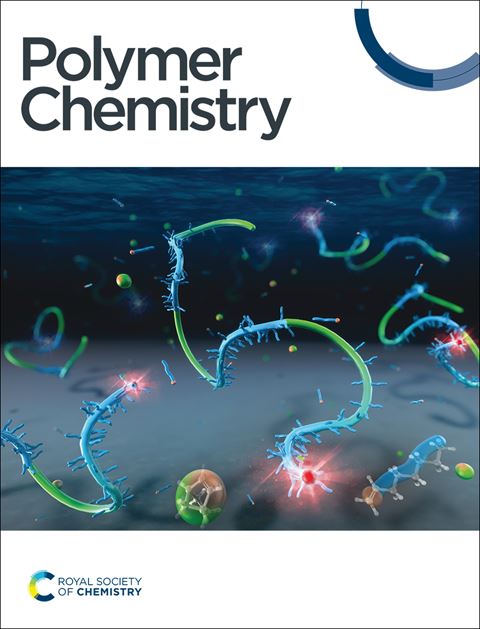
Polymer Chemistry
Polymer Chemistry POLYMER SCIENCE-
CiteScore
8.60
自引率
8.70%
发文量
535
审稿时长
1.7 months
期刊介绍: Polymer Chemistry welcomes submissions in all areas of polymer science that have a strong focus on macromolecular chemistry. Manuscripts may cover a broad range of fields, yet no direct application focus is required.

×
引用
GB/T 7714-2015
复制
MLA
复制
APA
复制
导出至
BibTeX EndNote RefMan NoteFirst NoteExpress
×
提示
您的信息不完整,为了账户安全,请先补充。
现在去补充
×
提示
您因"违规操作"
具体请查看互助需知
我知道了
×
提示
确定
请完成安全验证×
copy
已复制链接
快去分享给好友吧!
我知道了
右上角分享
点击右上角分享
0
联系我们:info@booksci.cn Book学术提供免费学术资源搜索服务,方便国内外学者检索中英文文献。致力于提供最便捷和优质的服务体验。 Copyright © 2023 布克学术 All rights reserved.
京ICP备2023020795号-1
ghs 京公网安备 11010802042870号
Book学术文献互助
Book学术文献互助群
群 号:604180095
Book学术官方微信
小红书


