Kayla RS Hale, Timothy J Fernandes, Reilly F O'Connor, Charlotte A Ward, Kevin Cazelles, Joey R Bernhardt, Cindy Chu, Henrique C Giacomini, Alexander Koeberle, Marten A Koops, Stuart A Ludsin, Andrew M Muir, Tom Stewart, Caroline Tucker, Tyler D Tunney, Kevin S McCann
{"title":"Managing for resilience with ecological structure: Portfolio effects in the Laurentian Great Lakes","authors":"Kayla RS Hale, Timothy J Fernandes, Reilly F O'Connor, Charlotte A Ward, Kevin Cazelles, Joey R Bernhardt, Cindy Chu, Henrique C Giacomini, Alexander Koeberle, Marten A Koops, Stuart A Ludsin, Andrew M Muir, Tom Stewart, Caroline Tucker, Tyler D Tunney, Kevin S McCann","doi":"10.1002/fee.70057","DOIUrl":null,"url":null,"abstract":"<p>Combined effects of global change, including land conversion, biological invasions, and overexploitation, have degraded the resilience of ecosystems and the services they provide. Here, we identify key ecological structures and processes that can be targeted by management to improve resilience at scales ranging from single species to entire landscapes. We highlight portfolio effects as a resilience-promoting process that both stabilizes and increases yield within food webs. We then discuss how habitat heterogeneity propagates portfolio effects across trophic levels and spatial scales to generate resilient ecosystems. Using examples from the North American Great Lakes Basin, we show that human-driven global change has broadly eroded portfolio effects and habitat heterogeneity, thereby increasing ecosystem vulnerability to future disturbances. Fortunately, strategic management actions can amplify resilience-promoting processes and dampen instabilities. Our synthesis supports the incorporation of whole-ecosystem resilience indices into conventional natural resource management and the structured, landscape-scale restoration of habitat heterogeneity to promote across-scale portfolio effects.</p>","PeriodicalId":171,"journal":{"name":"Frontiers in Ecology and the Environment","volume":"24 6","pages":""},"PeriodicalIF":6.5000,"publicationDate":"2026-08-03","publicationTypes":"Journal Article","fieldsOfStudy":null,"isOpenAccess":false,"openAccessPdf":"https://onlinelibrary.wiley.com/doi/epdf/10.1002/fee.70057","citationCount":"0","resultStr":null,"platform":"Semanticscholar","paperid":null,"PeriodicalName":"Frontiers in Ecology and the Environment","FirstCategoryId":"93","ListUrlMain":"https://onlinelibrary.wiley.com/doi/10.1002/fee.70057","RegionNum":1,"RegionCategory":"环境科学与生态学","ArticlePicture":[],"TitleCN":null,"AbstractTextCN":null,"PMCID":null,"EPubDate":"2026/6/25 0:00:00","PubModel":"Epub","JCR":"Q1","JCRName":"ECOLOGY","Score":null,"Total":0}
引用次数: 0
Abstract
Combined effects of global change, including land conversion, biological invasions, and overexploitation, have degraded the resilience of ecosystems and the services they provide. Here, we identify key ecological structures and processes that can be targeted by management to improve resilience at scales ranging from single species to entire landscapes. We highlight portfolio effects as a resilience-promoting process that both stabilizes and increases yield within food webs. We then discuss how habitat heterogeneity propagates portfolio effects across trophic levels and spatial scales to generate resilient ecosystems. Using examples from the North American Great Lakes Basin, we show that human-driven global change has broadly eroded portfolio effects and habitat heterogeneity, thereby increasing ecosystem vulnerability to future disturbances. Fortunately, strategic management actions can amplify resilience-promoting processes and dampen instabilities. Our synthesis supports the incorporation of whole-ecosystem resilience indices into conventional natural resource management and the structured, landscape-scale restoration of habitat heterogeneity to promote across-scale portfolio effects.
期刊介绍:
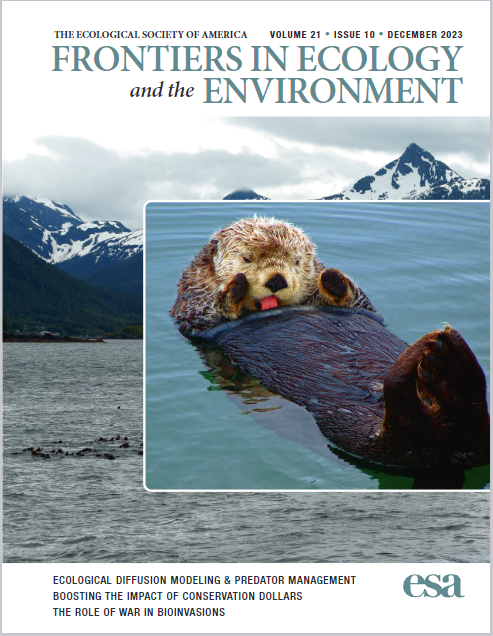
Frontiers in Ecology and the Environment is a publication by the Ecological Society of America that focuses on the significance of ecology and environmental science in various aspects of research and problem-solving. The journal covers topics such as biodiversity conservation, ecosystem preservation, natural resource management, public policy, and other related areas.
The publication features a range of content, including peer-reviewed articles, editorials, commentaries, letters, and occasional special issues and topical series. It releases ten issues per year, excluding January and July. ESA members receive both print and electronic copies of the journal, while institutional subscriptions are also available.
Frontiers in Ecology and the Environment is highly regarded in the field, as indicated by its ranking in the 2021 Journal Citation Reports by Clarivate Analytics. The journal is ranked 4th out of 174 in ecology journals and 11th out of 279 in environmental sciences journals. Its impact factor for 2021 is reported as 13.789, which further demonstrates its influence and importance in the scientific community.


 求助内容:
 应助结果提醒方式:


 京公网安备 11010802042870号


