
Effective defluorination of per- and polyfluoroalkyl substances in actual water environment by liquid phase microwave discharge: Elucidation of discharge characteristics and mechanism
IF 7.9
2区 环境科学与生态学
Q1 ENGINEERING, CHEMICAL
Process Safety and Environmental Protection
Pub Date : 2026-08-01
Epub Date: 2026-07-17
DOI:10.1016/j.psep.2026.109310
引用次数: 0
Abstract
As a novel water treatment technology, plasma technology can generate free radicals in situ and exhibits a favorable effect on the degradation of per- and polyfluoroalkyl substances (PFAS). Nevertheless, the high conductivity and complex composition of the actual water environment can interfere with the defluorination effect of PFAS. To attain the objective of more efficient defluorination of PFAS in actual water environment, the discharge characteristics of liquid phase microwave discharge plasma technology were explored. It was discovered that conductivity had a negligible impact on the discharge. A stable discharge could be attained when the conductivity of the aqueous solution was elevated to 2000 μS/cm, with the defluorination rates of PFOA reaching up to 82.6% and those of PFOS reaching 72.4%. The research findings indicate that the microwave discharge plasma technology has wide applicability and can adapt to various water environments with different electrical conductivities. Based on the research results, the experimental parameters were optimized, and the method to address the difficulty of PFAS defluorination in the actual water environment was identified. After parameter optimization, the defluorination of two types of PFAS can reach approximately 80% in lake and tap water. It indicates that the technology presents substantial advantages in the defluorination of PFAS within the actual water environment.
液相微波放电对实际水环境中全氟烷基和多氟烷基物质的有效脱氟:放电特性和机理的阐明
等离子体技术作为一种新型的水处理技术,可以原位生成自由基,对全氟烷基和多氟烷基物质(PFAS)的降解具有良好的效果。然而,实际水环境的高电导率和复杂成分会干扰PFAS的除氟效果。为达到在实际水环境中对PFAS进行高效除氟的目的,对液相微波放电等离子体技术的放电特性进行了研究。人们发现电导率对放电的影响可以忽略不计。当溶液电导率提高到2000 μS/cm时,可实现稳定放电,对PFOA和PFOS的除氟率分别达到82.6%和72.4%。研究结果表明,微波放电等离子体技术具有广泛的适用性,可以适应不同电导率的各种水环境。在研究结果的基础上,对实验参数进行了优化,确定了解决PFAS在实际水环境中除氟难的方法。经参数优化后,两种PFAS在湖泊和自来水中的除氟效果均可达到80%左右。表明该技术在实际水环境中对PFAS的除氟具有实质性优势。
本文章由计算机程序翻译,如有差异,请以英文原文为准。
求助全文
约1分钟内获得全文
求助全文
来源期刊
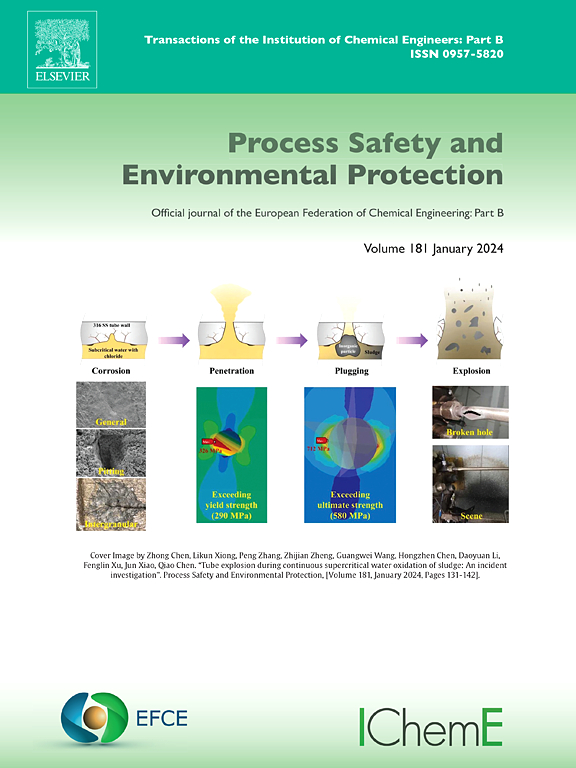
Process Safety and Environmental Protection
环境科学-工程:化工
CiteScore
11.40
自引率
15.40%
发文量
929
审稿时长
8.0 months
期刊介绍:
The Process Safety and Environmental Protection (PSEP) journal is a leading international publication that focuses on the publication of high-quality, original research papers in the field of engineering, specifically those related to the safety of industrial processes and environmental protection. The journal encourages submissions that present new developments in safety and environmental aspects, particularly those that show how research findings can be applied in process engineering design and practice.
PSEP is particularly interested in research that brings fresh perspectives to established engineering principles, identifies unsolved problems, or suggests directions for future research. The journal also values contributions that push the boundaries of traditional engineering and welcomes multidisciplinary papers.
PSEP's articles are abstracted and indexed by a range of databases and services, which helps to ensure that the journal's research is accessible and recognized in the academic and professional communities. These databases include ANTE, Chemical Abstracts, Chemical Hazards in Industry, Current Contents, Elsevier Engineering Information database, Pascal Francis, Web of Science, Scopus, Engineering Information Database EnCompass LIT (Elsevier), and INSPEC. This wide coverage facilitates the dissemination of the journal's content to a global audience interested in process safety and environmental engineering.
 求助内容:
 应助结果提醒方式:


 京公网安备 11010802042870号


