
Boosting responsible and sustainable processes by exploiting aqueous azeotropes
IF 11
2区 化学
Q1 CHEMISTRY, MULTIDISCIPLINARY
Current Opinion in Green and Sustainable Chemistry
Pub Date : 2026-08-01
Epub Date: 2026-07-11
DOI:10.1016/j.cogsc.2026.101087
引用次数: 0
Abstract
Among alternatives to the large volumes of organic solvents commonly employed in organic synthesis, water is particularly appealing owing to its safety, non-toxicity, and abundance. Even more so when water is used in combination with a precise ratio of organic solvent, the resulting azeotrope can be considered a strategic tool for transitioning toward a more responsible and sustainable chemical production. Recent literature discussed herein highlights the role of aqueous azeotropes in the production of chemicals and materials, as well as in the design of waste–minimization processes and waste valorization approaches. Indeed, azeotropic distillation offers several advantages, including reduced energy costs, improved synthetic protocols, and high yield while minimizing by-product formation, thereby facilitating purification. Moreover, the use of azeotropes facilitates the recovery and reuse of reaction media and unreacted materials, thereby minimizing waste.
Among alternatives to the large volumes of organic solvents commonly employed in organic synthesis, water is particularly appealing owing to its safety, non-toxicity, and abundance. Even more so when water is used in combination with a precise ratio of organic solvent, the resulting azeotrope can be considered a strategic tool for transitioning toward a more responsible and sustainable chemical production. Recent literature discussed herein highlights the role of aqueous azeotropes in the production of chemicals and materials, as well as in the design of waste–minimization processes and waste valorization approaches. Indeed, azeotropic distillation offers several advantages, including reduced energy costs, improved synthetic protocols, and high yield while minimizing by-product formation, thereby facilitating purification. Moreover, the use of azeotropes facilitates the recovery and reuse of reaction media and unreacted materials, thereby minimizing waste.
- Download: Download high-res image (302KB)
- Download: Download full-size image
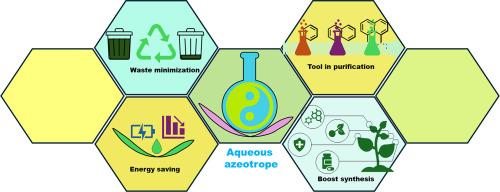
通过开发水共沸物促进负责任和可持续的过程
在有机合成中常用的大量有机溶剂的替代品中,水因其安全、无毒和丰富而特别具有吸引力。更重要的是,当水与精确比例的有机溶剂结合使用时,所得的共沸物可以被认为是向更负责任和可持续的化学品生产过渡的战略工具。本文讨论的最新文献强调了水共沸物在化学品和材料生产中的作用,以及在设计废物最小化过程和废物增值方法中的作用。事实上,共沸蒸馏有几个优点,包括降低能源成本,改进合成工艺,产率高,同时最大限度地减少副产品的形成,从而促进净化。此外,共沸物的使用有利于反应介质和未反应物质的回收和再利用,从而最大限度地减少浪费。在有机合成中常用的大量有机溶剂的替代品中,水因其安全、无毒和丰富而特别具有吸引力。更重要的是,当水与精确比例的有机溶剂结合使用时,所得的共沸物可以被认为是向更负责任和可持续的化学品生产过渡的战略工具。本文讨论的最新文献强调了水共沸物在化学品和材料生产中的作用,以及在设计废物最小化过程和废物增值方法中的作用。事实上,共沸蒸馏有几个优点,包括降低能源成本,改进合成工艺,产率高,同时最大限度地减少副产品的形成,从而促进净化。此外,共沸物的使用有利于反应介质和未反应物质的回收和再利用,从而最大限度地减少浪费。下载:下载高清图片(302KB)下载:下载全尺寸图片
本文章由计算机程序翻译,如有差异,请以英文原文为准。
求助全文
约1分钟内获得全文
求助全文
来源期刊
Current Opinion in Green and Sustainable Chemistry
Chemical Engineering-Catalysis
CiteScore
16.00
自引率
2.20%
发文量
140
审稿时长
103 days
期刊介绍:
The Current Opinion journals address the challenge specialists face in keeping up with the expanding information in their fields. In Current Opinion in Green and Sustainable Chemistry, experts present views on recent advances in a clear and readable form. The journal also provides evaluations of the most noteworthy papers, annotated by experts, from the extensive pool of original publications in Green and Sustainable Chemistry.
 求助内容:
求助内容: 应助结果提醒方式:

 京公网安备 11010802042870号


