
Drivers of tree growth across Europe: An explainable AI analysis of tree- and site-level influences
IF 8.5
2区 环境科学与生态学
Q1 ECOLOGY
引用次数: 0
Abstract
Climate change is increasingly impairing forest ecosystems in Europe, reducing tree vitality and increasing mortality. Crown defoliation and stem growth are widely used indicators of early stress responses, yet their drivers remain difficult to disentangle due to complex, non-linear interactions among climatic, edaphic, and biotic factors.
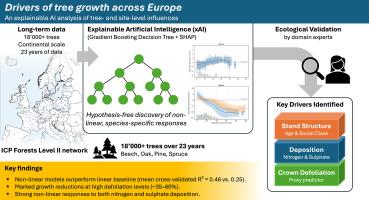
Here, we apply explainable AI (XAI) to model annual diameter growth of individual trees from four dominant European tree species (Norway spruce, Scots pine, Common beech, and Oak) using long-term data from the ICP Forests Level II network. Gradient-boosted decision trees trained on tree-level attributes (e.g., defoliation, social class) and plot-level variables (e.g., soil solution chemistry, atmospheric deposition, and topography) outperform linear baselines across all ablations and grouping strategies. Ablation experiments show that plot-level features account for most of the predictive power while defoliation contributes only marginally.
XAI analyses reveal strong non-linear, species-specific response regimes, including marked growth reductions at high defoliation levels (∼35–60%) and optimal regimes of nitrogen and sulphate deposition, illustrating the capacity of XAI to identify candidate growth-relevant regimes and interactions.
However, temporally explicit validation using tree-wise cross validation results in a 54% reduction in R2 score whereas spatially explicit validation based on plot-wise cross-validation leads to a near-complete collapse in predictive performance, indicating strong reliance on both temporal and spatial autocorrelation and context-specific patterns. Moreover, ablating defoliation features causes attribution to shift toward correlated environmental variables, highlighting the role of proxying and statistical confounding.
Overall, our results illustrate both the potential and the limitations of XAI for forest ecology: while effective for screening large observational datasets and generating hypotheses, XAI outputs require cautious interpretation, mechanistic understanding and spatially robust validation.
整个欧洲树木生长的驱动因素:树木和站点级别影响的可解释的人工智能分析
气候变化正在日益损害欧洲的森林生态系统,降低树木的活力,增加死亡率。冠脱落和茎生长是早期胁迫反应的广泛指标,但由于气候、土壤和生物因素之间复杂的非线性相互作用,其驱动因素仍然难以解开。在这里,我们应用可解释的人工智能(XAI)来模拟四种主要欧洲树种(挪威云杉、苏格兰松、普通山毛榉和橡树)的年直径增长,使用来自ICP森林水平II网络的长期数据。在树级属性(如落叶、社会阶层)和地块级变量(如土壤溶液化学、大气沉积和地形)上训练的梯度增强决策树在所有消融和分组策略上都优于线性基线。消融实验表明,地块水平特征占预测能力的大部分,而落叶只贡献很小。XAI分析揭示了强大的非线性、物种特异性响应机制,包括高落叶水平(~ 35-60%)下显著的生长减少和氮和硫酸盐沉积的最佳机制,说明了XAI识别候选生长相关机制和相互作用的能力。然而,使用树交叉验证的时间显式验证导致R2分数降低54%,而基于图交叉验证的空间显式验证导致预测性能几乎完全崩溃,这表明强烈依赖于时间和空间自相关以及上下文特定模式。此外,消融的落叶特征导致归因向相关环境变量转移,突出了代理和统计混淆的作用。总体而言,我们的研究结果说明了XAI在森林生态学中的潜力和局限性:虽然XAI在筛选大型观测数据集和生成假设方面是有效的,但它的输出需要谨慎的解释、机制理解和空间鲁棒性验证。
本文章由计算机程序翻译,如有差异,请以英文原文为准。
求助全文
约1分钟内获得全文
求助全文
来源期刊
Ecological Informatics
环境科学-生态学
CiteScore
8.30
自引率
11.80%
发文量
346
审稿时长
46 days
期刊介绍:
The journal Ecological Informatics is devoted to the publication of high quality, peer-reviewed articles on all aspects of computational ecology, data science and biogeography. The scope of the journal takes into account the data-intensive nature of ecology, the growing capacity of information technology to access, harness and leverage complex data as well as the critical need for informing sustainable management in view of global environmental and climate change.
The nature of the journal is interdisciplinary at the crossover between ecology and informatics. It focuses on novel concepts and techniques for image- and genome-based monitoring and interpretation, sensor- and multimedia-based data acquisition, internet-based data archiving and sharing, data assimilation, modelling and prediction of ecological data.
 求助内容:
求助内容: 应助结果提醒方式:

 京公网安备 11010802042870号


