
SWARM-IS: Adaptive sensor swarm search strategy and simulation framework for predator surveillance and control
IF 8.5
2区 环境科学与生态学
Q1 ECOLOGY
引用次数: 0
Abstract
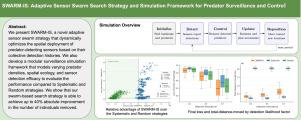
Effective monitoring of predator eradication and control efforts critically depends on reliable detection across diverse and heterogeneous environments. However, existing search strategies do not take full advantage of the developed AI-enabled sensing technologies. In this paper, we present SWARM-IS, a novel adaptive sensor swarm strategy that dynamically optimises the spatial deployment of predator-detecting sensors based on their collective detection histories. The method leverages collective swarm information to iteratively guide sensor placement, enabling responsive adaptation to evolving environmental and ecological conditions. To evaluate the proposed approach, we developed a modular surveillance simulation framework that models varying predator densities, spatial ecology, and sensor detection efficacy. The performance of SWARM-IS is compared against conventional systematic and random search strategies across a range of ecological scenarios. The framework is generalisable and can be readily adapted to other predator surveillance and management contexts. Using this framework, we conducted a case study on brushtail possum surveillance under diverse ecological conditions and detection-efficacy regimes. Results demonstrate that the proposed adaptive swarm-based strategy can achieve up to a 40% absolute improvement in the number of individuals removed from the site compared to conventional approaches, highlighting its potential to enhance predator monitoring and, consequently, improve management outcomes.
swarm - is:用于捕食者监视和控制的自适应传感器群搜索策略和仿真框架
有效监测捕食者的消灭和控制工作严重依赖于在不同和异质环境中的可靠检测。然而,现有的搜索策略并没有充分利用已开发的人工智能传感技术。在本文中,我们提出了一种新的自适应传感器群策略swarm - is,该策略基于捕食者探测传感器的集体探测历史动态优化其空间部署。该方法利用集体群体信息迭代指导传感器放置,使其能够响应不断变化的环境和生态条件。为了评估提出的方法,我们开发了一个模块化的监视模拟框架,模拟不同的捕食者密度、空间生态和传感器检测效率。在一系列生态场景中,将SWARM-IS的性能与传统的系统和随机搜索策略进行了比较。该框架具有通用性,可以很容易地适用于其他捕食者监视和管理环境。在此框架下,我们对不同生态条件下的负鼠监测进行了案例研究。结果表明,与传统方法相比,提出的基于自适应群体的策略可以使从该地点移走的个体数量绝对提高40%,突出了其加强捕食者监测的潜力,从而改善了管理结果。
本文章由计算机程序翻译,如有差异,请以英文原文为准。
求助全文
约1分钟内获得全文
求助全文
来源期刊
Ecological Informatics
环境科学-生态学
CiteScore
8.30
自引率
11.80%
发文量
346
审稿时长
46 days
期刊介绍:
The journal Ecological Informatics is devoted to the publication of high quality, peer-reviewed articles on all aspects of computational ecology, data science and biogeography. The scope of the journal takes into account the data-intensive nature of ecology, the growing capacity of information technology to access, harness and leverage complex data as well as the critical need for informing sustainable management in view of global environmental and climate change.
The nature of the journal is interdisciplinary at the crossover between ecology and informatics. It focuses on novel concepts and techniques for image- and genome-based monitoring and interpretation, sensor- and multimedia-based data acquisition, internet-based data archiving and sharing, data assimilation, modelling and prediction of ecological data.
 求助内容:
求助内容: 应助结果提醒方式:

 京公网安备 11010802042870号


