B. Fernández-Arguijo, J. E. Vilasó-Cadre, A. Ramírez-Rodríguez, I. A. Reyes-Domínguez, J. Aguilar-Carrillo, E. F. Armendáriz-Alonso, R. Cruz, L. A. Guerra-Fuentes, R. I. Hernández-Molinar, E. J. Gutiérrez-Castañeda
{"title":"A Low-Cost Method for Determining the Quantitative Chemical Composition of Slag Wool","authors":"B. Fernández-Arguijo, J. E. Vilasó-Cadre, A. Ramírez-Rodríguez, I. A. Reyes-Domínguez, J. Aguilar-Carrillo, E. F. Armendáriz-Alonso, R. Cruz, L. A. Guerra-Fuentes, R. I. Hernández-Molinar, E. J. Gutiérrez-Castañeda","doi":"10.1134/S1061934825601926","DOIUrl":null,"url":null,"abstract":"<p>An important issue to consider when determining the chemical composition of slag wool (<b>CCSW</b>) is sample digestion due to the complexity of the matrix. Some methods usually employed to determine the composition of silicate rocks and minerals have been adapted to determine CCSW. However, the dissolution characteristics between rock/glass and slag wool fibers are rather different and thus affect quantitative analysis. The present work reports a reliable, quantitative, low-cost method for the determination of CCSW based on sample fusion, acid dissolution, and subsequent analysis by flame atomic absorption spectrometry. Some oxides were analyzed by gravimetry, allowing the overall chemical characterization of slag wool. Scanning electron microscopy/energy dispersive X-ray spectrometry and traditional current methods were performed for comparison. A study regarding the effects of sample amount and particle size is presented. The results show that the proposed method allows determining CCSW with accuracy; in addition, it offers the advantage of reducing both the melting temperature and the sample preparation time, representing a lower-cost analytical method for the determination of CCSW.</p>","PeriodicalId":606,"journal":{"name":"Journal of Analytical Chemistry","volume":"81 :","pages":"1261 - 1271"},"PeriodicalIF":1.5000,"publicationDate":"2026-08-02","publicationTypes":"Journal Article","fieldsOfStudy":null,"isOpenAccess":false,"openAccessPdf":"","citationCount":"0","resultStr":null,"platform":"Semanticscholar","paperid":null,"PeriodicalName":"Journal of Analytical Chemistry","FirstCategoryId":"92","ListUrlMain":"https://link.springer.com/article/10.1134/S1061934825601926","RegionNum":4,"RegionCategory":"化学","ArticlePicture":[],"TitleCN":null,"AbstractTextCN":null,"PMCID":null,"EPubDate":"","PubModel":"","JCR":"Q4","JCRName":"CHEMISTRY, ANALYTICAL","Score":null,"Total":0}
引用次数: 0
Abstract
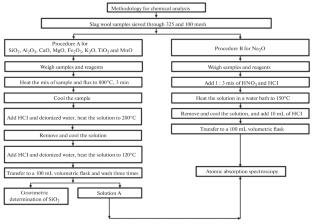
An important issue to consider when determining the chemical composition of slag wool (CCSW) is sample digestion due to the complexity of the matrix. Some methods usually employed to determine the composition of silicate rocks and minerals have been adapted to determine CCSW. However, the dissolution characteristics between rock/glass and slag wool fibers are rather different and thus affect quantitative analysis. The present work reports a reliable, quantitative, low-cost method for the determination of CCSW based on sample fusion, acid dissolution, and subsequent analysis by flame atomic absorption spectrometry. Some oxides were analyzed by gravimetry, allowing the overall chemical characterization of slag wool. Scanning electron microscopy/energy dispersive X-ray spectrometry and traditional current methods were performed for comparison. A study regarding the effects of sample amount and particle size is presented. The results show that the proposed method allows determining CCSW with accuracy; in addition, it offers the advantage of reducing both the melting temperature and the sample preparation time, representing a lower-cost analytical method for the determination of CCSW.
期刊介绍:
The Journal of Analytical Chemistry is an international peer reviewed journal that covers theoretical and applied aspects of analytical chemistry; it informs the reader about new achievements in analytical methods, instruments and reagents. Ample space is devoted to problems arising in the analysis of vital media such as water and air. Consideration is given to the detection and determination of metal ions, anions, and various organic substances. The journal welcomes manuscripts from all countries in the English or Russian language.

 求助内容:
求助内容: 应助结果提醒方式:

 京公网安备 11010802042870号


