V. R. Khabibullin, E. S. Ryndina, I. V. Mikheev, S. V. Krasheninina, Yu. S. Vershinina, V. M. Shkinev, M. A. Proskurnin
{"title":"Precision and Sensitivity of Photothermal Thermal-Lens Measurements in Aqueous Polyethylene Glycol Solutions","authors":"V. R. Khabibullin, E. S. Ryndina, I. V. Mikheev, S. V. Krasheninina, Yu. S. Vershinina, V. M. Shkinev, M. A. Proskurnin","doi":"10.1134/S1061934826700541","DOIUrl":null,"url":null,"abstract":"<p>A feedback-mode variant of thermal lens spectrometry was employed for steady-state photothermal measurements and time-resolved studies of thermal lens formation dynamics to compare the precision and sensitivity of measurements in aqueous polyethylene glycol (PEG) solutions of different molecular weights using a series of model systems (ferroin, cobalt complexes with nitrosonaphthols, and aqueous fullerene dispersions). The results of thermal lens measurements obtained in single-phase aqueous PEG solutions were compared with those obtained under extractive preconcentration conditions in PEG-based aqueous two-phase systems. Time-resolved thermal lens development curves in PEG-containing media were shown to exhibit greater stability and improved temporal separation between the thermal lens effect itself and the interfering thermophoresis phenomenon (the Soret effect) than those recorded in polymer-free aqueous media. To improve the accuracy of thermal diffusivity measurements, experimental conditions were selected under which the deviation from the theoretical curve development was minimal, and the Soret effect was absent (50–300 ms from the beginning of the measurement cycle). In PEG-containing media, the dynamics of thermal lens development showed better agreement with theory even for finely dispersed systems (aqueous fullerene dispersions), resulting in a substantial increase in the sensitivity of thermal lens measurements. The precision of thermal lens measurements in PEG solutions was higher than that in aqueous solutions because of lower signal fluctuations, which further enhanced the sensitivity of thermal lens measurements in such media. Conditions were proposed for the extraction-thermal lens determination of cobalt with 2-nitroso-1-naphthol based on the partitioning of the colored complex in an aqueous two-phase system composed of PEG and phosphate ions (K<sub>2</sub>HPO<sub>4</sub>, NaH<sub>2</sub>PO<sub>4</sub>, or NH<sub>4</sub>H<sub>2</sub>PO<sub>4</sub>), followed by thermal lens determination in the extract phase. The detection limit for cobalt with 2-nitroso-1-naphthol in the phosphate–PEG aqueous system was 1 μmol/L (532 nm, excitation laser power 10 mW), whereas the detection limit for cobalt with nitroso-R salt in the ammonium sulfate–PEG aqueous system (excitation laser power 100 mW) was 0.2 μmol/L. For aqueous fullerene dispersions, a twofold increase in measurement sensitivity was demonstrated compared with aqueous media without PEG.</p>","PeriodicalId":606,"journal":{"name":"Journal of Analytical Chemistry","volume":"81 :","pages":"1133 - 1145"},"PeriodicalIF":1.5000,"publicationDate":"2026-08-02","publicationTypes":"Journal Article","fieldsOfStudy":null,"isOpenAccess":false,"openAccessPdf":"","citationCount":"0","resultStr":null,"platform":"Semanticscholar","paperid":null,"PeriodicalName":"Journal of Analytical Chemistry","FirstCategoryId":"92","ListUrlMain":"https://link.springer.com/article/10.1134/S1061934826700541","RegionNum":4,"RegionCategory":"化学","ArticlePicture":[],"TitleCN":null,"AbstractTextCN":null,"PMCID":null,"EPubDate":"","PubModel":"","JCR":"Q4","JCRName":"CHEMISTRY, ANALYTICAL","Score":null,"Total":0}
引用次数: 0
Abstract
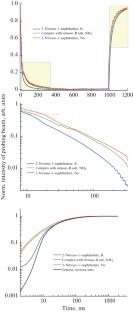
A feedback-mode variant of thermal lens spectrometry was employed for steady-state photothermal measurements and time-resolved studies of thermal lens formation dynamics to compare the precision and sensitivity of measurements in aqueous polyethylene glycol (PEG) solutions of different molecular weights using a series of model systems (ferroin, cobalt complexes with nitrosonaphthols, and aqueous fullerene dispersions). The results of thermal lens measurements obtained in single-phase aqueous PEG solutions were compared with those obtained under extractive preconcentration conditions in PEG-based aqueous two-phase systems. Time-resolved thermal lens development curves in PEG-containing media were shown to exhibit greater stability and improved temporal separation between the thermal lens effect itself and the interfering thermophoresis phenomenon (the Soret effect) than those recorded in polymer-free aqueous media. To improve the accuracy of thermal diffusivity measurements, experimental conditions were selected under which the deviation from the theoretical curve development was minimal, and the Soret effect was absent (50–300 ms from the beginning of the measurement cycle). In PEG-containing media, the dynamics of thermal lens development showed better agreement with theory even for finely dispersed systems (aqueous fullerene dispersions), resulting in a substantial increase in the sensitivity of thermal lens measurements. The precision of thermal lens measurements in PEG solutions was higher than that in aqueous solutions because of lower signal fluctuations, which further enhanced the sensitivity of thermal lens measurements in such media. Conditions were proposed for the extraction-thermal lens determination of cobalt with 2-nitroso-1-naphthol based on the partitioning of the colored complex in an aqueous two-phase system composed of PEG and phosphate ions (K2HPO4, NaH2PO4, or NH4H2PO4), followed by thermal lens determination in the extract phase. The detection limit for cobalt with 2-nitroso-1-naphthol in the phosphate–PEG aqueous system was 1 μmol/L (532 nm, excitation laser power 10 mW), whereas the detection limit for cobalt with nitroso-R salt in the ammonium sulfate–PEG aqueous system (excitation laser power 100 mW) was 0.2 μmol/L. For aqueous fullerene dispersions, a twofold increase in measurement sensitivity was demonstrated compared with aqueous media without PEG.
期刊介绍:
The Journal of Analytical Chemistry is an international peer reviewed journal that covers theoretical and applied aspects of analytical chemistry; it informs the reader about new achievements in analytical methods, instruments and reagents. Ample space is devoted to problems arising in the analysis of vital media such as water and air. Consideration is given to the detection and determination of metal ions, anions, and various organic substances. The journal welcomes manuscripts from all countries in the English or Russian language.

 求助内容:
求助内容: 应助结果提醒方式:

 京公网安备 11010802042870号


