Na Li, Huilin Shao, Yongxia Huang, Bingyuan Su, Minshan Wu, Yaping Zhang, Shuying Huang
{"title":"Arsenic-Free Urinary Iodine Determination via Iodide-Electron Shuttle Catalysis: A Rapid Kinetic Method on Automated Biochemical Analyzers","authors":"Na Li, Huilin Shao, Yongxia Huang, Bingyuan Su, Minshan Wu, Yaping Zhang, Shuying Huang","doi":"10.1134/S1061934825602518","DOIUrl":null,"url":null,"abstract":"<p>A novel arsenic-free method for the determination of iodine in urine was developed using a cerium(IV)−Ferroin catalytic reaction combined with an automated biochemistry analyzer. The method was based on the oxidation of the Ferroin reagent by cerium(IV) ions in an acidic medium, followed by reduction with hydrazine hydrochloride. Iodide ions catalyzed the reaction, and the absorbance was measured using an automated biochemistry analyzer. A quadratic relationship between iodine concentration (<i>c</i>, μg/L) and absorbance (<i>A</i>) was observed within the range of 0–400 μg/L and was described by the regression equation <i>c</i> = <i>aA</i><sup>2</sup> + <i>bA</i> + <i>d</i>, with a coefficient of correleation (<i>r</i>) greater than 0.999. The method exhibited high sensitivity, with a limit of detection for urinary iodine of 3.6 μg/L. Excellent precision was achieved, with an intra-assay coefficient of variation (<b>CV</b>) of ≤3.0% and inter-assay CVs of <3% for low, medium, and high iodine concentration standards. Accuracy was confirmed by an average recovery rate of 98.3% in spiked samples. The results obtained from the simultaneous determination of 40 urine samples using this method were highly consistent with those obtained by the standard arsenic-cerium catalytic spectrophotometry method, demonstrating good reliability and accuracy for urinary iodine determination. Owing to its high sensitivity, precision, accuracy, and rapid analysis performance, the proposed arsenic-free method was considered suitable for large-scale monitoring of iodine deficiency disorders and showed broad potential for application in urinary iodine detection while ensuring improved environmental and occupational safety.</p>","PeriodicalId":606,"journal":{"name":"Journal of Analytical Chemistry","volume":"81 :","pages":"1236 - 1243"},"PeriodicalIF":1.5000,"publicationDate":"2026-08-02","publicationTypes":"Journal Article","fieldsOfStudy":null,"isOpenAccess":false,"openAccessPdf":"","citationCount":"0","resultStr":null,"platform":"Semanticscholar","paperid":null,"PeriodicalName":"Journal of Analytical Chemistry","FirstCategoryId":"92","ListUrlMain":"https://link.springer.com/article/10.1134/S1061934825602518","RegionNum":4,"RegionCategory":"化学","ArticlePicture":[],"TitleCN":null,"AbstractTextCN":null,"PMCID":null,"EPubDate":"","PubModel":"","JCR":"Q4","JCRName":"CHEMISTRY, ANALYTICAL","Score":null,"Total":0}
引用次数: 0
Abstract
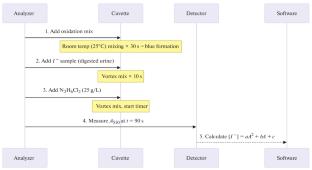
A novel arsenic-free method for the determination of iodine in urine was developed using a cerium(IV)−Ferroin catalytic reaction combined with an automated biochemistry analyzer. The method was based on the oxidation of the Ferroin reagent by cerium(IV) ions in an acidic medium, followed by reduction with hydrazine hydrochloride. Iodide ions catalyzed the reaction, and the absorbance was measured using an automated biochemistry analyzer. A quadratic relationship between iodine concentration (c, μg/L) and absorbance (A) was observed within the range of 0–400 μg/L and was described by the regression equation c = aA2 + bA + d, with a coefficient of correleation (r) greater than 0.999. The method exhibited high sensitivity, with a limit of detection for urinary iodine of 3.6 μg/L. Excellent precision was achieved, with an intra-assay coefficient of variation (CV) of ≤3.0% and inter-assay CVs of <3% for low, medium, and high iodine concentration standards. Accuracy was confirmed by an average recovery rate of 98.3% in spiked samples. The results obtained from the simultaneous determination of 40 urine samples using this method were highly consistent with those obtained by the standard arsenic-cerium catalytic spectrophotometry method, demonstrating good reliability and accuracy for urinary iodine determination. Owing to its high sensitivity, precision, accuracy, and rapid analysis performance, the proposed arsenic-free method was considered suitable for large-scale monitoring of iodine deficiency disorders and showed broad potential for application in urinary iodine detection while ensuring improved environmental and occupational safety.
期刊介绍:
The Journal of Analytical Chemistry is an international peer reviewed journal that covers theoretical and applied aspects of analytical chemistry; it informs the reader about new achievements in analytical methods, instruments and reagents. Ample space is devoted to problems arising in the analysis of vital media such as water and air. Consideration is given to the detection and determination of metal ions, anions, and various organic substances. The journal welcomes manuscripts from all countries in the English or Russian language.

 求助内容:
求助内容: 应助结果提醒方式:

 京公网安备 11010802042870号


