Application of Ensemble Machine Learning Methods to the Classification and Interpretation of Raman Spectra of Adipose Tissue During Enzymatic Hydrolysis by Lipase
{"title":"Application of Ensemble Machine Learning Methods to the Classification and Interpretation of Raman Spectra of Adipose Tissue During Enzymatic Hydrolysis by Lipase","authors":"E. S. Prikhozhdenko","doi":"10.1134/S1061934826700516","DOIUrl":null,"url":null,"abstract":"<p>Raman spectroscopy (<b>RS</b>) in combination with machine learning methods was used to solve the problem of the classification of adipose tissue before and after exposure to lipase. Differences between the classes were identified using principal component analysis. Hyperparameters such as the number of trees (n_estimators) and the maximum depth (max_depth) of the random forest (<b>RF</b>) and gradient boosting (<b>GB</b>) ensemble models are optimized for balanced accuracy and training time. This made ensured obtaining models with high predictive ability. In this method, models with 50 decision trees with a maximum depth of 3 were trained. The weighted accuracies of the RF and GB models were 96.4 ± 8.7% and 92.9 ± 11.3%, respectively. While the final prediction of the RF model was affected by intensities at 37 wavenumbers, including those corresponding to vibrations of the C=C bonds of unsaturated fatty acids, as well as of aliphatic C−C bonds and the carbonyl group >C=O, the prediction of the GB was based predominantly on the intensity at 1650 cm<sup>−1</sup> (C=C, importance 95.4%). The results obtained are consistent with the formation of free fatty acids, mono- and diglycerides as a result of the enzymatic hydrolysis of adipose tissue.</p>","PeriodicalId":606,"journal":{"name":"Journal of Analytical Chemistry","volume":"81 :","pages":"1110 - 1117"},"PeriodicalIF":1.5000,"publicationDate":"2026-08-02","publicationTypes":"Journal Article","fieldsOfStudy":null,"isOpenAccess":false,"openAccessPdf":"","citationCount":"0","resultStr":null,"platform":"Semanticscholar","paperid":null,"PeriodicalName":"Journal of Analytical Chemistry","FirstCategoryId":"92","ListUrlMain":"https://link.springer.com/article/10.1134/S1061934826700516","RegionNum":4,"RegionCategory":"化学","ArticlePicture":[],"TitleCN":null,"AbstractTextCN":null,"PMCID":null,"EPubDate":"","PubModel":"","JCR":"Q4","JCRName":"CHEMISTRY, ANALYTICAL","Score":null,"Total":0}
引用次数: 0
Abstract
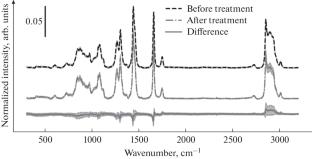
Raman spectroscopy (RS) in combination with machine learning methods was used to solve the problem of the classification of adipose tissue before and after exposure to lipase. Differences between the classes were identified using principal component analysis. Hyperparameters such as the number of trees (n_estimators) and the maximum depth (max_depth) of the random forest (RF) and gradient boosting (GB) ensemble models are optimized for balanced accuracy and training time. This made ensured obtaining models with high predictive ability. In this method, models with 50 decision trees with a maximum depth of 3 were trained. The weighted accuracies of the RF and GB models were 96.4 ± 8.7% and 92.9 ± 11.3%, respectively. While the final prediction of the RF model was affected by intensities at 37 wavenumbers, including those corresponding to vibrations of the C=C bonds of unsaturated fatty acids, as well as of aliphatic C−C bonds and the carbonyl group >C=O, the prediction of the GB was based predominantly on the intensity at 1650 cm−1 (C=C, importance 95.4%). The results obtained are consistent with the formation of free fatty acids, mono- and diglycerides as a result of the enzymatic hydrolysis of adipose tissue.
期刊介绍:
The Journal of Analytical Chemistry is an international peer reviewed journal that covers theoretical and applied aspects of analytical chemistry; it informs the reader about new achievements in analytical methods, instruments and reagents. Ample space is devoted to problems arising in the analysis of vital media such as water and air. Consideration is given to the detection and determination of metal ions, anions, and various organic substances. The journal welcomes manuscripts from all countries in the English or Russian language.

 求助内容:
求助内容: 应助结果提醒方式:

 京公网安备 11010802042870号


