
Achieving selective C−O bond cleavage of esters over monolayer NiMoS catalysts derived from oil-soluble polyoxometalates
IF 17.2
1区 化学
Q1 CHEMISTRY, APPLIED
Chinese Journal of Catalysis
Pub Date : 2026-08-01
Epub Date: 2026-08-02
DOI:10.1016/S1872-2067(26)65104-2
引用次数: 0
Abstract
Sulfided NiMo catalysts can effectively hydrogenate oxygen-rich bio-oils into high quality hydrocarbon fuels. However, precisely controlling the cleavage of C−O bonds remains challenging. Here, we synthesized an oil-soluble precursor NiMo6-DODA by encapsulating the polyoxometalates (POMs) (NH4)4[NiMo6O24H6] (NiMo6) with surfactants, followed by in-situ construction of an ultra-dispersed monolayer NiMoS catalyst. The “surfactant shell” of the precursor ensured its homogeneous dispersion in the oil phase, while gradually sacrificing and decomposing during the sulfidation to mitigate the aggregation of the MoS2 nanosheets. Meanwhile, the well-defined “POMs core” established an atomic-level Ni-Mo proximity, ensuring the dominance of the Ni-promoted MoS2 active phase. This design not only altered the adsorption configuration of esters on the NiMo catalyst but also introduced abundant edge sulfur vacancies to promote oxygen atom adsorption and accelerate C−O bond cleavage. The results showed that NiMo6-DODA achieved 100% conversion of methyl palmitate and 100% alkane selectivity under low catalyst loading conditions. Notably, the selectivity for n-hexadecane reached 94.2%, significantly surpassing that obtained with a commercial oil-soluble precursor (69.8%). Furthermore, the catalyst maintained high activity across multiple reaction cycles and in the solvent-free conversion of real bio-oils. This strategy of pre-assembly combined with sacrificial sulfidation provides a simple and effective route for designing hydrodeoxygenation catalysts that enable precise control over ester C−O bond cleavage.
在油溶性多金属氧酸盐衍生的单层NiMoS催化剂上实现酯类C−O键的选择性裂解
硫化镍催化剂能有效地将富氧生物油氢化成高质量的碳氢燃料。然而,精确控制C−O键的裂解仍然具有挑战性。本研究采用表面活性剂包封聚金属氧酸盐(POMs) (NH4)4[NiMo6O24H6] (NiMo6),并原位构建了超分散单层NiMoS催化剂,合成了油溶性前驱体NiMo6- doda。前驱体的“表面活性剂外壳”保证了其在油相中的均匀分散,同时在硫化过程中逐渐牺牲和分解,以减轻MoS2纳米片的聚集。同时,定义明确的“pom核心”建立了原子级的Ni-Mo接近,确保了ni促进的MoS2活性相的优势。这种设计不仅改变了酯类在NiMo催化剂上的吸附构型,而且引入了丰富的边缘硫空位,促进了氧原子的吸附,加速了C−O键的裂解。结果表明,在低催化剂负载条件下,NiMo6-DODA的棕榈酸甲酯转化率达到100%,烷烃选择性达到100%。值得注意的是,正十六烷的选择性达到94.2%,明显超过了商用油溶性前驱体的选择性(69.8%)。此外,该催化剂在多个反应周期和真实生物油的无溶剂转化中保持高活性。这种预组装与牺牲硫化相结合的策略为设计氢脱氧催化剂提供了一种简单有效的途径,可以精确控制酯C−O键的裂解。
本文章由计算机程序翻译,如有差异,请以英文原文为准。
求助全文
约1分钟内获得全文
求助全文
来源期刊
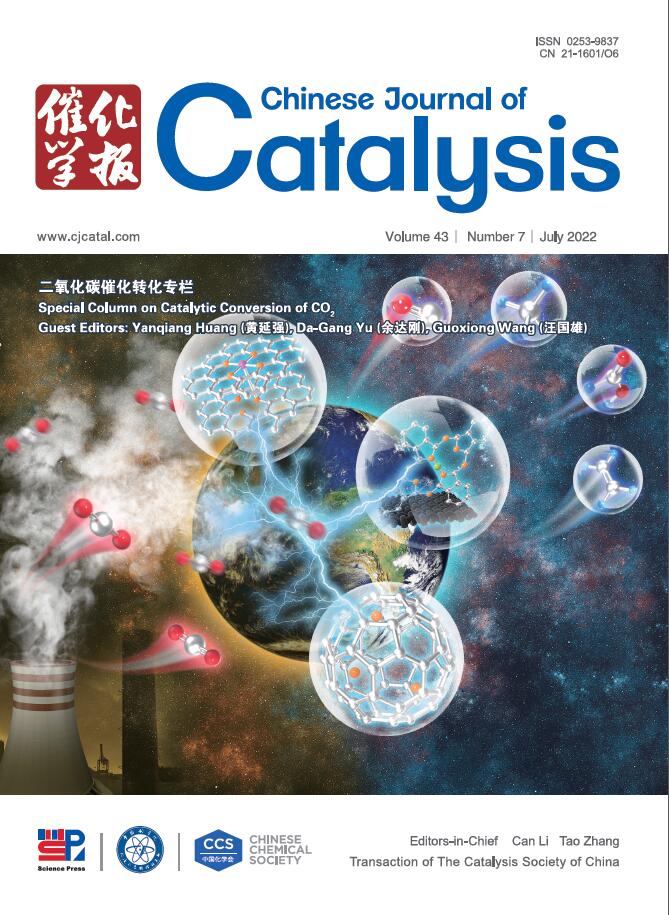
Chinese Journal of Catalysis
工程技术-工程:化工
CiteScore
25.80
自引率
10.30%
发文量
235
审稿时长
1.2 months
期刊介绍:
The journal covers a broad scope, encompassing new trends in catalysis for applications in energy production, environmental protection, and the preparation of materials, petroleum chemicals, and fine chemicals. It explores the scientific foundation for preparing and activating catalysts of commercial interest, emphasizing representative models.The focus includes spectroscopic methods for structural characterization, especially in situ techniques, as well as new theoretical methods with practical impact in catalysis and catalytic reactions.The journal delves into the relationship between homogeneous and heterogeneous catalysis and includes theoretical studies on the structure and reactivity of catalysts.Additionally, contributions on photocatalysis, biocatalysis, surface science, and catalysis-related chemical kinetics are welcomed.
 求助内容:
 应助结果提醒方式:


 京公网安备 11010802042870号


