
Ligand-shell engineering of a Au25 nanocluster boosting CO2 electroreduction to syngas with tunable range proportion
IF 17.2
1区 化学
Q1 CHEMISTRY, APPLIED
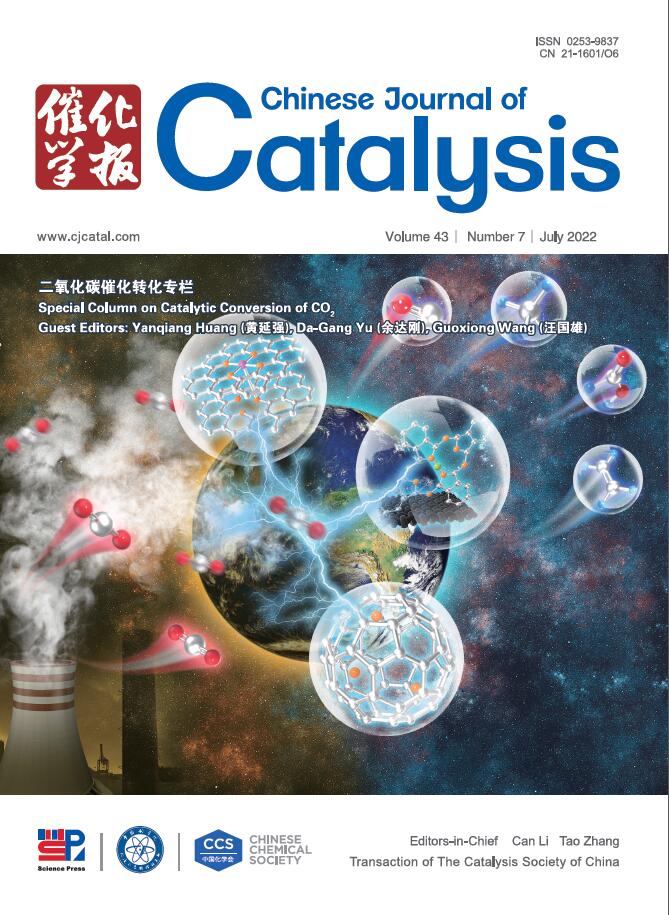
Chinese Journal of Catalysis
Pub Date : 2026-08-01
Epub Date: 2026-08-02
DOI:10.1016/S1872-2067(26)65113-3
引用次数: 0
Abstract
Au nanoclusters (NCs) with atomic-level precision represent an ideal model catalyst enabling efficient CO2-to-chemical conversion, yet the catalytic performance of distinct active sites in Au NCs remains poorly understood. In this work, ligand-shell engineering has been successfully carried out through a “ligand-stripping pyrolysis” strategy to obtain modified Au25 NCs for electrocatalytic CO2 reduction reaction (eCO2RR). Significantly, in situ pyrolysis techniques and structural characterization identify that the exposure of S/Au active sites has been precisely controlled during the adjusted thermal decomposition of the Au NCs, which establishs a clear site-product relationship. The CO/H2 molar ratio can be precisely adjusted across an exceptionally wide range (0.26–25.47) – a span that encompasses key industrially relevant ratios, such as the 1:2 ratio optimal for Fischer-Tropsch synthesis. Molecular dynamics (MD) simulations quantitatively disclose the interaction trend between exposed S/Au sites and CO2. S sites exhibit a superior CO2 affinity, with the local CO2 concentration increasing as S-site density increases, thereby kinetically promoting eCO2RR. Theoretical calculations also reveal that S sites facilitate the stabilization of *CO2 and *CO intermediates and promote electron transfer. In contrast, Au sites are energetically more favorable for the hydrogen evolution reaction. This study establishes an ideal platform for investigating structure-performance relationships of atomically precise NCs and provides guidance for designing metal NCs-based catalysts.
Au25纳米团簇促进CO2电还原成比例可调合成气的配壳工程
具有原子级精度的金纳米团簇(NCs)是一种理想的催化剂模型,可以实现高效的二氧化碳到化学物质的转化,但对金纳米团簇中不同活性位点的催化性能仍知之甚少。在本研究中,通过“配体剥脱热解”策略,成功地进行了配体壳工程,获得了用于电催化CO2还原反应(eCO2RR)的改性Au25 NCs。值得注意的是,原位热解技术和结构表征表明,在Au NCs的调整热分解过程中,S/Au活性位点的暴露得到了精确控制,从而建立了明确的位点-产物关系。CO/H2的摩尔比可以在一个非常宽的范围内精确调节(0.26-25.47),这个范围包括了关键的工业相关比例,如1:2的费托合成最佳比例。分子动力学(MD)模拟定量揭示了暴露的S/Au位点与CO2的相互作用趋势。S位点表现出优异的CO2亲和力,随着S位点密度的增加,局部CO2浓度增加,从而在动力学上促进eCO2RR。理论计算还表明,S位点有助于*CO2和*CO中间体的稳定,并促进电子转移。相反,Au位在能量上更有利于析氢反应。本研究为研究原子精密NCs的结构-性能关系提供了理想的平台,并为金属NCs基催化剂的设计提供了指导。
本文章由计算机程序翻译,如有差异,请以英文原文为准。
求助全文
约1分钟内获得全文
求助全文
来源期刊
Chinese Journal of Catalysis
工程技术-工程:化工
CiteScore
25.80
自引率
10.30%
发文量
235
审稿时长
1.2 months
期刊介绍:
The journal covers a broad scope, encompassing new trends in catalysis for applications in energy production, environmental protection, and the preparation of materials, petroleum chemicals, and fine chemicals. It explores the scientific foundation for preparing and activating catalysts of commercial interest, emphasizing representative models.The focus includes spectroscopic methods for structural characterization, especially in situ techniques, as well as new theoretical methods with practical impact in catalysis and catalytic reactions.The journal delves into the relationship between homogeneous and heterogeneous catalysis and includes theoretical studies on the structure and reactivity of catalysts.Additionally, contributions on photocatalysis, biocatalysis, surface science, and catalysis-related chemical kinetics are welcomed.
 求助内容:
 应助结果提醒方式:


 京公网安备 11010802042870号


