
Boehmite lattice hydroxyl-mediated selective hydrogenation of cinnamaldehyde via water as hydrogen source
IF 17.2
1区 化学
Q1 CHEMISTRY, APPLIED
Chinese Journal of Catalysis
Pub Date : 2026-08-01
Epub Date: 2026-08-02
DOI:10.1016/S1872-2067(26)65103-0
引用次数: 0
Abstract
Selective hydrogenation of cinnamaldehyde (CAL) to cinnamyl alcohol (COL) using water as the hydrogen source offers a promising route to eliminate traditional H2 preparation. However, this approach faces a trade-off between concurrently crating abundant active hydroxyls for hydrogenation and readily removing residual oxygen under mild conditions, restricting current development. Here, we report a naturally abundant lattice hydroxyl-mediated selective hydrogenation process over a boehmite-supported gold catalyst (Au/AlOOH), using H2O as the hydrogen source and CO as the oxygen acceptor. This process achieves 79% CAL conversion and 84% COL selectivity at 90 °C, doubling the efficiency of H2-based hydrogenation counterpart. In contrast, the OH-free Au/Al2O3 shows no activity. Mechanistic studies indicate that the Au/AlOOH boundary provides unsaturated Al3+ sites for selective C=O adsorption and lattice hydroxyls for hydrogenation, which are continuously replenished from water. CO adsorbed on Au facilitates oxygen removal, regenerating Al3+ sites. This work presents a practical hydrogen transfer strategy that leverages the unique lattice hydroxyls of boehmite to efficiently extract hydrogen from water.
薄水铝石晶格羟基介导肉桂醛以水为氢源选择性加氢
以水为氢源,肉桂醛(CAL)选择性加氢制肉桂醇(COL)是一种很有前途的替代传统制氢方法。然而,这种方法面临着同时产生大量用于氢化的活性羟基和在温和条件下容易去除残余氧的权衡,限制了当前的发展。在这里,我们报道了一种天然丰富的晶格羟基介导的选择性加氢过程,在一种薄铝石负载的金催化剂(Au/AlOOH)上,以H2O为氢源,CO为氧受体。该工艺在90℃条件下可实现79%的CAL转化率和84%的COL选择性,效率是h2加氢工艺的两倍。而无oh的Au/Al2O3则没有活性。机制研究表明,Au/AlOOH边界为选择性C=O吸附提供了不饱和Al3+位点,并为加氢提供了晶格羟基,这些羟基不断从水中补充。CO吸附在Au上有利于除氧,再生Al3+位点。这项工作提出了一种实用的氢转移策略,利用薄水铝石独特的晶格羟基来有效地从水中提取氢。
本文章由计算机程序翻译,如有差异,请以英文原文为准。
求助全文
约1分钟内获得全文
求助全文
来源期刊
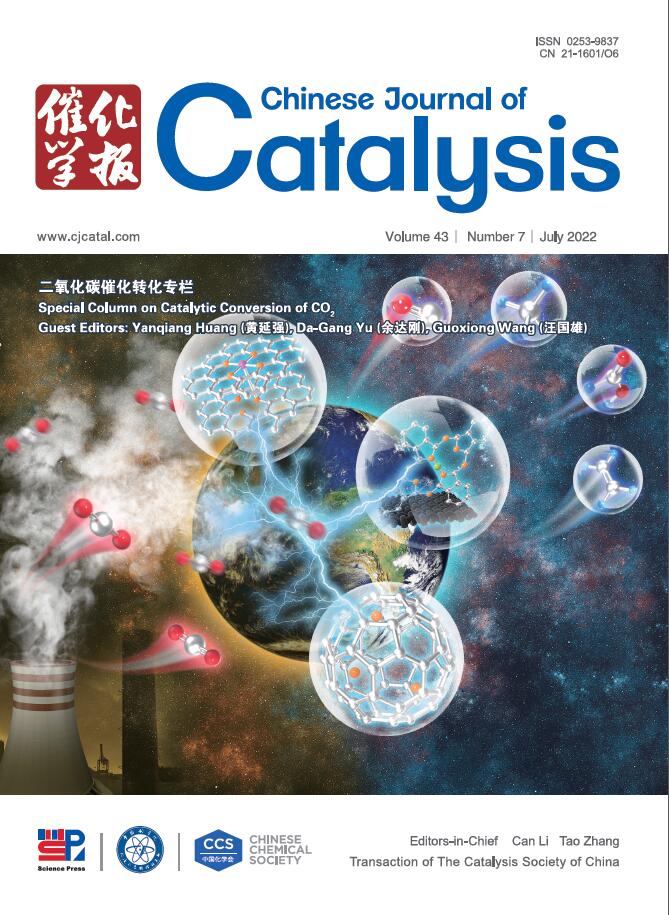
Chinese Journal of Catalysis
工程技术-工程:化工
CiteScore
25.80
自引率
10.30%
发文量
235
审稿时长
1.2 months
期刊介绍:
The journal covers a broad scope, encompassing new trends in catalysis for applications in energy production, environmental protection, and the preparation of materials, petroleum chemicals, and fine chemicals. It explores the scientific foundation for preparing and activating catalysts of commercial interest, emphasizing representative models.The focus includes spectroscopic methods for structural characterization, especially in situ techniques, as well as new theoretical methods with practical impact in catalysis and catalytic reactions.The journal delves into the relationship between homogeneous and heterogeneous catalysis and includes theoretical studies on the structure and reactivity of catalysts.Additionally, contributions on photocatalysis, biocatalysis, surface science, and catalysis-related chemical kinetics are welcomed.
 求助内容:
 应助结果提醒方式:


 京公网安备 11010802042870号


