
Coking-resistant CeAlO3-Socketed Nickel Nanocatalysts for dry reforming of methane
IF 17.2
1区 化学
Q1 CHEMISTRY, APPLIED
Chinese Journal of Catalysis
Pub Date : 2026-08-01
Epub Date: 2026-08-02
DOI:10.1016/S1872-2067(26)65063-2
引用次数: 0
Abstract
Nickel-based catalysts are regarded as the most promising candidates for industrial dry reforming of methane (DRM), yet severe coking and metal sintering impede their commercial viability. Herein, we report a CeAlO3-socketed Ni nanocatalyst with extensive Ni-CeAlO3 interfaces, demonstrating coke-free stability with no deactivation over 500 h test at 700 °C for a feed of CH4/CO2 = 1/1 (undiluted). The socket-structured catalyst was obtained via H2-reduction-triggered Ni exsolution and simultaneous formation of CeAlO3 from a Ce1Al0.95Ni0.05Ox composite oxide. A socketed structure featuring extensive Ni-CeAlO3 interface was achieved upon reduction at 750 °C, which essentially modulated the catalytic activation kinetics of both CO2 and CH4. In-situ diffused reflectance infrared Fourier transformed spectroscopy and isotope-labeling experiments were performed to gain insight into the interfacial catalysis, revealing that CO2 was preferentially activated at the Ni-CeAlO3 interface to form CO and O*, and CH4 was subsequently oxidized by O* to form H2 and another CO through formation of CH3O* intermediates. Such tandem reaction pathway led to stoichiometric conversion of CO2 and CH4 molecules thereby imparting our catalyst to high coking resistance. Our findings shed light on the rational design of a valid Ni-based DRM catalyst with substantial potential for industrial application.
甲烷干重整用抗焦化cealo3嵌套镍纳米催化剂
镍基催化剂被认为是最有希望用于工业甲烷干重整(DRM)的催化剂,但严重的焦化和金属烧结阻碍了它们的商业可行性。在此,我们报道了一种具有广泛Ni- cealo3界面的cealo3嵌套镍纳米催化剂,在700°C、CH4/CO2 = 1/1(未稀释)的条件下,在500 h的测试中显示出无焦稳定性和无失活。以Ce1Al0.95Ni0.05Ox复合氧化物为原料,通过h2还原引发Ni析出,同时生成CeAlO3,得到了套孔结构催化剂。在750℃还原后,得到了具有广泛Ni-CeAlO3界面的嵌套结构,这从本质上调节了CO2和CH4的催化活化动力学。原位扩散反射红外傅立叶变换光谱和同位素标记实验揭示了Ni-CeAlO3界面上CO2优先活化生成CO和O*,随后CH4通过生成ch30 *中间体被O*氧化生成H2和另一个CO。这种串联反应途径导致CO2和CH4分子的化学计量转化,从而使我们的催化剂具有高的抗焦化性。我们的研究结果为合理设计具有工业应用潜力的有效镍基DRM催化剂提供了启示。
本文章由计算机程序翻译,如有差异,请以英文原文为准。
求助全文
约1分钟内获得全文
求助全文
来源期刊
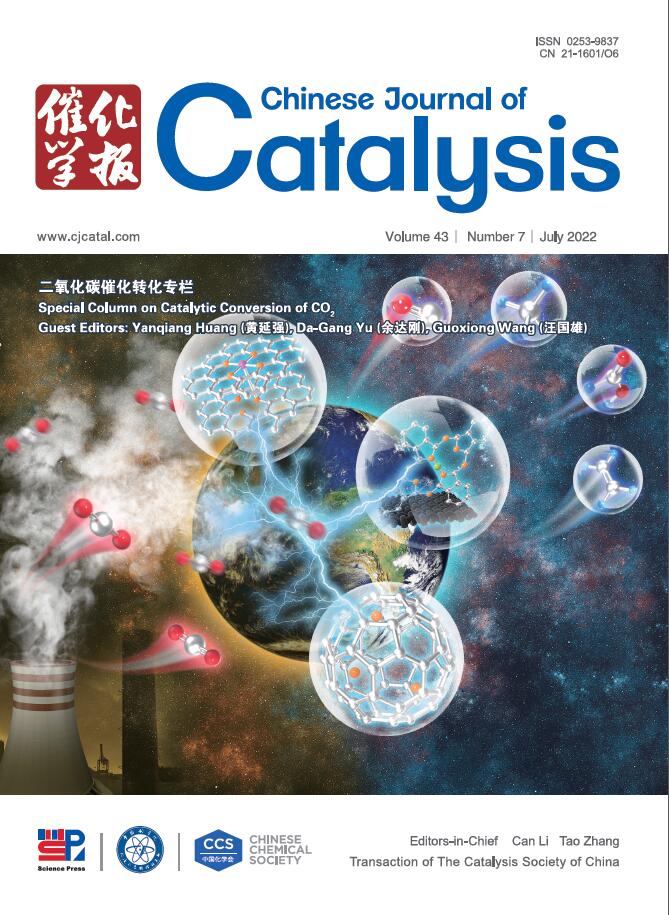
Chinese Journal of Catalysis
工程技术-工程:化工
CiteScore
25.80
自引率
10.30%
发文量
235
审稿时长
1.2 months
期刊介绍:
The journal covers a broad scope, encompassing new trends in catalysis for applications in energy production, environmental protection, and the preparation of materials, petroleum chemicals, and fine chemicals. It explores the scientific foundation for preparing and activating catalysts of commercial interest, emphasizing representative models.The focus includes spectroscopic methods for structural characterization, especially in situ techniques, as well as new theoretical methods with practical impact in catalysis and catalytic reactions.The journal delves into the relationship between homogeneous and heterogeneous catalysis and includes theoretical studies on the structure and reactivity of catalysts.Additionally, contributions on photocatalysis, biocatalysis, surface science, and catalysis-related chemical kinetics are welcomed.
 求助内容:
 应助结果提醒方式:


 京公网安备 11010802042870号


