
Decoding structure-selectivity interplay in Pd-Ag nanocatalysts for butadiene semi-hydrogenation
IF 17.2
1区 化学
Q1 CHEMISTRY, APPLIED
Chinese Journal of Catalysis
Pub Date : 2026-08-01
Epub Date: 2026-08-02
DOI:10.1016/S1872-2067(26)65078-4
引用次数: 0
Abstract
Precise control over product selectivity in heterogeneous catalysis remains a key challenge due to the complex interplay of structural and electronic factors. Here, we demonstrate delicate tuning of product distribution in 1,3-butadiene semi-hydrogenation by engineering the size and composition of Pd-Ag nanostructures. By systematically decoupling size and electronic effects, we identify critical selectivity descriptors and establish structure-selectivity correlations across both monometallic and bimetallic series. The thresholds of ensemble size and Pd valence state for the formation of distinct products are experimentally determined. Integrating kinetic analysis, chemisorption studies, and density functional theory calculations, we show that increased ensemble size and Ag incorporation weaken 1-butene binding and elevate hydrogenation barriers, enabling selective formation of 1-butene (up to 66%) over thermodynamically favored 2-butenes. These insights reveal the fundamental roles of geometric and electronic modulation in governing selectivity and offer a generalizable framework for the rational design of multifunctional bimetallic catalysts.
丁二烯半加氢钯银纳米催化剂结构-选择性相互作用的解码
由于结构和电子因素的复杂相互作用,对多相催化中产物选择性的精确控制仍然是一个关键的挑战。在这里,我们展示了通过设计Pd-Ag纳米结构的尺寸和组成来精细调节1,3-丁二烯半氢化过程中的产物分布。通过系统地解耦尺寸和电子效应,我们确定了关键选择性描述符,并建立了单金属和双金属系列的结构选择性相关性。实验确定了形成不同产物的系综尺寸和钯价态的阈值。综合动力学分析、化学吸附研究和密度泛函数理论计算,我们发现,增加的系综尺寸和银的加入削弱了1-丁烯的结合,提高了加氢屏障,使1-丁烯(高达66%)比热力学上有利的2-丁烯选择性形成。这些见解揭示了几何和电子调制在控制选择性中的基本作用,并为多功能双金属催化剂的合理设计提供了一个可推广的框架。
本文章由计算机程序翻译,如有差异,请以英文原文为准。
求助全文
约1分钟内获得全文
求助全文
来源期刊
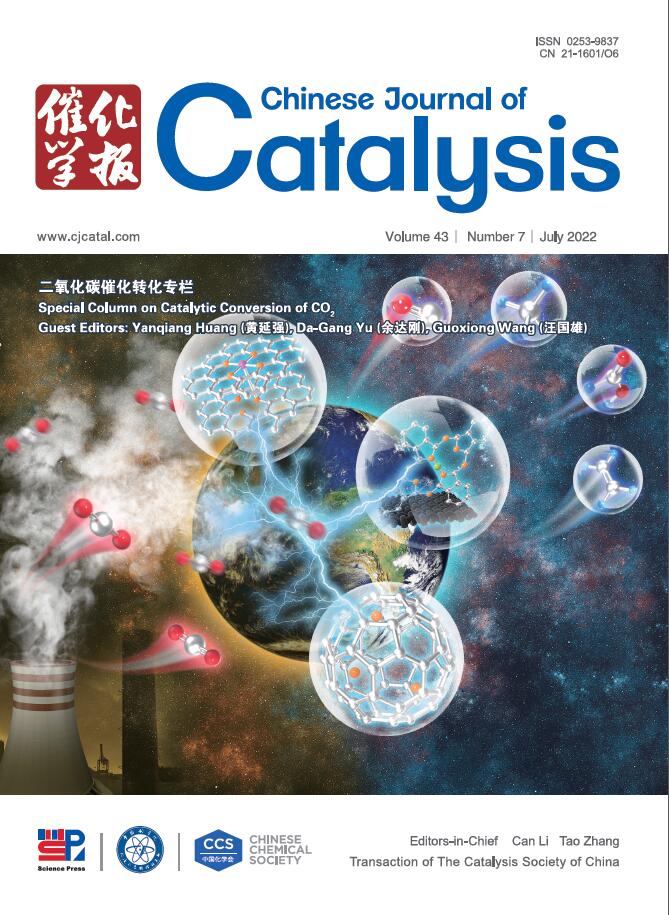
Chinese Journal of Catalysis
工程技术-工程:化工
CiteScore
25.80
自引率
10.30%
发文量
235
审稿时长
1.2 months
期刊介绍:
The journal covers a broad scope, encompassing new trends in catalysis for applications in energy production, environmental protection, and the preparation of materials, petroleum chemicals, and fine chemicals. It explores the scientific foundation for preparing and activating catalysts of commercial interest, emphasizing representative models.The focus includes spectroscopic methods for structural characterization, especially in situ techniques, as well as new theoretical methods with practical impact in catalysis and catalytic reactions.The journal delves into the relationship between homogeneous and heterogeneous catalysis and includes theoretical studies on the structure and reactivity of catalysts.Additionally, contributions on photocatalysis, biocatalysis, surface science, and catalysis-related chemical kinetics are welcomed.
 求助内容:
 应助结果提醒方式:


 京公网安备 11010802042870号


