
Atomic vacancies accelerating photochemical solar fuel and value-added chemical production: From materials to mechanism
IF 17.2
1区 化学
Q1 CHEMISTRY, APPLIED
Chinese Journal of Catalysis
Pub Date : 2026-08-01
Epub Date: 2026-08-02
DOI:10.1016/S1872-2067(26)65084-X
引用次数: 0
Abstract
Atomic vacancies in semiconductor materials are usually considered detrimental due to their role in trapping photogenerated carriers, leading to attenuated crystallinity and poor photoelectric conversion efficiency. However, the deliberate and controlled introduction of atomic vacancies within an optimal ratio range in semiconductor photocatalysts can significantly improve their catalytic efficiency. Specifically, vacancy sites can optimize the electronic configuration, promote charge carrier separation, activate reactant molecules, lower activation energies, and improve visible light harvesting, thereby enhancing photocatalytic performance. In this review, we systematically highlight the multiplicity of vacancies in semiconductor materials and examine their innovative role in driving photochemical solar fuel and high-value chemical production. An in-depth discussion of the underlying photoreaction mechanisms associated with the vacancy-mediated process is firstly elaborated, followed by introducing the advanced characterizations employed to uncover the merits of vacancies as well as currently developed strategies for vacancy-engineering in photocatalysts. Next, the current advances in utilizing vacancy contained photocatalysts for photochemical solar fuel and value-added chemical production are discussed and appraised, putting emphasis on their applications in water splitting, CO2 conversion, H2O2 generation, and N2 fixation. With the opportunities and challenges in this field, we concluded by presenting an outlook on the further prospects and key issues for the practical application of vacancy contained semiconductor materials. We sincerely hope that this review can spur new concepts to advance industrial-scale solar fuel and value-added chemical generation using vacancy-engineered semiconductor photocatalysts.
原子空位加速光化学太阳能燃料和化工增值生产:从材料到机理
半导体材料中的原子空位通常被认为是有害的,因为它们会捕获光生载流子,导致结晶度衰减和光电转换效率低下。然而,在半导体光催化剂中有意和有控制地在最佳比例范围内引入原子空位可以显著提高其催化效率。具体来说,空位位点可以优化电子构型,促进载流子分离,激活反应物分子,降低活化能,提高可见光捕获,从而提高光催化性能。在这篇综述中,我们系统地强调了半导体材料中空缺的多样性,并研究了它们在推动光化学太阳能燃料和高价值化学品生产方面的创新作用。首先深入讨论了与空位介导过程相关的潜在光反应机制,然后介绍了用于揭示空位优点的先进表征以及目前开发的光催化剂空位工程策略。其次,对含空位光催化剂在光化学太阳能燃料和增值化工生产中的应用现状进行了讨论和评价,重点介绍了其在水裂解、CO2转化、H2O2生成和N2固定等方面的应用。面对这一领域的机遇和挑战,最后展望了含空位半导体材料的进一步发展前景和实际应用的关键问题。我们真诚地希望这篇综述可以激发新的概念,以推进工业规模的太阳能燃料和利用空缺工程半导体光催化剂的增值化学发电。
本文章由计算机程序翻译,如有差异,请以英文原文为准。
求助全文
约1分钟内获得全文
求助全文
来源期刊
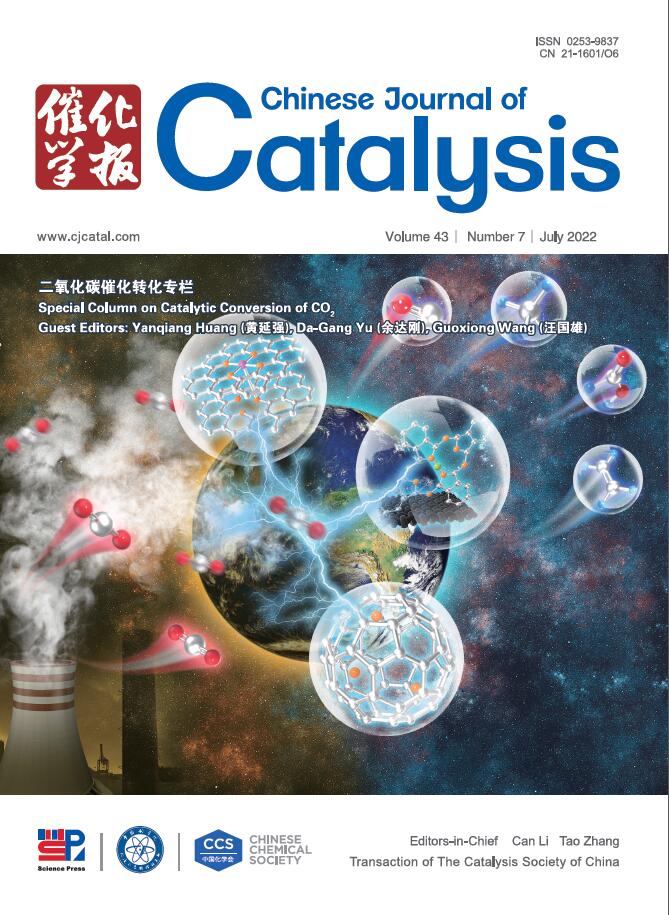
Chinese Journal of Catalysis
工程技术-工程:化工
CiteScore
25.80
自引率
10.30%
发文量
235
审稿时长
1.2 months
期刊介绍:
The journal covers a broad scope, encompassing new trends in catalysis for applications in energy production, environmental protection, and the preparation of materials, petroleum chemicals, and fine chemicals. It explores the scientific foundation for preparing and activating catalysts of commercial interest, emphasizing representative models.The focus includes spectroscopic methods for structural characterization, especially in situ techniques, as well as new theoretical methods with practical impact in catalysis and catalytic reactions.The journal delves into the relationship between homogeneous and heterogeneous catalysis and includes theoretical studies on the structure and reactivity of catalysts.Additionally, contributions on photocatalysis, biocatalysis, surface science, and catalysis-related chemical kinetics are welcomed.
 求助内容:
 应助结果提醒方式:


 京公网安备 11010802042870号


