
Synergistic chloride resistance via hydrogen−bond network dynamic optimization and electrostatic repulsion for alkaline seawater oxidation
IF 17.2
1区 化学
Q1 CHEMISTRY, APPLIED
Chinese Journal of Catalysis
Pub Date : 2026-08-01
Epub Date: 2026-08-02
DOI:10.1016/S1872-2067(26)65100-5
引用次数: 0
Abstract
Seawater electrolysis, while promising for sustainable hydrogen production, is fundamentally challenged by the relentless chloride ions (Cl–)-induced corrosion, which impairs catalyst stability during long-term operation. We report a polyhydroquinone (PHQ)-modified electrocatalyst, where the redox-active PHQ layer is firmly coated to CoFe layered double hydroxide (CoFe LDH) surface through a strong hydrogen-bond network. Theoretical calculations and characterization techniques collectively elucidate that the unique interface creates an in situ protective coating, which effectively optimizes the composition of the interfacial water and prevents Cl– attack. Such a catalyst shows outstanding performance in alkaline seawater, requiring an overpotential of only 335 mV to reach 1 A cm–2 and exhibiting remarkable durability for 2000 h even at high current densities (j = 1, 1.5, and 2 A cm–2). Furthermore, the constructed alkaline anion exchange membrane water electrolyzer achieves a j of 1 A cm–2 at a low voltage of 2.55 V, significantly outperforming the benchmark Pt/C/NF||RuO2/NF.
基于氢键网络动态优化和静电斥力的碱性海水氧化协同抗氯性
海水电解虽然有望实现可持续制氢,但从根本上说,它受到氯离子(Cl -)引起的持续腐蚀的挑战,这种腐蚀会损害催化剂在长期运行中的稳定性。我们报道了一种聚对苯二酚(PHQ)修饰的电催化剂,其中氧化还原活性PHQ层通过强氢键网络牢固地涂覆在CoFe层状双氢氧化物(CoFe LDH)表面。理论计算和表征技术共同表明,独特的界面形成了一层原位保护涂层,有效地优化了界面水的组成,防止了Cl -的攻击。这种催化剂在碱性海水中表现出优异的性能,只需要335 mV的过电位就能达到1 a cm-2,即使在高电流密度(j = 1,1.5和2 a cm-2)下也能表现出2000小时的耐久性。此外,所构建的碱性阴离子交换膜水电解槽在2.55 V的低电压下达到了1 a cm-2的j,显著优于基准Pt/C/NF||RuO2/NF。
本文章由计算机程序翻译,如有差异,请以英文原文为准。
求助全文
约1分钟内获得全文
求助全文
来源期刊
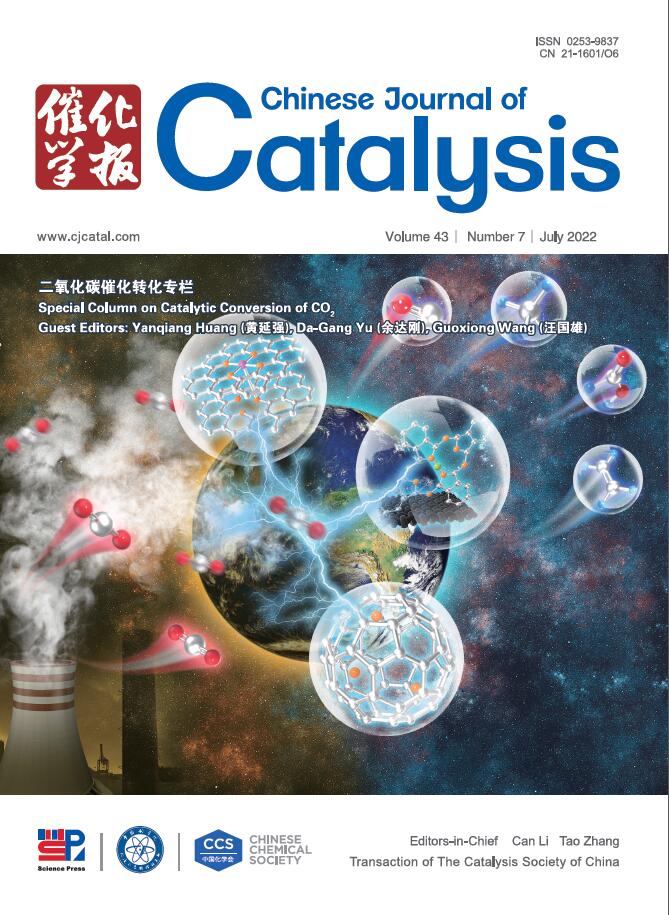
Chinese Journal of Catalysis
工程技术-工程:化工
CiteScore
25.80
自引率
10.30%
发文量
235
审稿时长
1.2 months
期刊介绍:
The journal covers a broad scope, encompassing new trends in catalysis for applications in energy production, environmental protection, and the preparation of materials, petroleum chemicals, and fine chemicals. It explores the scientific foundation for preparing and activating catalysts of commercial interest, emphasizing representative models.The focus includes spectroscopic methods for structural characterization, especially in situ techniques, as well as new theoretical methods with practical impact in catalysis and catalytic reactions.The journal delves into the relationship between homogeneous and heterogeneous catalysis and includes theoretical studies on the structure and reactivity of catalysts.Additionally, contributions on photocatalysis, biocatalysis, surface science, and catalysis-related chemical kinetics are welcomed.
 求助内容:
 应助结果提醒方式:


 京公网安备 11010802042870号


