
WN enhanced metal-N-C platform for ultra-stable Pt oxygen reduction electrocatalyst in fuel cell
IF 17.2
1区 化学
Q1 CHEMISTRY, APPLIED
Chinese Journal of Catalysis
Pub Date : 2026-08-01
Epub Date: 2026-08-02
DOI:10.1016/S1872-2067(26)65108-X
引用次数: 0
Abstract
The widespread deployment of proton exchange membrane fuel cells is hindered by the “catalysis trilemma” of the oxygen reduction reaction (ORR), which demands simultaneous high activity, exceptional durability and low cost. To overcome this longstanding bottleneck, we propose a universal tungsten nitride (WN) enhanced metal-N-C platform, where WN synergizes with metal-Nx sites to create a robust and electronically modulated support for Pt catalysts. This dual-anchoring and synergistic-catalyzing architecture not only effectively suppresses Pt nanoparticle migration and dissolution but also optimizes Pt activity, thereby accelerating ORR kinetics and enhancing structural integrity. As a prototypical example, the Pt/WN-Fe-N-C catalyst delivers a remarkable peak power density of 1.85 W/cm2 at an ultralow cathode Pt loading of 0.05 mg-Pt/cm2 and retains 91.1% peak power density after 90000 accelerated durability test cycles with 4 mV voltage loss at 0.80 A/cm2-significantly exceeding the U.S. DOE 2030 targets. This work establishes a generalizable materials design strategy to break the activity-stability-cost trade-off in fuel cell catalysis.
氮化钨增强金属- n - c平台用于燃料电池中超稳定铂氧还原电催化剂
质子交换膜燃料电池的广泛应用受到氧还原反应(ORR)的“催化三难困境”的阻碍,该反应要求同时具有高活性、优异的耐久性和低成本。为了克服这一长期存在的瓶颈,我们提出了一种通用的氮化钨(WN)增强金属- n - c平台,其中WN与金属- nx位点协同作用,为Pt催化剂创造了强大的电子调制支撑。这种双锚定和协同催化结构不仅有效抑制了Pt纳米颗粒的迁移和溶解,而且优化了Pt活性,从而加速了ORR动力学,增强了结构完整性。作为一个典型的例子,Pt/WN-Fe-N-C催化剂在0.05 mg-Pt/cm2的超低阴极Pt负载下提供了1.85 W/cm2的峰值功率密度,并且在0.80 a /cm2的4 mV电压损失下,在90000次加速耐久性测试循环后保持了91.1%的峰值功率密度,大大超过了美国能源部2030年的目标。这项工作建立了一种通用的材料设计策略,以打破燃料电池催化中活性-稳定性-成本的权衡。
本文章由计算机程序翻译,如有差异,请以英文原文为准。
求助全文
约1分钟内获得全文
求助全文
来源期刊
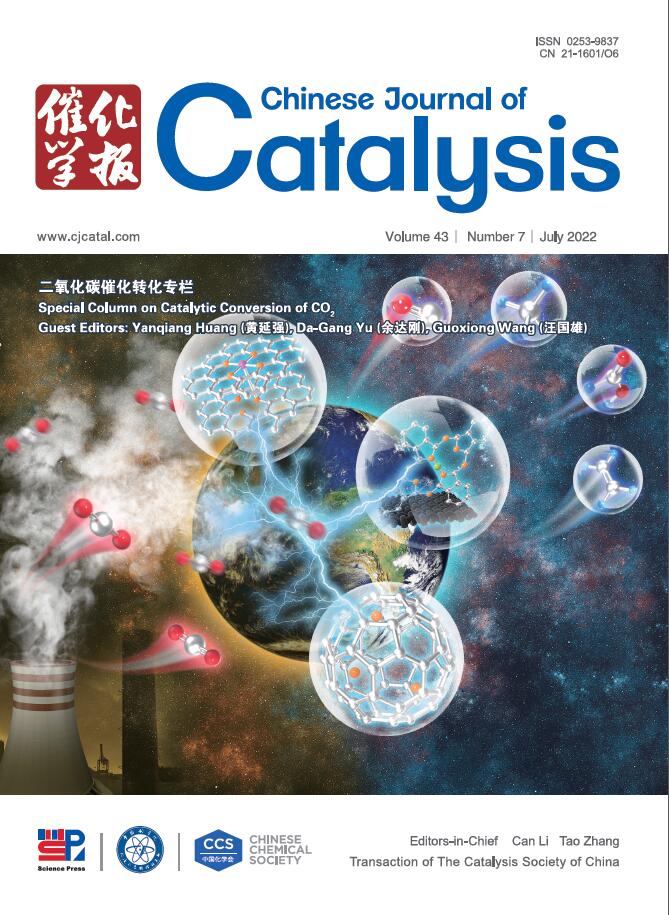
Chinese Journal of Catalysis
工程技术-工程:化工
CiteScore
25.80
自引率
10.30%
发文量
235
审稿时长
1.2 months
期刊介绍:
The journal covers a broad scope, encompassing new trends in catalysis for applications in energy production, environmental protection, and the preparation of materials, petroleum chemicals, and fine chemicals. It explores the scientific foundation for preparing and activating catalysts of commercial interest, emphasizing representative models.The focus includes spectroscopic methods for structural characterization, especially in situ techniques, as well as new theoretical methods with practical impact in catalysis and catalytic reactions.The journal delves into the relationship between homogeneous and heterogeneous catalysis and includes theoretical studies on the structure and reactivity of catalysts.Additionally, contributions on photocatalysis, biocatalysis, surface science, and catalysis-related chemical kinetics are welcomed.
 求助内容:
 应助结果提醒方式:


 京公网安备 11010802042870号


