
BCAT2 links branched-chain amino acids metabolism to interferon signaling to sustain macrophage inflammation
IF 26.5
1区 医学
Q1 IMMUNOLOGY
引用次数: 0
Abstract
The mechanisms sustaining chronic inflammation in rheumatoid arthritis (RA) remain incompletely understood. Here we show that branched-chain amino acid (BCAA) catabolism, mediated by the mitochondrial enzyme BCAT2, sustained interferon-driven macrophage activation in autoimmune arthritis. Multi-omics and histological analyses of individuals with active RA or sustained remission revealed that active disease was associated with systemic BCAA depletion, synovial branched-chain ketoacid accumulation and elevated BCAT2 expression in interferon-responsive synovial macrophages. Mechanistically, interferon-γ induced BCAT2 transcription through the transcription factor IRF1 in RA synovial macrophages. In human monocyte-derived macrophages, BCAT2-dependent BCAA catabolism elevated mitochondrial reactive oxygen species, which in turn restrained SHP-1 activity, prolonged STAT1 and STAT2 phosphorylation and drove inflammatory cytokine production. Furthermore, myeloid-specific deletion of Bcat2 ameliorated collagen antibody-induced arthritis in mice. Pharmacological targeting of this pathway with telmisartan suppressed persistent arthritis in methotrexate-treated mice. Together, our findings identified BCAT2-dependent amino acid catabolism as a potentially targetable metabolic pathway in autoimmune arthritis. Zhang and colleagues show that BCAT2-dependent branched-chain amino acid catabolism sustains IFN-driven macrophage activation and chronic inflammation during autoimmune arthritis.

BCAT2将支链氨基酸代谢与干扰素信号联系起来,维持巨噬细胞炎症。
类风湿性关节炎(RA)持续慢性炎症的机制仍不完全清楚。本研究表明,在自身免疫性关节炎中,由线粒体酶BCAT2介导的支链氨基酸(BCAA)分解代谢可维持干扰素驱动的巨噬细胞激活。活动期RA患者或持续缓解患者的多组学和组织学分析显示,活动期疾病与系统性BCAA消耗、滑膜支链酮酸积累和干扰素反应性滑膜巨噬细胞中BCAT2表达升高有关。在机制上,干扰素-γ通过转录因子IRF1诱导RA滑膜巨噬细胞中BCAT2的转录。在人单核细胞来源的巨噬细胞中,bcat2依赖的BCAA分解代谢提高了线粒体活性氧,从而抑制了SHP-1活性,延长了STAT1和STAT2的磷酸化,并推动了炎症细胞因子的产生。此外,骨髓特异性缺失Bcat2可改善胶原抗体诱导的小鼠关节炎。替米沙坦在甲氨蝶呤治疗小鼠中对这一途径的药理靶向抑制了持续性关节炎。总之,我们的研究结果确定了bcat2依赖性氨基酸分解代谢是自身免疫性关节炎的潜在靶向代谢途径。
本文章由计算机程序翻译,如有差异,请以英文原文为准。
求助全文
约1分钟内获得全文
求助全文
来源期刊
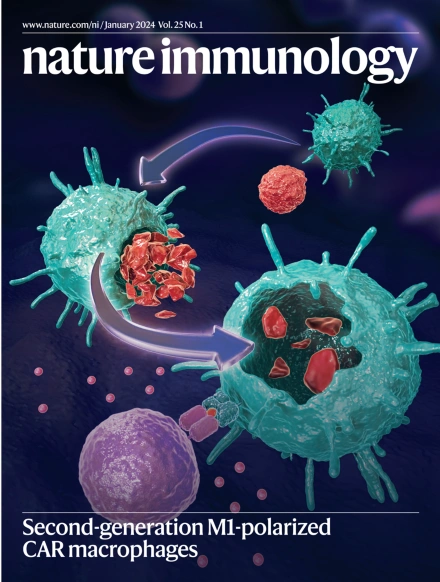
Nature Immunology
医学-免疫学
CiteScore
40.00
自引率
2.30%
发文量
248
审稿时长
4-8 weeks
期刊介绍:
Nature Immunology is a monthly journal that publishes the highest quality research in all areas of immunology. The editorial decisions are made by a team of full-time professional editors. The journal prioritizes work that provides translational and/or fundamental insight into the workings of the immune system. It covers a wide range of topics including innate immunity and inflammation, development, immune receptors, signaling and apoptosis, antigen presentation, gene regulation and recombination, cellular and systemic immunity, vaccines, immune tolerance, autoimmunity, tumor immunology, and microbial immunopathology. In addition to publishing significant original research, Nature Immunology also includes comments, News and Views, research highlights, matters arising from readers, and reviews of the literature. The journal serves as a major conduit of top-quality information for the immunology community.
 求助内容:
 应助结果提醒方式:


 京公网安备 11010802042870号


