
Manejo de la anemia preoperatoria en cáncer colorrectal y análisis de las estrategias perioperatorias Patient Blood Management

IF 1.3 Q3 ANESTHESIOLOGY
A. Bernardo Chávez, N. Bakhshaliyeva, A. Planas Roca, E. Alday Muñoz
{"title":"Manejo de la anemia preoperatoria en cáncer colorrectal y análisis de las estrategias perioperatorias Patient Blood Management","authors":"A. Bernardo Chávez,&nbsp;N. Bakhshaliyeva,&nbsp;A. Planas Roca,&nbsp;E. Alday Muñoz","doi":"10.1016/j.redar.2026.502174","DOIUrl":null,"url":null,"abstract":"<div><h3>Introduction and endpoints</h3><div>Preoperative anaemia is a common finding in patients with colorectal cancer (CRC) and is significantly associated with morbidity and mortality. Patient Blood Management Programs (PBM) have been developed to improve patient outcomes. This study aimed to evaluate the effectiveness of the Outpatient Blood Management Program (OBMP) in a tertiary hospital in Spain. The primary endpoint was to determine the percentage of patients who recover from anaemia after treatment at the OBMP. Additionally, correlations between preoperative anaemia, administered treatments, and surgical waiting times were analyzed.</div></div><div><h3>Methods</h3><div>A retrospective observational study was conducted including 537 patients who underwent surgical intervention for CRC. Demographic data, haemoglobin values at three time points (inclusion on the surgical waiting list, preoperative, and postoperative), as well as the time intervals between inclusion on the waiting list and the performance of surgery, were collected.</div></div><div><h3>Results</h3><div>The prevalence of anaemia was 43.3% at the time of inclusion on the surgical waiting list. Of the total anaemic patients, 42% received specific treatment. Treatment at the OBMP was associated with a higher recovery rate (37%) and a more significant increase in haemoglobin (1.35<!--> <!-->g/dl IC<sub>95%</sub> [0.7-2.1] vs. 0.4<!--> <!-->g/dl IC<sub>95%</sub> [0-1.6]). Preoperative anaemia was associated with longer surgical waiting times, higher incidence of transfusions, higher prevalence of postoperative anaemia, and prolonged hospital stays.</div></div><div><h3>Conclusion</h3><div>The OBMP offers an opportunity to improve the management of anaemia in patients undergoing surgery for CRC; however, it requires interdisciplinary coordination to minimize its impact on surgical waiting times.</div></div>","PeriodicalId":46479,"journal":{"name":"Revista Espanola de Anestesiologia y Reanimacion","volume":"73 7","pages":"Article 502174"},"PeriodicalIF":1.3000,"publicationDate":"2026-08-01","publicationTypes":"Journal Article","fieldsOfStudy":null,"isOpenAccess":false,"openAccessPdf":"","citationCount":"0","resultStr":null,"platform":"Semanticscholar","paperid":null,"PeriodicalName":"Revista Espanola de Anestesiologia y Reanimacion","FirstCategoryId":"1085","ListUrlMain":"https://www.sciencedirect.com/science/article/pii/S0034935626001416","RegionNum":0,"RegionCategory":null,"ArticlePicture":[],"TitleCN":null,"AbstractTextCN":null,"PMCID":null,"EPubDate":"2026/6/11 0:00:00","PubModel":"Epub","JCR":"Q3","JCRName":"ANESTHESIOLOGY","Score":null,"Total":0}
引用次数: 0

Abstract

Introduction and endpoints

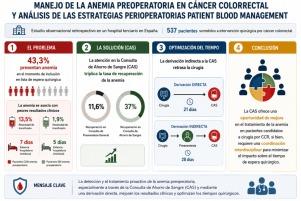
Preoperative anaemia is a common finding in patients with colorectal cancer (CRC) and is significantly associated with morbidity and mortality. Patient Blood Management Programs (PBM) have been developed to improve patient outcomes. This study aimed to evaluate the effectiveness of the Outpatient Blood Management Program (OBMP) in a tertiary hospital in Spain. The primary endpoint was to determine the percentage of patients who recover from anaemia after treatment at the OBMP. Additionally, correlations between preoperative anaemia, administered treatments, and surgical waiting times were analyzed.

Methods

A retrospective observational study was conducted including 537 patients who underwent surgical intervention for CRC. Demographic data, haemoglobin values at three time points (inclusion on the surgical waiting list, preoperative, and postoperative), as well as the time intervals between inclusion on the waiting list and the performance of surgery, were collected.

Results

The prevalence of anaemia was 43.3% at the time of inclusion on the surgical waiting list. Of the total anaemic patients, 42% received specific treatment. Treatment at the OBMP was associated with a higher recovery rate (37%) and a more significant increase in haemoglobin (1.35 g/dl IC95% [0.7-2.1] vs. 0.4 g/dl IC95% [0-1.6]). Preoperative anaemia was associated with longer surgical waiting times, higher incidence of transfusions, higher prevalence of postoperative anaemia, and prolonged hospital stays.

Conclusion

The OBMP offers an opportunity to improve the management of anaemia in patients undergoing surgery for CRC; however, it requires interdisciplinary coordination to minimize its impact on surgical waiting times.
Abstract Image

结肠直肠癌术前贫血的管理和患者血液管理策略的分析
前言和终点手术后贫血是结直肠癌(CRC)患者的常见发现,并与发病率和死亡率显著相关。患者血液管理方案(PBM)已开发,以改善患者的结果。本研究旨在评估门诊血液管理计划(OBMP)在西班牙三级医院的有效性。主要终点是确定在OBMP治疗后从贫血中恢复的患者百分比。此外,还分析了术前贫血、给予治疗和手术等待时间之间的相关性。方法对537例行结直肠癌手术治疗的患者进行回顾性观察研究。收集了人口统计数据、三个时间点的血红蛋白值(列入手术等候名单、术前和术后)以及列入等候名单和手术之间的时间间隔。结果纳入手术候诊名单时,贫血发生率为43.3%。在所有贫血患者中,42%接受了特异性治疗。在OBMP治疗与更高的恢复率(37%)和更显著的血红蛋白增加(1.35 g/dl IC95% [0.7-2.1] vs. 0.4 g/dl IC95%[0-1.6])相关。术前贫血与较长的手术等待时间、较高的输血发生率、较高的术后贫血发生率和较长的住院时间有关。结论OBMP为改善CRC手术患者的贫血管理提供了机会;然而,它需要跨学科的协调,以尽量减少其对手术等待时间的影响。
本文章由计算机程序翻译,如有差异,请以英文原文为准。
求助全文
约1分钟内获得全文 求助全文
来源期刊
CiteScore
1.80
自引率
15.40%
发文量
113
审稿时长
82 days

×
引用
GB/T 7714-2015
复制
MLA
复制
APA
复制
导出至
BibTeX EndNote RefMan NoteFirst NoteExpress
×
提示
您的信息不完整,为了账户安全,请先补充。
现在去补充
×
提示
您因"违规操作"
具体请查看互助需知
我知道了
×
提示
确定
请完成安全验证×
copy
已复制链接
快去分享给好友吧!
我知道了
右上角分享
点击右上角分享
0
联系我们:info@booksci.cn Book学术提供免费学术资源搜索服务,方便国内外学者检索中英文文献。致力于提供最便捷和优质的服务体验。 Copyright © 2023 布克学术 All rights reserved.
京ICP备2023020795号-1
ghs 京公网安备 11010802042870号
Book学术文献互助
Book学术文献互助群
群 号:604180095
Book学术官方微信
小红书


