
Molecular reconstruction of vacuum residue based on high-resolution mass spectrometric characterization
IF 3.5
3区 工程技术
Q2 ENGINEERING, CHEMICAL
Chinese Journal of Chemical Engineering
Pub Date : 2026-08-01
Epub Date: 2026-06-18
DOI:10.1016/j.cjche.2026.05.007
引用次数: 0
Abstract
Accurately obtaining the molecular composition of vacuum residue (VR) is of great significance for feedstock screening, process development, and operational optimization. However, due to the complex molecular composition of VR, traditional molecular reconstruction models based on bulk properties struggle to accurately capture the characteristics of the molecular distribution. To address this, this study proposed a precise molecular reconstruction method for VR based on high-resolution mass spectrometry (HRMS) data. Using molecular-level characterization data obtained from HRMS as a reference, a method for the compositional similarity between the calculated and experimental molecular distribution was introduced. The compositional similarity was incorporated into the global optimization algorithm that simultaneously matched both bulk properties and molecular composition, effectively constraining the distribution of both hydrocarbon and heteroatom-containing species. The method was applied to five inferior VRs from different sources. The results demonstrate that the developed model can accurately calculate the VR bulk properties. Moreover, the predicted molecular distribution agreed well with experimental measurements, and the content of over 20000 molecules in VR was quantitatively predicted. This approach reduced the multi-solution problem inherent in the traditional molecular reconstruction method, providing a precise foundational model for molecular-level process optimization and regulation.
基于高分辨率质谱表征的真空残渣分子重构
准确获取真空渣油的分子组成对原料筛选、工艺开发和操作优化具有重要意义。然而,由于VR的分子组成复杂,传统的基于体性质的分子重建模型难以准确捕捉分子分布的特征。为此,本研究提出了一种基于高分辨率质谱(HRMS)数据的VR精确分子重建方法。以HRMS获得的分子水平表征数据为参考,介绍了一种计算分子分布与实验分子分布相似度的方法。将成分相似度纳入全局优化算法,同时匹配体积性质和分子组成,有效地约束了含烃和杂原子物种的分布。将该方法应用于5个不同来源的劣质vr。结果表明,所建立的模型能较准确地计算出虚拟现实体特性。此外,预测的分子分布与实验测量结果吻合较好,定量预测了VR中超过20000个分子的含量。该方法减少了传统分子重建方法固有的多解问题,为分子水平的过程优化和调控提供了精确的基础模型。
本文章由计算机程序翻译,如有差异,请以英文原文为准。
求助全文
约1分钟内获得全文
求助全文
来源期刊
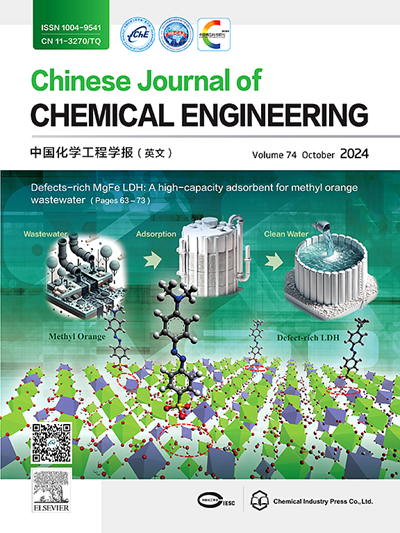
Chinese Journal of Chemical Engineering
工程技术-工程:化工
CiteScore
6.60
自引率
5.30%
发文量
4309
审稿时长
31 days
期刊介绍:
The Chinese Journal of Chemical Engineering (Monthly, started in 1982) is the official journal of the Chemical Industry and Engineering Society of China and published by the Chemical Industry Press Co. Ltd. The aim of the journal is to develop the international exchange of scientific and technical information in the field of chemical engineering. It publishes original research papers that cover the major advancements and achievements in chemical engineering in China as well as some articles from overseas contributors.
The topics of journal include chemical engineering, chemical technology, biochemical engineering, energy and environmental engineering and other relevant fields. Papers are published on the basis of their relevance to theoretical research, practical application or potential uses in the industry as Research Papers, Communications, Reviews and Perspectives. Prominent domestic and overseas chemical experts and scholars have been invited to form an International Advisory Board and the Editorial Committee. It enjoys recognition among Chinese academia and industry as a reliable source of information of what is going on in chemical engineering research, both domestic and abroad.
 求助内容:
 应助结果提醒方式:


 京公网安备 11010802042870号


