
Understanding the role of surface Zn species in CO2 hydrogenation to methanol over Cu/ZnO/Al2O3
IF 3.5
3区 工程技术
Q2 ENGINEERING, CHEMICAL
Chinese Journal of Chemical Engineering
Pub Date : 2026-08-01
Epub Date: 2026-05-16
DOI:10.1016/j.cjche.2026.04.007
引用次数: 0
Abstract
The structural characteristics of surface Zn species are of significance to regulate the activity and selectivity of Cu-based catalysts for CO2 hydrogenation to methanol. A series of Cu/ZnO/Al2O3 catalysts derived from layered double hydroxides (LDH) precursors was systematically optimized and subjected to calcination and reduction at various temperatures to tune the surface Zn species with controlled characteristics of Cu species, including Cu sizes and Cu+/Cu0 ratios. Structural characterization reveals that formation of a well-defined Cu–ZnO interface with variable surface Zn species (Zn2+ and Znδ+), and maintained Cu nanoparticle sizes and Cu+/Cu0 ratios within similar degrees. A strong positive correlation is established between the fraction of surface Znδ+ species and methanol productivity, highlighting the critical role of ZnOx species in Cu–ZnO interface during CO2 hydrogenation. The optimized catalyst achieved a methanol space-time yield of 610.6 mg·g−1·h−1 at 250 °C and 3.0 MPa, exceeding most reported Cu-based catalysts under comparable conditions. This work provides mechanistic insights into interfacial structure–activity relationships and offers practical guidelines for the rational design of high-performance Cu/ZnO/Al2O3 catalysts for CO2 hydrogenation to methanol.
了解Cu/ZnO/Al2O3表面Zn在CO2加氢制甲醇中的作用
表面Zn的结构特征对cu基催化剂的活性和选择性调控具有重要意义。系统优化了一系列由层状双氢氧化物(LDH)前驱体衍生的Cu/ZnO/Al2O3催化剂,并在不同温度下进行了煅烧和还原,以调节表面Zn种类,控制Cu种类的特征,包括Cu尺寸和Cu+/Cu0比。结构表征表明,Cu - zno界面形成了明确的Cu - zno界面,表面锌种类(Zn2+和Znδ+)变化,Cu纳米颗粒尺寸和Cu+/Cu0比值保持在相似程度。结果表明,表面Znδ+组分与甲醇产率呈显著正相关,表明CO2加氢过程中ZnOx组分在Cu-ZnO界面中的重要作用。优化后的催化剂在250℃、3.0 MPa条件下的甲醇空时产率为610.6 mg·g−1·h−1,超过了目前报道的大多数cu基催化剂。这项工作提供了界面结构-活性关系的机理见解,并为合理设计高性能Cu/ZnO/Al2O3催化剂用于CO2加氢制甲醇提供了实用指导。
本文章由计算机程序翻译,如有差异,请以英文原文为准。
求助全文
约1分钟内获得全文
求助全文
来源期刊
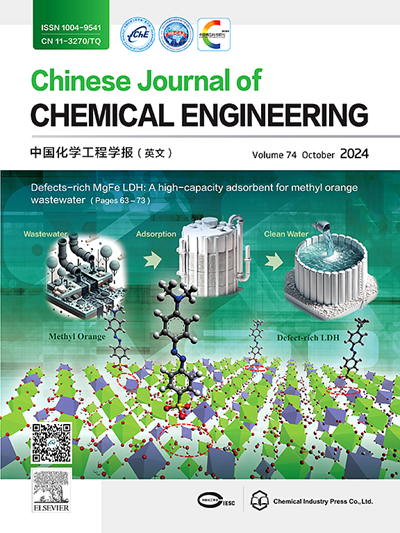
Chinese Journal of Chemical Engineering
工程技术-工程:化工
CiteScore
6.60
自引率
5.30%
发文量
4309
审稿时长
31 days
期刊介绍:
The Chinese Journal of Chemical Engineering (Monthly, started in 1982) is the official journal of the Chemical Industry and Engineering Society of China and published by the Chemical Industry Press Co. Ltd. The aim of the journal is to develop the international exchange of scientific and technical information in the field of chemical engineering. It publishes original research papers that cover the major advancements and achievements in chemical engineering in China as well as some articles from overseas contributors.
The topics of journal include chemical engineering, chemical technology, biochemical engineering, energy and environmental engineering and other relevant fields. Papers are published on the basis of their relevance to theoretical research, practical application or potential uses in the industry as Research Papers, Communications, Reviews and Perspectives. Prominent domestic and overseas chemical experts and scholars have been invited to form an International Advisory Board and the Editorial Committee. It enjoys recognition among Chinese academia and industry as a reliable source of information of what is going on in chemical engineering research, both domestic and abroad.
 求助内容:
 应助结果提醒方式:


 京公网安备 11010802042870号


