
Synergistic energy absorption in hybrid auxetic sandwich panels: A parametric study of combined positive–negative poisson's ratio cores fabricated via fused deposition modeling
IF 3.1
Q2 MATERIALS SCIENCE, MULTIDISCIPLINARY
引用次数: 0
Abstract
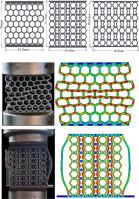
This study investigates the design, fabrication, and quasi-static compressive behavior of corrugated sandwich panels with auxetic cores manufactured via fused deposition modeling (FDM) using polylactic acid (PLA). Three core topologies, hexagonal honeycomb (positive Poisson's ratio), re-entrant (negative Poisson's ratio), and hybrid (combining both) were systematically evaluated for energy absorption capacity while maintaining a constant relative density. The hybrid core demonstrated superior performance. When tested as a corrugated sandwich panel (core + corrugated skins), the hybrid configuration achieved a specific energy absorption (SEA) of 7.49 J/g, which exceeded that of the honeycomb sandwich panel (4.82 J/g) and re-entrant sandwich panel (5.35 J/g) by 55% and 40%, respectively. These values refer to the full sandwich panel; the core-only SEA values were lower (1.89–4.70 J/g), as the skins and corrugation geometry contribute additional structural stability and energy dissipation. Taguchi optimization identified the optimal FDM printing parameters as a raster angle, a printing speed of 4000 mm/min, and a layer thickness of 0.2 mm to maximize ultimate tensile strength (UTS) and energy absorption per unit volume (EA) in the printed PLA material. Finite element simulations showed strong agreement with experimental results, with force-displacement curve deviations below 10% for the hybrid core, accurately predicting deformation modes and progressive collapse behavior. The unique deformation mechanism of the hybrid core combining progressive collapse from honeycomb regions and inward buckling from re-entrant regions enhances energy dissipation while maintaining structural stability, making it a promising candidate for lightweight quasi-static energy absorption applications.
混合动力夹层板的协同能量吸收:熔融沉积模型制备正负泊松比组合芯的参数化研究
本研究探讨了用聚乳酸(PLA)熔融沉积建模(FDM)制造的带辅助芯的波纹夹层板的设计、制造和准静态压缩性能。在保持恒定相对密度的情况下,系统地评估了三种核心拓扑结构,六边形蜂窝(正泊松比)、重入式(负泊松比)和混合型(两者结合)的能量吸收能力。混合芯表现出优异的性能。当作为波纹夹层板(芯+波纹表皮)进行测试时,混合结构的比能吸收(SEA)为7.49 J/g,分别比蜂窝夹层板(4.82 J/g)和返回式夹层板(5.35 J/g)高出55%和40%。这些值指的是整个夹芯板;仅核心的SEA值较低(1.89-4.70 J/g),因为表皮和波纹几何形状有助于额外的结构稳定性和能量耗散。田口优化确定了FDM打印的最佳参数为±45°光栅角、打印速度为4000 mm/min、层厚为0.2 mm,以最大限度地提高打印PLA材料的极限拉伸强度(UTS)和单位体积能量吸收(EA)。有限元模拟结果与试验结果吻合较好,混合岩心的力-位移曲线偏差小于10%,能够准确预测变形模式和渐进破坏行为。混合芯的独特变形机制结合了蜂窝区域的渐进式坍塌和再入区域的向内屈曲,在保持结构稳定性的同时增强了能量耗散,使其成为轻量级准静态吸能应用的有希望的候选材料。
本文章由计算机程序翻译,如有差异,请以英文原文为准。
求助全文
约1分钟内获得全文
求助全文
来源期刊
Materialia
MATERIALS SCIENCE, MULTIDISCIPLINARY-
CiteScore
6.40
自引率
2.90%
发文量
345
审稿时长
36 days
期刊介绍:
Materialia is a multidisciplinary journal of materials science and engineering that publishes original peer-reviewed research articles. Articles in Materialia advance the understanding of the relationship between processing, structure, property, and function of materials.
Materialia publishes full-length research articles, review articles, and letters (short communications). In addition to receiving direct submissions, Materialia also accepts transfers from Acta Materialia, Inc. partner journals. Materialia offers authors the choice to publish on an open access model (with author fee), or on a subscription model (with no author fee).
 求助内容:
求助内容: 应助结果提醒方式:

 京公网安备 11010802042870号


