
New insights on the metastable cubic GexSbyTez phase
IF 3.1
Q2 MATERIALS SCIENCE, MULTIDISCIPLINARY
引用次数: 0
Abstract
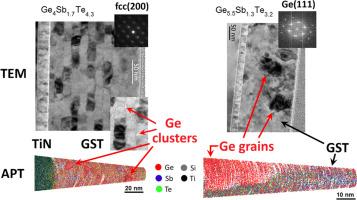
Ge-rich Ge-Sb-Te (GGST) alloys are of high interest for industrial production of complementary metal-oxide-semiconductor integrated phase change random access memories (PCRAM) of high performance. BEOL-integrated GGST-based PCRAM constitute a relevant solution for low-power on-chip non-volatile memory production and in-memory computing, addressing new challenges of automotive and artificial intelligence applications for example. During cycling, in the low-resistive SET state, the crystallized GGST alloy is mainly made of nano-grains of two phases: diamond Ge and a ternary rock-salt (RS) Ge-Sb-Te (GST) phase. The RS-GST phase is metastable and generally assumed to exhibit the stoichiometry Ge2Sb2Te5 corresponding to the stable hexagonal Ge2Sb2Te5 compound. However, recent works suggest that this metastable RS-GST phase is not stoichiometric and can accept higher Ge contents, meaning that the Ge content of RS-GST could vary depending on the Ge excess level in the GGST alloy compared to the Ge2Sb2Te5 reference stoichiometry. Consequently, the performance of GGST-based PCRAMs could vary with Ge composition of GGST alloy, suggesting the existence of an ideal GGST alloy composition showing a good compromise between crystallization temperature, programming current density, resistance, threshold voltage drift… In the present work, the structure and composition of crystallized GGST films elaborated through Ge, Sb, and Te co-sputtering were studied by X-ray diffraction, high resolution transmission electron microscopy, and atom probe tomography. The metastable RS-GST phase crystallized in GGST films exhibiting a Ge excess between 23% and 42% is found to be able to incorporate a large amount of Ge, of about 50 at% and sometimes beyond.
亚稳立方GexSbyTez相的新认识
富锗锗sb - te (GGST)合金是工业生产高性能互补金属氧化物半导体集成相变随机存取存储器(PCRAM)的重要材料。beol集成的基于ggst的PCRAM构成了低功耗片上非易失性存储器生产和内存计算的相关解决方案,解决了汽车和人工智能应用的新挑战。循环过程中,在低阻SET状态下,结晶的GGST合金主要由金刚石Ge和三元岩盐(RS) Ge- sb - te (GST)两相纳米晶粒组成。RS-GST相是亚稳的,通常被认为具有Ge2Sb2Te5的化学计量,对应于稳定的六方Ge2Sb2Te5化合物。然而,最近的研究表明,这种亚稳的RS-GST相不是化学计量的,可以接受更高的Ge含量,这意味着RS-GST的Ge含量可以根据GGST合金中与Ge2Sb2Te5参考化学计量的Ge过剩水平而变化。因此,基于GGST的PCRAMs的性能会随着GGST合金的Ge成分而变化,这表明存在一种理想的GGST合金成分,该成分在结晶温度、编程电流密度、电阻和阈值电压漂移之间有很好的平衡。原子探针断层扫描。在GGST薄膜中结晶的亚稳RS-GST相显示出23%至42%的Ge过剩,可以吸收大量的Ge,约为50%,有时甚至超过50%。
本文章由计算机程序翻译,如有差异,请以英文原文为准。
求助全文
约1分钟内获得全文
求助全文
来源期刊
Materialia
MATERIALS SCIENCE, MULTIDISCIPLINARY-
CiteScore
6.40
自引率
2.90%
发文量
345
审稿时长
36 days
期刊介绍:
Materialia is a multidisciplinary journal of materials science and engineering that publishes original peer-reviewed research articles. Articles in Materialia advance the understanding of the relationship between processing, structure, property, and function of materials.
Materialia publishes full-length research articles, review articles, and letters (short communications). In addition to receiving direct submissions, Materialia also accepts transfers from Acta Materialia, Inc. partner journals. Materialia offers authors the choice to publish on an open access model (with author fee), or on a subscription model (with no author fee).
 求助内容:
求助内容: 应助结果提醒方式:

 京公网安备 11010802042870号


