
A Novel Method With Encoder-Decoder for Cross-Sensor Adaptation in Surface Shape Sensing With Sparse Strain Sensors

IF 5.3 2区 计算机科学 Q2 ROBOTICS
IEEE Robotics and Automation Letters Pub Date : 2026-07-01 Epub Date: 2026-06-01 DOI:10.1109/LRA.2026.3699130
Shuo Wang;Heng Luo;Dian Jin;Xiaoming Tao
{"title":"A Novel Method With Encoder-Decoder for Cross-Sensor Adaptation in Surface Shape Sensing With Sparse Strain Sensors","authors":"Shuo Wang;Heng Luo;Dian Jin;Xiaoming Tao","doi":"10.1109/LRA.2026.3699130","DOIUrl":null,"url":null,"abstract":"Performance variations in sensor arrays, caused by intrinsic differences or installation conditions, can lead to inconsistent results during shape sensing. To obtain accurate results, a large amount of data is usually required, and a separate model must be retrained for each sensor array, thereby increasing the cost and time of data acquisition, transmission, and computation. To address this issue, this work proposes an encoder-decoder architecture for surface shape sensing based on sparse strain sensors and further incorporates meta-learning and few-shot adaptation strategies to enable adaptation across different groups of sensor arrays. Experimental results demonstrate that, after the cross-sensor adaptation, a newly deployed sensor array achieves a sensing error of approximately 4.0 mm relying on less than 5.0% newly labeled data and requiring an adaptation time of under 1 s, which represents a substantial improvement from 23.0 mm error without adaptation and 20-minute data collection time required to train a new model. Moreover, the number of points with errors below 5.0 mm increased by more than 65.0%. These results indicate that the proposed method can substantially reduce the cost and training burden of surface shape sensing, and it has broad potential applications in soft robotics and wearable devices.","PeriodicalId":13241,"journal":{"name":"IEEE Robotics and Automation Letters","volume":"11 7","pages":"8600-8607"},"PeriodicalIF":5.3000,"publicationDate":"2026-07-01","publicationTypes":"Journal Article","fieldsOfStudy":null,"isOpenAccess":false,"openAccessPdf":"","citationCount":"0","resultStr":null,"platform":"Semanticscholar","paperid":null,"PeriodicalName":"IEEE Robotics and Automation Letters","FirstCategoryId":"94","ListUrlMain":"https://ieeexplore.ieee.org/document/11543208/","RegionNum":2,"RegionCategory":"计算机科学","ArticlePicture":[],"TitleCN":null,"AbstractTextCN":null,"PMCID":null,"EPubDate":"2026/6/1 0:00:00","PubModel":"Epub","JCR":"Q2","JCRName":"ROBOTICS","Score":null,"Total":0}
引用次数: 0

Abstract

Performance variations in sensor arrays, caused by intrinsic differences or installation conditions, can lead to inconsistent results during shape sensing. To obtain accurate results, a large amount of data is usually required, and a separate model must be retrained for each sensor array, thereby increasing the cost and time of data acquisition, transmission, and computation. To address this issue, this work proposes an encoder-decoder architecture for surface shape sensing based on sparse strain sensors and further incorporates meta-learning and few-shot adaptation strategies to enable adaptation across different groups of sensor arrays. Experimental results demonstrate that, after the cross-sensor adaptation, a newly deployed sensor array achieves a sensing error of approximately 4.0 mm relying on less than 5.0% newly labeled data and requiring an adaptation time of under 1 s, which represents a substantial improvement from 23.0 mm error without adaptation and 20-minute data collection time required to train a new model. Moreover, the number of points with errors below 5.0 mm increased by more than 65.0%. These results indicate that the proposed method can substantially reduce the cost and training burden of surface shape sensing, and it has broad potential applications in soft robotics and wearable devices.
一种基于编码器-解码器的稀疏应变传感器表面形状感知跨传感器自适应方法
传感器阵列的性能变化,由于固有的差异或安装条件,可能导致不一致的结果在形状传感。为了获得准确的结果,通常需要大量的数据,并且必须为每个传感器阵列重新训练一个单独的模型,从而增加了数据采集、传输和计算的成本和时间。为了解决这个问题,本研究提出了一种基于稀疏应变传感器的表面形状传感的编码器-解码器架构,并进一步结合元学习和少镜头自适应策略,以实现跨不同组传感器阵列的自适应。实验结果表明,经过跨传感器自适应后,新部署的传感器阵列依靠不到5.0%的新标记数据实现了约4.0 mm的传感误差,并且需要不到1 s的自适应时间,这与未自适应的23.0 mm误差和训练新模型所需的20分钟的数据收集时间相比有了很大的改善。误差小于5.0 mm的点数增加了65.0%以上。研究结果表明,该方法可以大大降低曲面形状感知的成本和训练负担,在软机器人和可穿戴设备中具有广泛的应用前景。
本文章由计算机程序翻译,如有差异,请以英文原文为准。
求助全文
约1分钟内获得全文 求助全文
来源期刊
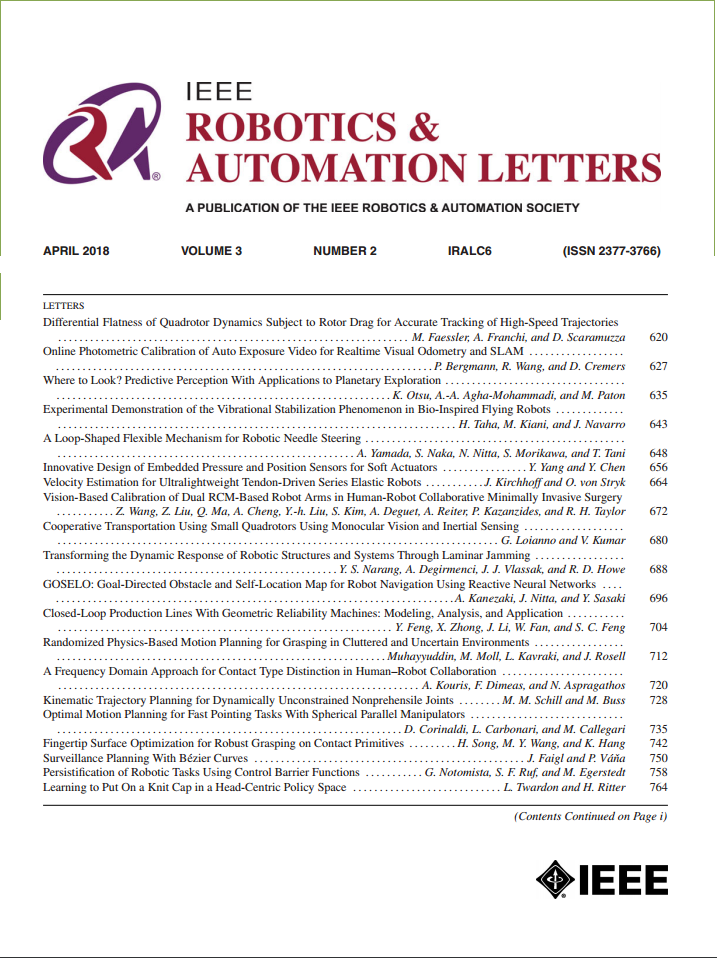
IEEE Robotics and Automation Letters
IEEE Robotics and Automation Letters Computer Science-Computer Science Applications
CiteScore
9.60
自引率
15.40%
发文量
1428
期刊介绍: The scope of this journal is to publish peer-reviewed articles that provide a timely and concise account of innovative research ideas and application results, reporting significant theoretical findings and application case studies in areas of robotics and automation.

×
引用
GB/T 7714-2015
复制
MLA
复制
APA
复制
导出至
BibTeX EndNote RefMan NoteFirst NoteExpress
×
提示
您的信息不完整,为了账户安全,请先补充。
现在去补充
×
提示
您因"违规操作"
具体请查看互助需知
我知道了
×
提示
确定
请完成安全验证×
copy
已复制链接
快去分享给好友吧!
我知道了
右上角分享
点击右上角分享
0
联系我们:info@booksci.cn Book学术提供免费学术资源搜索服务,方便国内外学者检索中英文文献。致力于提供最便捷和优质的服务体验。 Copyright © 2023 布克学术 All rights reserved.
京ICP备2023020795号-1
ghs 京公网安备 11010802042870号
Book学术文献互助
Book学术文献互助群
群 号:604180095
Book学术官方微信
小红书


