
From curing pathways to divergent properties in phenylethynyl-terminated polyimides: a multiscale DFT/MD study of network structure–property relationships

IF 3.9 2区 化学 Q2 POLYMER SCIENCE
Baiyu Li,Rong Ren,Jing Wang,Xuhai Xiong
{"title":"From curing pathways to divergent properties in phenylethynyl-terminated polyimides: a multiscale DFT/MD study of network structure–property relationships","authors":"Baiyu Li,Rong Ren,Jing Wang,Xuhai Xiong","doi":"10.1039/d6py00328a","DOIUrl":null,"url":null,"abstract":"The properties of phenylethynyl-terminated polyimide resins, which are critical high-performance matrices for aerospace composites, are fundamentally determined by their cured network structure. Clarifying this relationship has been challenging due to the complexity of the curing process, which involves multiple competing reaction pathways. This work employed a combined computational approach—utilising density functional theory and all-atom molecular dynamics simulations—to systematically investigate how different curing pathways influence the resulting microstructure and properties. The simulations suggest that diradical-initiated polymerization and cyclotrimerization are plausible and likely important among the pathways considered, whereas monoradical-initiated polymerization and the dehydro-Diels–Alder reaction appear less favorable under the studied DFT conditions. Networks formed via the diradical-initiated pathway endow the model with a high glass transition temperature, and high Young's and shear moduli. In contrast, structures produced by the cyclotrimerization pathway confer a high coefficient of thermal expansion. The distinct thermal and mechanical properties arising from the two curing pathways were elucidated by analysing chain flexibility, free volume, and radius of gyration. By comparing these two idealised, pure-pathway network archetypes, this work suggests a link between curing pathways, microstructure, and macroscopic performance. Although real curing involves mixed pathways, these limiting cases provide a rational, principle-guided framework for designing high-performance phenylethynyl-terminated polyimide resins.","PeriodicalId":100,"journal":{"name":"Polymer Chemistry","volume":"31 1","pages":""},"PeriodicalIF":3.9000,"publicationDate":"2026-07-28","publicationTypes":"Journal Article","fieldsOfStudy":null,"isOpenAccess":false,"openAccessPdf":"","citationCount":"0","resultStr":null,"platform":"Semanticscholar","paperid":null,"PeriodicalName":"Polymer Chemistry","FirstCategoryId":"92","ListUrlMain":"https://doi.org/10.1039/d6py00328a","RegionNum":2,"RegionCategory":"化学","ArticlePicture":[],"TitleCN":null,"AbstractTextCN":null,"PMCID":null,"EPubDate":"","PubModel":"","JCR":"Q2","JCRName":"POLYMER SCIENCE","Score":null,"Total":0}
引用次数: 0

Abstract

The properties of phenylethynyl-terminated polyimide resins, which are critical high-performance matrices for aerospace composites, are fundamentally determined by their cured network structure. Clarifying this relationship has been challenging due to the complexity of the curing process, which involves multiple competing reaction pathways. This work employed a combined computational approach—utilising density functional theory and all-atom molecular dynamics simulations—to systematically investigate how different curing pathways influence the resulting microstructure and properties. The simulations suggest that diradical-initiated polymerization and cyclotrimerization are plausible and likely important among the pathways considered, whereas monoradical-initiated polymerization and the dehydro-Diels–Alder reaction appear less favorable under the studied DFT conditions. Networks formed via the diradical-initiated pathway endow the model with a high glass transition temperature, and high Young's and shear moduli. In contrast, structures produced by the cyclotrimerization pathway confer a high coefficient of thermal expansion. The distinct thermal and mechanical properties arising from the two curing pathways were elucidated by analysing chain flexibility, free volume, and radius of gyration. By comparing these two idealised, pure-pathway network archetypes, this work suggests a link between curing pathways, microstructure, and macroscopic performance. Although real curing involves mixed pathways, these limiting cases provide a rational, principle-guided framework for designing high-performance phenylethynyl-terminated polyimide resins.

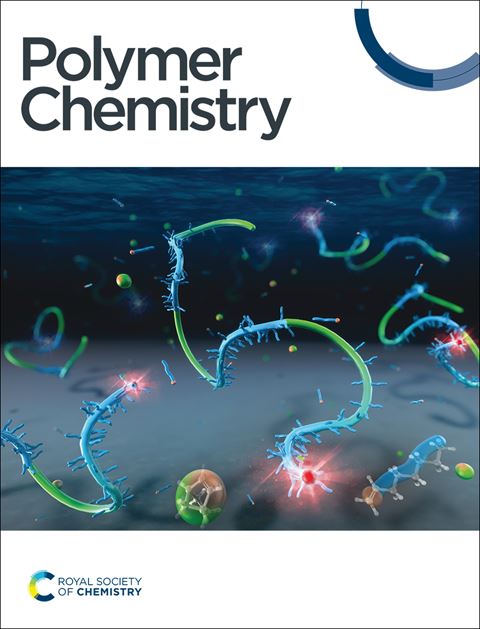
Abstract Image

从固化途径到苯乙基端端聚酰亚胺的不同性质:网络结构-性质关系的多尺度DFT/MD研究
苯基乙基端端聚酰亚胺树脂是航空航天复合材料的关键高性能基体,其性能从根本上取决于其固化的网络结构。由于固化过程的复杂性,其中涉及多个相互竞争的反应途径,阐明这种关系一直具有挑战性。这项工作采用了一种结合计算方法-利用密度泛函理论和全原子分子动力学模拟-系统地研究不同的固化途径如何影响所得的微观结构和性能。模拟表明,在考虑的途径中,双自由基引发的聚合和环三聚化是合理的,并且可能是重要的,而在研究的DFT条件下,单自由基引发的聚合和脱氢- diols - alder反应似乎不太有利。通过双自由基起始途径形成的网络使模型具有较高的玻璃化转变温度、较高的杨氏模量和剪切模量。相反,由环三聚化途径产生的结构具有很高的热膨胀系数。通过分析链的柔韧性、自由体积和旋转半径,阐明了两种固化途径所产生的不同的热性能和力学性能。通过比较这两种理想化的纯通路网络原型,这项工作表明了固化途径、微观结构和宏观性能之间的联系。虽然实际的固化涉及混合途径,但这些限制案例为设计高性能的苯基乙基端端聚酰亚胺树脂提供了合理的、原则指导的框架。
本文章由计算机程序翻译,如有差异,请以英文原文为准。
求助全文
约1分钟内获得全文 求助全文
来源期刊
Polymer Chemistry
Polymer Chemistry POLYMER SCIENCE-
CiteScore
8.60
自引率
8.70%
发文量
535
审稿时长
1.7 months
期刊介绍: Polymer Chemistry welcomes submissions in all areas of polymer science that have a strong focus on macromolecular chemistry. Manuscripts may cover a broad range of fields, yet no direct application focus is required.

×
引用
GB/T 7714-2015
复制
MLA
复制
APA
复制
导出至
BibTeX EndNote RefMan NoteFirst NoteExpress
×
提示
您的信息不完整,为了账户安全,请先补充。
现在去补充
×
提示
您因"违规操作"
具体请查看互助需知
我知道了
×
提示
确定
请完成安全验证×
copy
已复制链接
快去分享给好友吧!
我知道了
右上角分享
点击右上角分享
0
联系我们:info@booksci.cn Book学术提供免费学术资源搜索服务,方便国内外学者检索中英文文献。致力于提供最便捷和优质的服务体验。 Copyright © 2023 布克学术 All rights reserved.
京ICP备2023020795号-1
ghs 京公网安备 11010802042870号
Book学术文献互助
Book学术文献互助群
群 号:604180095
Book学术官方微信
小红书


