
TIE1 acts as a maternal brake on fertilization-independent endosperm development by associating with PRC2 to enforce imprinting

IF 15 1区 生物学 Q1 PLANT SCIENCES
Zeliang Zhang  (, ), Xinxue Wang  (, ), Rongrong Yuan  (, ), Yiyi Li  (, ), Yige Pan  (, ), Qing He  (, ), Xuemei Chen  (, ), Genji Qin  (, )
{"title":"TIE1 acts as a maternal brake on fertilization-independent endosperm development by associating with PRC2 to enforce imprinting","authors":"Zeliang Zhang \n (, ), Xinxue Wang \n (, ), Rongrong Yuan \n (, ), Yiyi Li \n (, ), Yige Pan \n (, ), Qing He \n (, ), Xuemei Chen \n (, ), Genji Qin \n (, )","doi":"10.1038/s41477-026-02344-2","DOIUrl":null,"url":null,"abstract":"Fully autonomous apomixis with fertilization-independent embryo and endosperm development enables the production of clonal seeds to fix crop hybrid vigour. However, the mechanisms underlying autonomous endosperm development remain unclear. Here we show that TIE1 acts as a maternally expressed transcriptional repressor inhibiting autonomous endosperm. The disruption of four TIEs in tie1 tie2 tie3 tie4 (tieQ) mutants triggers the development of autonomous endosperm, recapitulating the phenotypes observed in fertilization-independent seeds (fis)-class mutants. TIE1 exhibits maternal genomic imprinting similar to MEDEA (MEA) that encodes a core component of the FIS–POLYCOMB REPRESSIVE COMPLEX 2 (PRC2). TIE1 recruits FIS–PRC2 to transcriptionally silence a subset of its target genes whose activation would otherwise trigger endosperm development in the absence of fertilization. Our findings reveal a maternally controlled brake mechanism that prevents autonomous endosperm development, providing both a molecular framework for understanding apomictic seed formation and a possible tool for engineering synthetic apomixis to fix heterosis in crops. Plants that form seeds without fertilization could fix hybrid vigour. This study determines that the maternal protein TIE1 serves as a brake to prevent autonomous seed development without fertilization.","PeriodicalId":18904,"journal":{"name":"Nature Plants","volume":"12 8","pages":"1485-1497"},"PeriodicalIF":15.0000,"publicationDate":"2026-07-28","publicationTypes":"Journal Article","fieldsOfStudy":null,"isOpenAccess":false,"openAccessPdf":"","citationCount":"0","resultStr":null,"platform":"Semanticscholar","paperid":null,"PeriodicalName":"Nature Plants","FirstCategoryId":"99","ListUrlMain":"https://www.nature.com/articles/s41477-026-02344-2","RegionNum":1,"RegionCategory":"生物学","ArticlePicture":[],"TitleCN":null,"AbstractTextCN":null,"PMCID":null,"EPubDate":"","PubModel":"","JCR":"Q1","JCRName":"PLANT SCIENCES","Score":null,"Total":0}
引用次数: 0

Abstract

Fully autonomous apomixis with fertilization-independent embryo and endosperm development enables the production of clonal seeds to fix crop hybrid vigour. However, the mechanisms underlying autonomous endosperm development remain unclear. Here we show that TIE1 acts as a maternally expressed transcriptional repressor inhibiting autonomous endosperm. The disruption of four TIEs in tie1 tie2 tie3 tie4 (tieQ) mutants triggers the development of autonomous endosperm, recapitulating the phenotypes observed in fertilization-independent seeds (fis)-class mutants. TIE1 exhibits maternal genomic imprinting similar to MEDEA (MEA) that encodes a core component of the FIS–POLYCOMB REPRESSIVE COMPLEX 2 (PRC2). TIE1 recruits FIS–PRC2 to transcriptionally silence a subset of its target genes whose activation would otherwise trigger endosperm development in the absence of fertilization. Our findings reveal a maternally controlled brake mechanism that prevents autonomous endosperm development, providing both a molecular framework for understanding apomictic seed formation and a possible tool for engineering synthetic apomixis to fix heterosis in crops. Plants that form seeds without fertilization could fix hybrid vigour. This study determines that the maternal protein TIE1 serves as a brake to prevent autonomous seed development without fertilization.

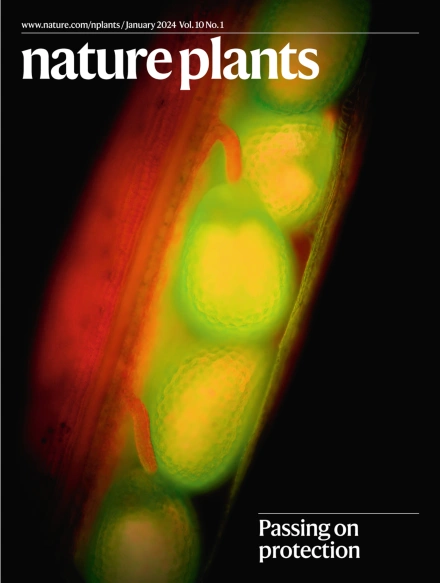
Abstract Image

TIE1通过与PRC2相关联来加强印迹,从而在不受受精影响的胚乳发育中起着母体制动的作用。
完全自主无融合与受精独立的胚胎和胚乳发育使无性系种子的生产能够固定作物杂交活力。然而,自主胚乳发育的机制尚不清楚。在这里,我们发现TIE1作为一种母系表达的转录抑制因子抑制自主胚乳。tieQ突变体中四个tie的破坏触发了自主胚乳的发育,再现了在受精不依赖种子(fis)类突变体中观察到的表型。TIE1表现出与MEDEA (MEA)相似的母体基因组印记,MEDEA (MEA)编码FIS-POLYCOMB抑制复合体2 (PRC2)的核心成分。TIE1招募FIS-PRC2在转录上沉默其靶基因子集,否则这些基因的激活将在没有受精的情况下触发胚乳发育。我们的研究结果揭示了一种母体控制的阻止胚乳自主发育的机制,为理解无融合种子形成提供了分子框架,并为工程合成无融合来固定作物的杂种优势提供了可能的工具。
本文章由计算机程序翻译,如有差异,请以英文原文为准。
求助全文
约1分钟内获得全文 求助全文
来源期刊
Nature Plants
Nature Plants PLANT SCIENCES-
CiteScore
25.30
自引率
2.20%
发文量
196
期刊介绍: Nature Plants is an online-only, monthly journal publishing the best research on plants — from their evolution, development, metabolism and environmental interactions to their societal significance.

×
引用
GB/T 7714-2015
复制
MLA
复制
APA
复制
导出至
BibTeX EndNote RefMan NoteFirst NoteExpress
×
提示
您的信息不完整,为了账户安全,请先补充。
现在去补充
×
提示
您因"违规操作"
具体请查看互助需知
我知道了
×
提示
确定
请完成安全验证×
copy
已复制链接
快去分享给好友吧!
我知道了
右上角分享
点击右上角分享
0
联系我们:info@booksci.cn Book学术提供免费学术资源搜索服务,方便国内外学者检索中英文文献。致力于提供最便捷和优质的服务体验。 Copyright © 2023 布克学术 All rights reserved.
京ICP备2023020795号-1
ghs 京公网安备 11010802042870号
Book学术文献互助
Book学术文献互助群
群 号:604180095
Book学术官方微信
小红书


