Nan Zhang, Zhiyuan Zhang, Jing Yu, Yu Fu, Jiameng Gao, Xuemei Jiang, Yang Jin, Chang Chen, Zongmei Wen
{"title":"IRF1-mediated sensing of oxidized mitochondrial DNA drives macrophage PANoptosis in lung ischemia–reperfusion injury","authors":"Nan Zhang, Zhiyuan Zhang, Jing Yu, Yu Fu, Jiameng Gao, Xuemei Jiang, Yang Jin, Chang Chen, Zongmei Wen","doi":"10.1007/s10495-026-02401-3","DOIUrl":null,"url":null,"abstract":"<div><p>Lung ischemia–reperfusion injury (IRI), a significant factor contributing to early mortality following lung transplantation (LTx), is driven by molecular mechanisms that are not yet fully understood. In this study, we elucidate a crucial signaling pathway initiated by extracellular histones (ex-His), which connects mitochondrial damage to inflammatory cell death. Through the use of a murine model of lung IRI and <i>in vitro</i> experiments with alveolar macrophages, we demonstrate that ex-His facilitate Drp1-dependent mitochondrial fission, resulting in the release of oxidized mitochondrial DNA (ox-mtDNA) into the cytosol. Our mechanistic analysis reveals that cytosolic ox-mtDNA is detected by the transcription factor IRF1, which subsequently upregulates NLRC5 at the transcriptional level. Additionally, we identify NLRC5 as a non-canonical scaffold that is essential for the assembly of the PANoptosome, a multi-protein complex that mediates PANoptosis, an inflammatory cell death pathway that aggravates tissue damage. The clinical relevance of this pathway was then examined in lung transplant recipients. An analysis of their peripheral blood mononuclear cells (PBMCs) revealed that patients who developed primary graft dysfunction (PGD) exhibited markedly elevated levels of circulating histones and cytosolic ox-mtDNA. This was associated with hyperactivation of the core signaling axis, characterized by increased Drp1 phosphorylation and elevated expression of IRF1 and NLRC5. Collectively, our study elucidates a comprehensive pathogenic cascade from an extracellular danger signal to a specific cell death program, identifying the ex-His-mitochondria-IRF1-NLRC5 axis as a critical driver of macrophage PANoptosis and a promising therapeutic target for alleviating lung IRI.</p></div>","PeriodicalId":8062,"journal":{"name":"Apoptosis","volume":"31 8","pages":""},"PeriodicalIF":9.0000,"publicationDate":"2026-07-25","publicationTypes":"Journal Article","fieldsOfStudy":null,"isOpenAccess":false,"openAccessPdf":"https://www.ncbi.nlm.nih.gov/pmc/articles/PMC13401555/pdf/","citationCount":"0","resultStr":null,"platform":"Semanticscholar","paperid":null,"PeriodicalName":"Apoptosis","FirstCategoryId":"99","ListUrlMain":"https://link.springer.com/article/10.1007/s10495-026-02401-3","RegionNum":2,"RegionCategory":"生物学","ArticlePicture":[],"TitleCN":null,"AbstractTextCN":null,"PMCID":null,"EPubDate":"","PubModel":"","JCR":"Q1","JCRName":"BIOCHEMISTRY & MOLECULAR BIOLOGY","Score":null,"Total":0}
引用次数: 0
Abstract
Lung ischemia–reperfusion injury (IRI), a significant factor contributing to early mortality following lung transplantation (LTx), is driven by molecular mechanisms that are not yet fully understood. In this study, we elucidate a crucial signaling pathway initiated by extracellular histones (ex-His), which connects mitochondrial damage to inflammatory cell death. Through the use of a murine model of lung IRI and in vitro experiments with alveolar macrophages, we demonstrate that ex-His facilitate Drp1-dependent mitochondrial fission, resulting in the release of oxidized mitochondrial DNA (ox-mtDNA) into the cytosol. Our mechanistic analysis reveals that cytosolic ox-mtDNA is detected by the transcription factor IRF1, which subsequently upregulates NLRC5 at the transcriptional level. Additionally, we identify NLRC5 as a non-canonical scaffold that is essential for the assembly of the PANoptosome, a multi-protein complex that mediates PANoptosis, an inflammatory cell death pathway that aggravates tissue damage. The clinical relevance of this pathway was then examined in lung transplant recipients. An analysis of their peripheral blood mononuclear cells (PBMCs) revealed that patients who developed primary graft dysfunction (PGD) exhibited markedly elevated levels of circulating histones and cytosolic ox-mtDNA. This was associated with hyperactivation of the core signaling axis, characterized by increased Drp1 phosphorylation and elevated expression of IRF1 and NLRC5. Collectively, our study elucidates a comprehensive pathogenic cascade from an extracellular danger signal to a specific cell death program, identifying the ex-His-mitochondria-IRF1-NLRC5 axis as a critical driver of macrophage PANoptosis and a promising therapeutic target for alleviating lung IRI.
期刊介绍:
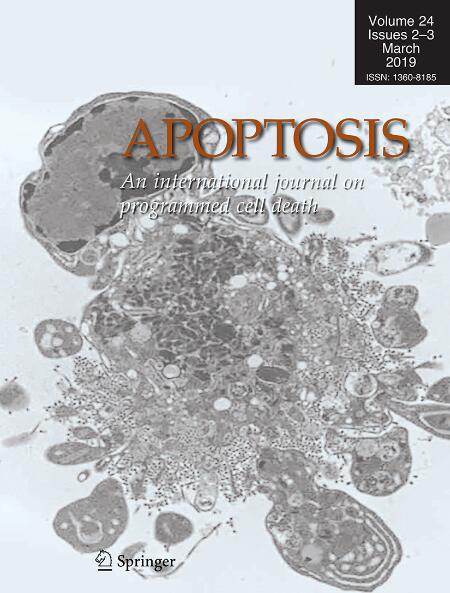
Apoptosis, a monthly international peer-reviewed journal, focuses on the rapid publication of innovative investigations into programmed cell death. The journal aims to stimulate research on the mechanisms and role of apoptosis in various human diseases, such as cancer, autoimmune disease, viral infection, AIDS, cardiovascular disease, neurodegenerative disorders, osteoporosis, and aging. The Editor-In-Chief acknowledges the importance of advancing clinical therapies for apoptosis-related diseases. Apoptosis considers Original Articles, Reviews, Short Communications, Letters to the Editor, and Book Reviews for publication.

 求助内容:
 应助结果提醒方式:


 京公网安备 11010802042870号


