{"title":"Self-assembly of DOPA-containing peptides for enhanced antimicrobial efficacy and promoted wound healing.","authors":"Xiang Zhou, Xinyao Wang, Haozhan Wang, Cong Zhang, Farong Ye, Chanjuan Liu, Deyue Yan, Ping Wang, Ping Huang","doi":"10.1039/d6bm00836d","DOIUrl":null,"url":null,"abstract":"<p><p>Bacterial infection and excessive reactive oxygen species (ROS) accumulation synergistically disrupt the wound microenvironment and severely impair the healing process. Therefore, multifunctional biomaterials with intrinsic antibacterial and antioxidant properties are highly desirable for the effective treatment of infected wounds. Here, we rationally designed and synthesized two DOPA-containing constitutional isomeric peptides with dual antimicrobial and antioxidant activities, each containing one 3,4-dihydroxy-L-phenylalanine (DOPA), four tryptophan residues (W), and three arginine residues (R), and designated as WRWRWRW(DOPA) and WWWWRRR(DOPA), respectively. These peptides can self-assemble in aqueous solutions into different morphologies, with WRWRWRW(DOPA) forming vesicles, whereas WWWWRRR(DOPA) assembles into micelles. Notably, both self-assembled nanostructures exhibited enhanced antibacterial activity compared with their corresponding peptide precursors, and the vesicular assemblies showed superior antimicrobial efficacy relative to their micellar counterparts. Based on these findings, the vesicle-forming peptide system was further investigated for ROS-scavenging capability and wound healing performance. The results demonstrated that the vesicular assemblies possessed efficient ROS elimination capacity and significantly promoted infected wound repair. Overall, this work highlights the critical role played by the morphology of self-assembled nanostructures in regulating antimicrobial and antioxidant performance, providing a promising strategy for the design of multifunctional peptide-based systems for infected wound therapy.</p>","PeriodicalId":65,"journal":{"name":"Biomaterials Science","volume":" ","pages":"4665-4675"},"PeriodicalIF":6.1000,"publicationDate":"2026-08-25","publicationTypes":"Journal Article","fieldsOfStudy":null,"isOpenAccess":false,"openAccessPdf":"","citationCount":"0","resultStr":null,"platform":"Semanticscholar","paperid":null,"PeriodicalName":"Biomaterials Science","FirstCategoryId":"5","ListUrlMain":"https://doi.org/10.1039/d6bm00836d","RegionNum":3,"RegionCategory":"医学","ArticlePicture":[],"TitleCN":null,"AbstractTextCN":null,"PMCID":null,"EPubDate":"","PubModel":"","JCR":"Q1","JCRName":"MATERIALS SCIENCE, BIOMATERIALS","Score":null,"Total":0}
引用次数: 0
Abstract
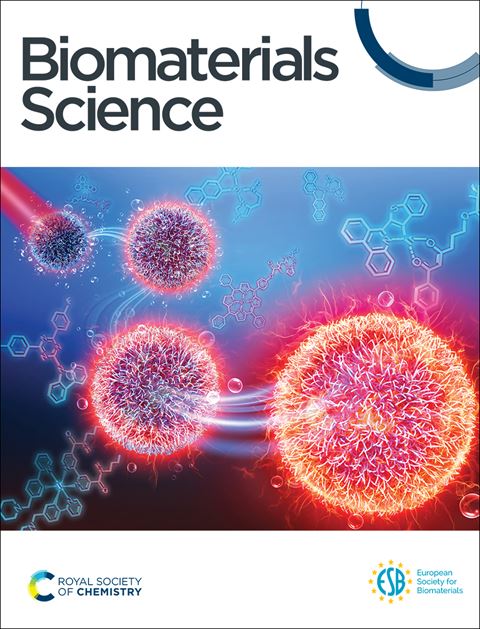
Bacterial infection and excessive reactive oxygen species (ROS) accumulation synergistically disrupt the wound microenvironment and severely impair the healing process. Therefore, multifunctional biomaterials with intrinsic antibacterial and antioxidant properties are highly desirable for the effective treatment of infected wounds. Here, we rationally designed and synthesized two DOPA-containing constitutional isomeric peptides with dual antimicrobial and antioxidant activities, each containing one 3,4-dihydroxy-L-phenylalanine (DOPA), four tryptophan residues (W), and three arginine residues (R), and designated as WRWRWRW(DOPA) and WWWWRRR(DOPA), respectively. These peptides can self-assemble in aqueous solutions into different morphologies, with WRWRWRW(DOPA) forming vesicles, whereas WWWWRRR(DOPA) assembles into micelles. Notably, both self-assembled nanostructures exhibited enhanced antibacterial activity compared with their corresponding peptide precursors, and the vesicular assemblies showed superior antimicrobial efficacy relative to their micellar counterparts. Based on these findings, the vesicle-forming peptide system was further investigated for ROS-scavenging capability and wound healing performance. The results demonstrated that the vesicular assemblies possessed efficient ROS elimination capacity and significantly promoted infected wound repair. Overall, this work highlights the critical role played by the morphology of self-assembled nanostructures in regulating antimicrobial and antioxidant performance, providing a promising strategy for the design of multifunctional peptide-based systems for infected wound therapy.
细菌感染和过多的活性氧(ROS)积累协同破坏伤口微环境,严重影响愈合过程。因此,具有抗菌和抗氧化特性的多功能生物材料是有效治疗感染伤口的迫切需要。本研究合理设计合成了两种具有抗菌和抗氧化双重活性的含DOPA的构状异构体肽,各含有1个3,4-二羟基- l -苯丙氨酸(DOPA)、4个色氨酸残基(W)和3个精氨酸残基(R),分别命名为WRWRWRW(DOPA)和WWWWRRR(DOPA)。这些肽可以在水溶液中自组装成不同的形态,其中WRWRWRW(DOPA)形成囊泡,而WWWWRRR(DOPA)组装成胶束。值得注意的是,与相应的肽前体相比,这两种自组装纳米结构都表现出更强的抗菌活性,而相对于胶束组装物,囊泡组装物表现出更好的抗菌功效。基于这些发现,我们进一步研究了囊泡形成肽系统的ros清除能力和伤口愈合性能。结果表明,这些囊泡组件具有有效的活性氧清除能力,并显著促进感染伤口的修复。总的来说,这项工作强调了自组装纳米结构的形态在调节抗菌和抗氧化性能方面所起的关键作用,为设计用于感染伤口治疗的多功能肽系统提供了一个有希望的策略。
期刊介绍:
Biomaterials Science is an international high impact journal exploring the science of biomaterials and their translation towards clinical use. Its scope encompasses new concepts in biomaterials design, studies into the interaction of biomaterials with the body, and the use of materials to answer fundamental biological questions.

 求助内容:
 应助结果提醒方式:


 京公网安备 11010802042870号


