
Limited direct fluid exchange between the deep subsurface ocean and the shallow subsurface environment of Europa
IF 15.2
1区 物理与天体物理
Q1 ASTRONOMY & ASTROPHYSICS
引用次数: 0
Abstract
Numerous icy moons, including Europa, possess subsurface oceans beneath their icy exteriors. Liquid water from Europa’s deep ocean has been proposed to rise through dykes and form shallow sills. Such reservoirs could create transient habitable environments and may be directly linked to the formation of various surface features on Europa. However, whether dykes can transport enough water from Europa’s deep ocean to form these shallow reservoirs remains poorly constrained. Here we couple high-resolution laminar and turbulent fluid–thermal simulations to test this mechanism. We first show that, even when we completely neglect convective heat losses, thus providing an upper-bound estimate, the volume of water capable of ascending through dykes before freezing is insufficient to account for the hypothesized surface features. We then show that turbulence notably strengthens this limitation by enhancing heat loss, driving rapid supercooling, promoting frazil ice formation and accelerating dyke clogging. Our results suggest that direct fluid exchange between Europa’s deep ocean and shallow subsurface is minimal and that in situ melting may be the primary source of any shallow liquid water, if present. Notably, this also implies that shallow liquid reservoirs, if encountered by future missions, may not truly reflect the geochemical signature of the underlying ocean.木卫二深层地下海洋与浅层地下环境之间的直接流体交换有限
许多冰冷的卫星,包括木卫二,在它们冰冷的外表下都有地下海洋。据推测,木卫二深海中的液态水会冲破堤坝,形成浅滩。这样的水库可以创造短暂的宜居环境,并可能与木卫二上各种表面特征的形成直接相关。然而,这些堤坝能否从木卫二的深海中输送足够的水来形成这些浅层水库,目前还没有得到充分的限制。在这里,我们结合高分辨率层流和湍流流体热模拟来测试这一机制。我们首先表明,即使我们完全忽略对流热损失,从而提供一个上限估计,在冻结之前能够通过堤坝上升的水量不足以解释假设的表面特征。然后,我们表明湍流通过增加热损失,驱动快速过冷,促进脆弱冰的形成和加速堤防堵塞,显着加强了这种限制。我们的研究结果表明,木卫二的深海和浅层地下之间的直接流体交换很少,如果存在的话,原位融化可能是浅层液态水的主要来源。值得注意的是,这也意味着,如果在未来的任务中遇到浅层液体储层,可能无法真正反映海底海洋的地球化学特征。
本文章由计算机程序翻译,如有差异,请以英文原文为准。
求助全文
约1分钟内获得全文
求助全文
来源期刊
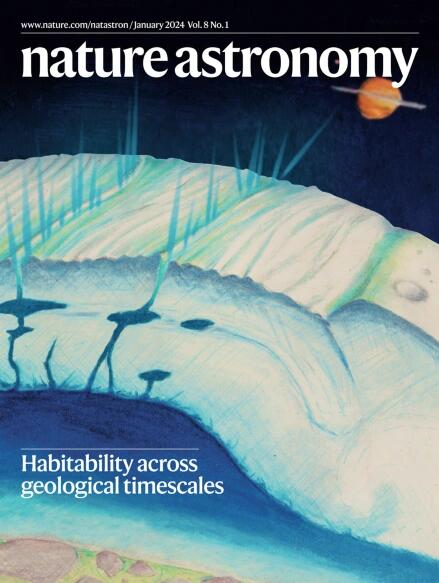
Nature Astronomy
Physics and Astronomy-Astronomy and Astrophysics
CiteScore
19.50
自引率
2.80%
发文量
252
期刊介绍:
Nature Astronomy, the oldest science, has played a significant role in the history of Nature. Throughout the years, pioneering discoveries such as the first quasar, exoplanet, and understanding of spiral nebulae have been reported in the journal. With the introduction of Nature Astronomy, the field now receives expanded coverage, welcoming research in astronomy, astrophysics, and planetary science. The primary objective is to encourage closer collaboration among researchers in these related areas.
Similar to other journals under the Nature brand, Nature Astronomy boasts a devoted team of professional editors, ensuring fairness and rigorous peer-review processes. The journal maintains high standards in copy-editing and production, ensuring timely publication and editorial independence.
In addition to original research, Nature Astronomy publishes a wide range of content, including Comments, Reviews, News and Views, Features, and Correspondence. This diverse collection covers various disciplines within astronomy and includes contributions from a diverse range of voices.
 求助内容:
 应助结果提醒方式:


 京公网安备 11010802042870号


