Guowei Chen, Zunke Xie, Lei Shi, Xuejing Guo, Junxin Wang, Ben Cao, Hao Hu, Lianchao Jin
{"title":"[Efficacy of thermo-expandable nickel-titanium alloy ureteral stent placement as maintenance therapy for ureteral strictures].","authors":"Guowei Chen, Zunke Xie, Lei Shi, Xuejing Guo, Junxin Wang, Ben Cao, Hao Hu, Lianchao Jin","doi":"","DOIUrl":null,"url":null,"abstract":"<p><strong>Objective: </strong>To evaluate the clinical efficacy and safety of thermo-expandable nickel-titanium alloy ureteral stents (Memokath-051) for maintenance therapy of ureteral strictures.</p><p><strong>Methods: </strong>A retrospective analysis was conducted on the clinical data of 16 patients with ureteral strictures admitted to Beijing Geriatric Hospital from January 2024 to April 2025. The cohort comprised 3 males and 13 females, with a mean age of (57.60±9.79) years. Etiologies included post-radiation stricture following abdominopelvic tumor radiotherapy in 13 patients, retroperitoneal fibrosis in 2, and ureteral granuloma in 1. All the 16 patients had experienced failure of previous indwelling double-J stent placement and subsequently underwent conversion to thermo-expandable nickel-titanium alloy ureteral stent insertion. Among the 16 patients, 7 had bilateral ureteral lesions, with a total of 23 ureteral units treated. Operative time, complications (graded according to the Clavien-Dindo classification), stent patency rate, and ureteral stent symptom questionnaire (USSQ) scores were recorded. Follow-up assessments of serum creatinine levels and hydronephrosis improvement were performed 3, 6, and 12 months postoperatively.</p><p><strong>Results: </strong>All 23 stents were successfully placed in the 16 patients (technical success rate, 100%), with a mean operative time of (51.52±9.55) min. The overall stent patency rate 12 months postoperatively was 82.61% (19/23). Early complications occurred in 7 patients. Long-term complications developed in 4 patients, including stent migration (<i>n</i>=1), tissue hyperplasia-induced obstruction (<i>n</i>=2), and stone-related obstruction (<i>n</i>=1); the remaining 5 patients had no complications. Three months postoperatively, serum creatinine decreased from the preoperative baseline of 186.80 (111.80, 244.93) μmol/L to 103.05 (96.20, 135.97) μmol/L (<i>P</i> < 0.01), and hydronephrosis width decreased from 3.20 (2.78, 3.40) cm to 2.05 (1.08, 2.20) cm (<i>P</i> < 0.01). Serum creatinine levels and hydronephrosis remained stable 6 and 12 months postoperatively. Compared with the previous indwelling period of double-J stents, USSQ scores showed significant improvements in urinary symptoms (34.75±2.34 <i>vs</i>. 23.75±3.26), bodily pain (6.50±2.26 <i>vs</i>. 3.00±1.22), general health status, and work performance (all <i>P</i> < 0.001).</p><p><strong>Conclusion: </strong>Placement of thermo-expandable nickel-titanium alloy ureteral stents (Memokath-051) as maintenance therapy for ureteral strictures is safe and effective. Compared with double-J stenting, it improves renal function and hydronephrosis, and enhances patient quality of life. This approach is particularly applicable to patients with long-segment ureteral strictures secondary to post-radiation etiologies.</p>","PeriodicalId":8790,"journal":{"name":"北京大学学报(医学版)","volume":"58 4","pages":"827-832"},"PeriodicalIF":0.0000,"publicationDate":"2026-08-18","publicationTypes":"Journal Article","fieldsOfStudy":null,"isOpenAccess":false,"openAccessPdf":"https://www.ncbi.nlm.nih.gov/pmc/articles/PMC13402056/pdf/","citationCount":"0","resultStr":null,"platform":"Semanticscholar","paperid":null,"PeriodicalName":"北京大学学报(医学版)","FirstCategoryId":"3","ListUrlMain":"","RegionNum":0,"RegionCategory":null,"ArticlePicture":[],"TitleCN":null,"AbstractTextCN":null,"PMCID":null,"EPubDate":"","PubModel":"","JCR":"Q3","JCRName":"Medicine","Score":null,"Total":0}
引用次数: 0
Abstract
Objective: To evaluate the clinical efficacy and safety of thermo-expandable nickel-titanium alloy ureteral stents (Memokath-051) for maintenance therapy of ureteral strictures.
Methods: A retrospective analysis was conducted on the clinical data of 16 patients with ureteral strictures admitted to Beijing Geriatric Hospital from January 2024 to April 2025. The cohort comprised 3 males and 13 females, with a mean age of (57.60±9.79) years. Etiologies included post-radiation stricture following abdominopelvic tumor radiotherapy in 13 patients, retroperitoneal fibrosis in 2, and ureteral granuloma in 1. All the 16 patients had experienced failure of previous indwelling double-J stent placement and subsequently underwent conversion to thermo-expandable nickel-titanium alloy ureteral stent insertion. Among the 16 patients, 7 had bilateral ureteral lesions, with a total of 23 ureteral units treated. Operative time, complications (graded according to the Clavien-Dindo classification), stent patency rate, and ureteral stent symptom questionnaire (USSQ) scores were recorded. Follow-up assessments of serum creatinine levels and hydronephrosis improvement were performed 3, 6, and 12 months postoperatively.
Results: All 23 stents were successfully placed in the 16 patients (technical success rate, 100%), with a mean operative time of (51.52±9.55) min. The overall stent patency rate 12 months postoperatively was 82.61% (19/23). Early complications occurred in 7 patients. Long-term complications developed in 4 patients, including stent migration (n=1), tissue hyperplasia-induced obstruction (n=2), and stone-related obstruction (n=1); the remaining 5 patients had no complications. Three months postoperatively, serum creatinine decreased from the preoperative baseline of 186.80 (111.80, 244.93) μmol/L to 103.05 (96.20, 135.97) μmol/L (P < 0.01), and hydronephrosis width decreased from 3.20 (2.78, 3.40) cm to 2.05 (1.08, 2.20) cm (P < 0.01). Serum creatinine levels and hydronephrosis remained stable 6 and 12 months postoperatively. Compared with the previous indwelling period of double-J stents, USSQ scores showed significant improvements in urinary symptoms (34.75±2.34 vs. 23.75±3.26), bodily pain (6.50±2.26 vs. 3.00±1.22), general health status, and work performance (all P < 0.001).
Conclusion: Placement of thermo-expandable nickel-titanium alloy ureteral stents (Memokath-051) as maintenance therapy for ureteral strictures is safe and effective. Compared with double-J stenting, it improves renal function and hydronephrosis, and enhances patient quality of life. This approach is particularly applicable to patients with long-segment ureteral strictures secondary to post-radiation etiologies.
期刊介绍:
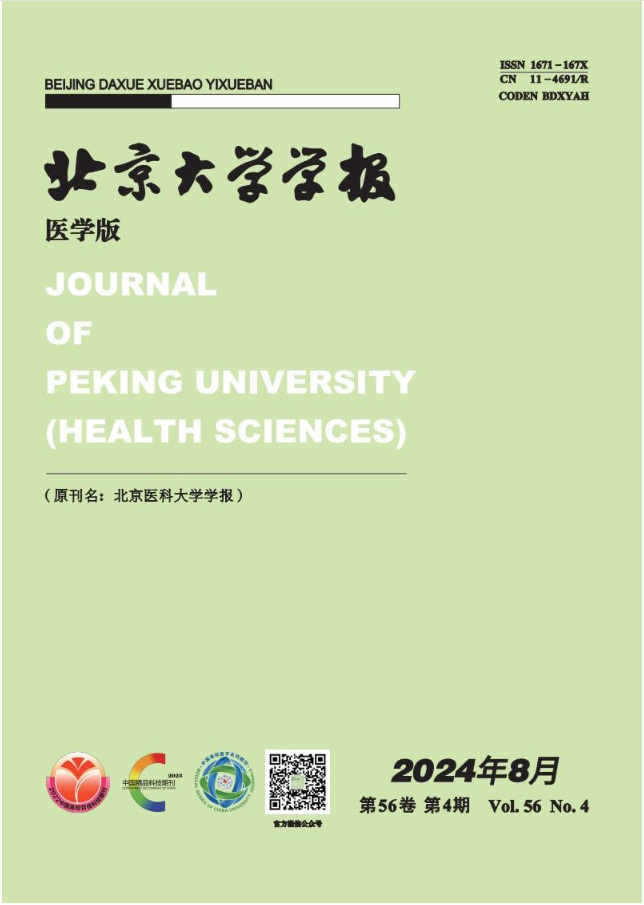
Beijing Da Xue Xue Bao Yi Xue Ban / Journal of Peking University (Health Sciences), established in 1959, is a national academic journal sponsored by Peking University, and its former name is Journal of Beijing Medical University. The coverage of the Journal includes basic medical sciences, clinical medicine, oral medicine, surgery, public health and epidemiology, pharmacology and pharmacy. Over the last few years, the Journal has published articles and reports covering major topics in the different special issues (e.g. research on disease genome, theory of drug withdrawal, mechanism and prevention of cardiovascular and cerebrovascular diseases, stomatology, orthopaedic, public health, urology and reproductive medicine). All the topics involve latest advances in medical sciences, hot topics in specific specialties, and prevention and treatment of major diseases.
The Journal has been indexed and abstracted by PubMed Central (PMC), MEDLINE/PubMed, EBSCO, Embase, Scopus, Chemical Abstracts (CA), Western Pacific Region Index Medicus (WPR), JSTChina, and almost all the Chinese sciences and technical index systems, including Chinese Science and Technology Paper Citation Database (CSTPCD), Chinese Science Citation Database (CSCD), China BioMedical Bibliographic Database (CBM), CMCI, Chinese Biological Abstracts, China National Academic Magazine Data-Base (CNKI), Wanfang Data (ChinaInfo), etc.

 求助内容:
 应助结果提醒方式:


 京公网安备 11010802042870号


