Ruotao Xiao, Zhifei Xie, Peng Hong, Bin Yang, Lei Liu, Shudong Zhang
{"title":"[Risk factors for perioperative acute kidney injury following partial nephrectomy in patients with stage 3 chronic kidney disease].","authors":"Ruotao Xiao, Zhifei Xie, Peng Hong, Bin Yang, Lei Liu, Shudong Zhang","doi":"","DOIUrl":null,"url":null,"abstract":"<p><strong>Objective: </strong>To explore the risk factors for acute kidney injury (AKI) in patients with stage 3 chronic kidney disease (CKD) after partial nephrectomy.</p><p><strong>Methods: </strong>The clinical data of 126 stage 3 CKD patients who underwent partial nephrectomy at Peking University Third Hospital from January 2013 to December 2025 were retrospectively analyzed. Demographic characteristics, comorbidities, surgical-related indicators, and laboratory data of the patients were collected. AKI was defined according to the Kidney Disease: Improving Global Outcomes (KDIGO) criteria. Univariate and multivariate regression analyses were used to identify the independent risk factors for postoperative AKI, and the predictive cutoff value of the receiver operating characteristic (ROC) curve was determined.</p><p><strong>Results: </strong>A total of 126 stage 3 CKD patients were included. The incidence of AKI after surgery was 31.0% (39/126). Univariate analysis showed that the proportion of robotic surgery was lower in the AKI group (12.8% <i>vs</i>. 33.3%, <i>P</i>=0.018), the duration of renal artery occlusion was longer (25 min <i>vs</i>. 18 min, <i>P</i> < 0.001), and the intraoperative blood loss was greater (20 mL <i>vs</i>. 50 mL, <i>P</i>=0.028). Multivariate Logistic regression analysis confirmed that the duration of renal artery occlusion (<i>OR</i>=1.105, 95%<i>CI</i>: 1.041-1.173, <i>P</i>=0.001) and intraoperative blood loss (<i>OR</i>=1.004, 95%<i>CI</i>: 1.000-1.007, <i>P</i>=0.046) were independent risk factors for postoperative AKI. ROC curve analysis showed that the area under the curve for predicting AKI by renal artery occlusion time was 0.737, and the optimal cutoff value was 18 min. The incidence of AKI was significantly higher in the patients with renal artery occlusion time ≥ 18 min than those with < 18 min (43.2% <i>vs</i>. 8.8%, <i>P</i> < 0.001).</p><p><strong>Conclusion: </strong>The incidence of AKI after partial nephrectomy in stage 3 CKD patients is relatively high. The duration of renal artery occlusion and intra-operative blood loss are independent risk factors for postoperative AKI. Controlling the renal artery occlusion time within 18 min and minimizing intraoperative blood loss can help reduce the risk of AKI in this high-risk population after surgery.</p>","PeriodicalId":8790,"journal":{"name":"北京大学学报(医学版)","volume":"58 4","pages":"723-728"},"PeriodicalIF":0.0000,"publicationDate":"2026-08-18","publicationTypes":"Journal Article","fieldsOfStudy":null,"isOpenAccess":false,"openAccessPdf":"https://www.ncbi.nlm.nih.gov/pmc/articles/PMC13402054/pdf/","citationCount":"0","resultStr":null,"platform":"Semanticscholar","paperid":null,"PeriodicalName":"北京大学学报(医学版)","FirstCategoryId":"3","ListUrlMain":"","RegionNum":0,"RegionCategory":null,"ArticlePicture":[],"TitleCN":null,"AbstractTextCN":null,"PMCID":null,"EPubDate":"","PubModel":"","JCR":"Q3","JCRName":"Medicine","Score":null,"Total":0}
引用次数: 0
Abstract
Objective: To explore the risk factors for acute kidney injury (AKI) in patients with stage 3 chronic kidney disease (CKD) after partial nephrectomy.
Methods: The clinical data of 126 stage 3 CKD patients who underwent partial nephrectomy at Peking University Third Hospital from January 2013 to December 2025 were retrospectively analyzed. Demographic characteristics, comorbidities, surgical-related indicators, and laboratory data of the patients were collected. AKI was defined according to the Kidney Disease: Improving Global Outcomes (KDIGO) criteria. Univariate and multivariate regression analyses were used to identify the independent risk factors for postoperative AKI, and the predictive cutoff value of the receiver operating characteristic (ROC) curve was determined.
Results: A total of 126 stage 3 CKD patients were included. The incidence of AKI after surgery was 31.0% (39/126). Univariate analysis showed that the proportion of robotic surgery was lower in the AKI group (12.8% vs. 33.3%, P=0.018), the duration of renal artery occlusion was longer (25 min vs. 18 min, P < 0.001), and the intraoperative blood loss was greater (20 mL vs. 50 mL, P=0.028). Multivariate Logistic regression analysis confirmed that the duration of renal artery occlusion (OR=1.105, 95%CI: 1.041-1.173, P=0.001) and intraoperative blood loss (OR=1.004, 95%CI: 1.000-1.007, P=0.046) were independent risk factors for postoperative AKI. ROC curve analysis showed that the area under the curve for predicting AKI by renal artery occlusion time was 0.737, and the optimal cutoff value was 18 min. The incidence of AKI was significantly higher in the patients with renal artery occlusion time ≥ 18 min than those with < 18 min (43.2% vs. 8.8%, P < 0.001).
Conclusion: The incidence of AKI after partial nephrectomy in stage 3 CKD patients is relatively high. The duration of renal artery occlusion and intra-operative blood loss are independent risk factors for postoperative AKI. Controlling the renal artery occlusion time within 18 min and minimizing intraoperative blood loss can help reduce the risk of AKI in this high-risk population after surgery.
期刊介绍:
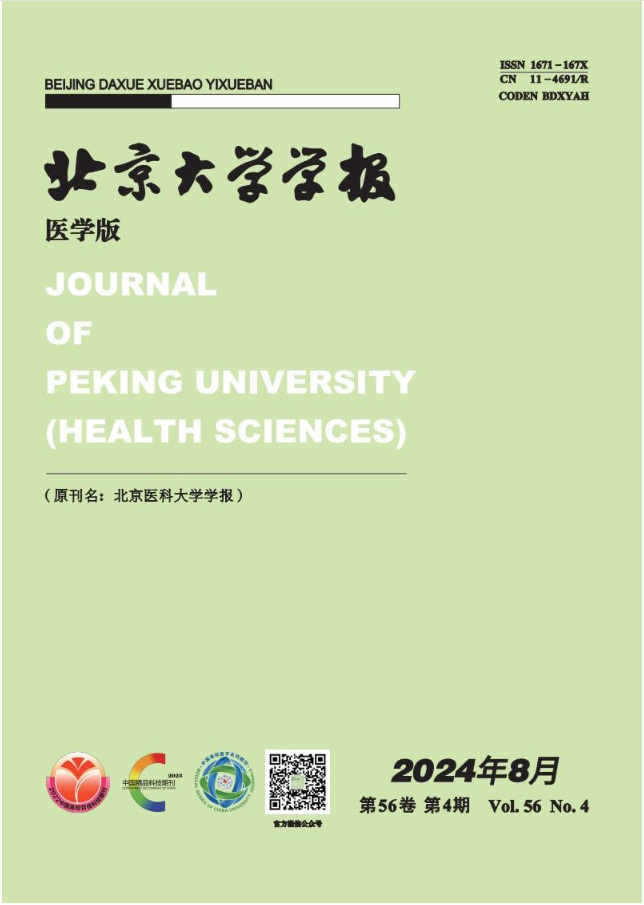
Beijing Da Xue Xue Bao Yi Xue Ban / Journal of Peking University (Health Sciences), established in 1959, is a national academic journal sponsored by Peking University, and its former name is Journal of Beijing Medical University. The coverage of the Journal includes basic medical sciences, clinical medicine, oral medicine, surgery, public health and epidemiology, pharmacology and pharmacy. Over the last few years, the Journal has published articles and reports covering major topics in the different special issues (e.g. research on disease genome, theory of drug withdrawal, mechanism and prevention of cardiovascular and cerebrovascular diseases, stomatology, orthopaedic, public health, urology and reproductive medicine). All the topics involve latest advances in medical sciences, hot topics in specific specialties, and prevention and treatment of major diseases.
The Journal has been indexed and abstracted by PubMed Central (PMC), MEDLINE/PubMed, EBSCO, Embase, Scopus, Chemical Abstracts (CA), Western Pacific Region Index Medicus (WPR), JSTChina, and almost all the Chinese sciences and technical index systems, including Chinese Science and Technology Paper Citation Database (CSTPCD), Chinese Science Citation Database (CSCD), China BioMedical Bibliographic Database (CBM), CMCI, Chinese Biological Abstracts, China National Academic Magazine Data-Base (CNKI), Wanfang Data (ChinaInfo), etc.

 求助内容:
 应助结果提醒方式:


 京公网安备 11010802042870号


