
Effects of drought stress on the productivity and quality of sunflower achenes and applied resilience approaches: A comprehensive review
IF 8.1
Q1 PLANT SCIENCES
引用次数: 0
Abstract
Drought stress is a cascade of dysfunctions involving multiple interconnected biological levels from early perception and signaling to agronomic outcomes. Prolonged periods and severity of drought stress exceed the sunflower’s natural moderate tolerance, and hinders the physiological function balance (stomatal closure, photosynthetic efficiency, and nutrient uptake) and the developmental progression in sensitive key growth stages like germination, flowering, and grain filling. Collectively, these cumulative modifications contribute to a significant decrease in various agronomic traits, particularly the overall seed productivity, seed oil accumulation, and the oil quality parameters, such as the fatty acid composition. This results in reducing the economic and nutritional value of sunflower. The severity of these effects is highly dependent on genetic factors (cultivars), stress severity (drought and deficit in irrigation), and stress timing (flowering and grain filling). In response to severe drought-induced damage, sunflower plants develop several adaptive strategies involving structural modifications (root system development), physiological regulation (osmotic adjustment, activation of an antioxidant defense system), along with molecular signaling pathways (expression of stress-responsive genes). Complementary to these natural defenses, external agronomic approaches such as irrigation, nutrient and soil optimization (zinc, biochar or biostimulant), exogenous application of growth regulators (abscisic acid, salicylic acid), and microbial inoculation with beneficial microorganisms (plant growth-promoting rhizobacteria (PGPR) and arbuscular mycorrhizal fungi (AMF)) have been employed to limit drought damage, and to enhance growth parameters and productivity. The purpose of this review is to provide an overview of sunflower responses to drought in recent years from molecular, physiological, morpho-anatomical, and agronomic perspectives.
干旱胁迫对向日葵瘦果产量和质量的影响及抗灾对策综述
干旱胁迫是一系列功能失调的连锁反应,涉及多个相互关联的生物学水平,从早期感知和信号传导到农艺结果。干旱胁迫的持续时间和严重程度超过了向日葵的自然适度耐受性,阻碍了其生理功能平衡(气孔关闭、光合效率和养分吸收)以及发芽、开花和灌浆等敏感关键生长阶段的发育进程。总的来说,这些累积的修饰导致了各种农艺性状的显著下降,特别是种子的总体生产力、种子油积累和油质参数,如脂肪酸组成。这就降低了向日葵的经济价值和营养价值。这些影响的严重程度高度依赖于遗传因素(品种)、胁迫严重程度(干旱和灌溉不足)和胁迫时机(开花和灌浆)。为了应对严重的干旱造成的损害,向日葵植物发展出几种适应策略,包括结构修饰(根系发育)、生理调节(渗透调节、抗氧化防御系统的激活)以及分子信号通路(应激反应基因的表达)。作为这些天然防御的补充,外部农艺方法,如灌溉、养分和土壤优化(锌、生物炭或生物刺激剂)、外源应用生长调节剂(脱落酸、水杨酸)和有益微生物(促进植物生长的根瘤菌(PGPR)和丛菌根真菌(AMF))的微生物接种,已被用来限制干旱损害,并提高生长参数和生产力。本文从分子、生理、形态解剖和农艺等方面综述了近年来向日葵对干旱的响应。
本文章由计算机程序翻译,如有差异,请以英文原文为准。
求助全文
约1分钟内获得全文
求助全文
来源期刊
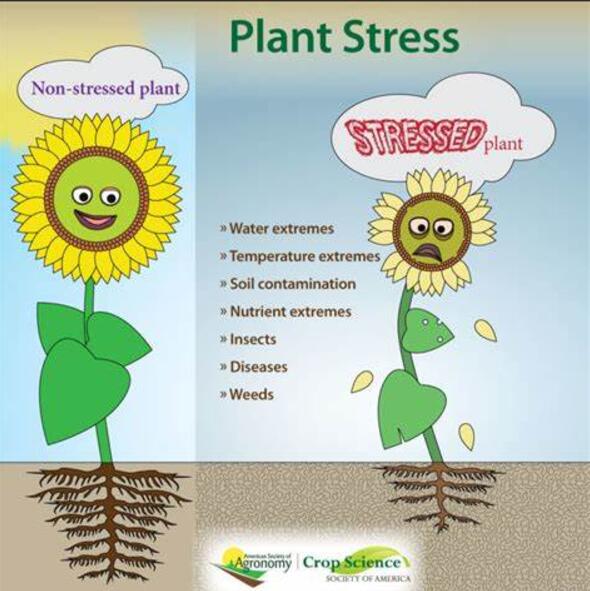
Plant Stress
PLANT SCIENCES-
CiteScore
5.20
自引率
8.00%
发文量
76
审稿时长
63 days
期刊介绍:
The journal Plant Stress deals with plant (or other photoautotrophs, such as algae, cyanobacteria and lichens) responses to abiotic and biotic stress factors that can result in limited growth and productivity. Such responses can be analyzed and described at a physiological, biochemical and molecular level. Experimental approaches/technologies aiming to improve growth and productivity with a potential for downstream validation under stress conditions will also be considered. Both fundamental and applied research manuscripts are welcome, provided that clear mechanistic hypotheses are made and descriptive approaches are avoided. In addition, high-quality review articles will also be considered, provided they follow a critical approach and stimulate thought for future research avenues.
Plant Stress welcomes high-quality manuscripts related (but not limited) to interactions between plants and:
Lack of water (drought) and excess (flooding),
Salinity stress,
Elevated temperature and/or low temperature (chilling and freezing),
Hypoxia and/or anoxia,
Mineral nutrient excess and/or deficiency,
Heavy metals and/or metalloids,
Plant priming (chemical, biological, physiological, nanomaterial, biostimulant) approaches for improved stress protection,
Viral, phytoplasma, bacterial and fungal plant-pathogen interactions.
The journal welcomes basic and applied research articles, as well as review articles and short communications. All submitted manuscripts will be subject to a thorough peer-reviewing process.
 求助内容:
 应助结果提醒方式:


 京公网安备 11010802042870号


