
Artificial intelligence and natural resource exploitation shaping load capacity factor in Quad economies: Role of renewable energy and green innovations
IF 12.7
1区 地球科学
Q1 GEOSCIENCES, MULTIDISCIPLINARY
引用次数: 0
Abstract
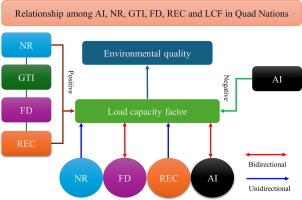
This study examines the heterogeneous effects of artificial intelligence (AI) adoption and natural resource exploitation on load capacity factor (LCF) in the Quad economies over the period 1995–2023. After accounting for cross-sectional dependence (CD) and slope heterogeneity (SH), second-generation econometric methods are employed to estimate reliable outcomes. To capture variation across different levels of ecological capacity, the Method of Moments Quantile Regression (MMQR) is applied. The estimated findings reveal that AI adoption has a statistically significant and negative influence on LCF, with coefficients declining from −0.240 at lower quantiles to −0.305 at upper quantiles, indicating stronger adverse environmental effects at higher levels of ecological capacity. In contrast, natural resources exert a positive influence on LCF, with effects strengthening from 0.305 to 0.330 across the quantile distribution. Also, green technological innovations contribute positively to environmental sustainability, with its impact rising from 0.093 at lower quantiles to 0.249 at higher quantiles. Moreover, financial development emerges as the most influential determinant of LCF, as indicated by the largest coefficient magnitudes across quantiles, with values ranging from 1.033 to 1.406. Additionally, renewable energy displays a stronger positive relation with LCF, growing from 0.421 at the lower quantile to 0.764 at the upper quantile. These results highlight the importance of integrated strategies combining AI governance, sustainable resource management, financial expansion, and renewable energy development to enhance environmental sustainability in the Quad economies.
人工智能和自然资源开发在四国经济中形成负荷能力因子:可再生能源和绿色创新的作用
本研究考察了1995年至2023年期间,人工智能(AI)的采用和自然资源开发对四国经济体负载能力因子(LCF)的异质影响。在考虑了截面依赖性(CD)和斜率异质性(SH)后,采用第二代计量经济学方法来估计可靠的结果。为了捕捉不同生态容量水平的变化,应用矩分位数回归(MMQR)方法。估计结果表明,人工智能的采用对LCF具有统计显著的负面影响,其系数从低分位数的- 0.240下降到高分位数的- 0.305,表明生态容量水平越高,不利环境影响越强。相反,自然资源对LCF有正向影响,在分位数分布上从0.305增强到0.330。此外,绿色技术创新对环境可持续性有积极的贡献,其影响从低分位数的0.093上升到高分位数的0.249。此外,金融发展成为LCF最具影响力的决定因素,各分位数的系数最大,其值从1.033到1.406不等。此外,可再生能源与LCF的正相关关系较强,从下分位数的0.421上升到上分位数的0.764。这些结果凸显了将人工智能治理、可持续资源管理、金融扩张和可再生能源开发相结合的综合战略对增强四国经济体环境可持续性的重要性。
本文章由计算机程序翻译,如有差异,请以英文原文为准。
求助全文
约1分钟内获得全文
求助全文
来源期刊
Geoscience frontiers
Earth and Planetary Sciences-General Earth and Planetary Sciences
CiteScore
17.80
自引率
3.40%
发文量
147
审稿时长
35 days
期刊介绍:
Geoscience Frontiers (GSF) is the Journal of China University of Geosciences (Beijing) and Peking University. It publishes peer-reviewed research articles and reviews in interdisciplinary fields of Earth and Planetary Sciences. GSF covers various research areas including petrology and geochemistry, lithospheric architecture and mantle dynamics, global tectonics, economic geology and fuel exploration, geophysics, stratigraphy and paleontology, environmental and engineering geology, astrogeology, and the nexus of resources-energy-emissions-climate under Sustainable Development Goals. The journal aims to bridge innovative, provocative, and challenging concepts and models in these fields, providing insights on correlations and evolution.
 求助内容:
求助内容: 应助结果提醒方式:

 京公网安备 11010802042870号


