
Engineering channel microenvironment and charge dynamics in covalent organic frameworks through linkage-specific povarov cyclization for enhanced photocatalytic hydrogen evolution
IF 17.2
1区 化学
Q1 CHEMISTRY, APPLIED
Chinese Journal of Catalysis
Pub Date : 2026-07-01
Epub Date: 2026-07-02
DOI:10.1016/S1872-2067(26)65053-X
引用次数: 0
Abstract
Covalent organic frameworks (COFs) offer a modular platform for photocatalytic hydrogen evolution (PHE), where linkage topology and channel architecture dictate charge separation and mass transport. However, the role of linkage isomerism in coupling pore microenvironments with photocatalytic function remains unclear. We synthesized COF-PQ and COF-DPPQ via in-situ Povarov cyclization of pyrene-based imine direction distinct intermediates, creating frameworks with identical building blocks but distinct donor-acceptor arrangements and pore microenvironments that underpin their contrasting catalytic behaviors. This structural divergence drives profound functional differences: COF-DPPQ achieves a PHE rate of 37.82 mmol g–1 h–1, nearly 100-fold higher than COF-PQ. Mechanistically, COF-DPPQ exhibits lower electron effective mass (0.574 vs. 1.046), stronger donor-acceptor polarization (~0.95 |e| vs. ~0.24 |e|), prolonged carrier lifetimes (37.28 vs. 1.26 ps), and superior proton adsorption and diffusion (2.2-fold capacity; 0.916 × 10⁻³ vs. 0.660 × 10⁻³ cm2 s–1). These results identify linkage topology as an effective lever to regulate exciton dynamics and mass transport, guiding the design of next-generation COF photocatalysts.
工程通道微环境和电荷动力学在共价有机框架通过连接特异性波瓦洛夫环增强光催化氢演化
共价有机框架(COFs)为光催化析氢(PHE)提供了一个模块化平台,其中链接拓扑结构和通道结构决定了电荷分离和质量传递。然而,链接异构在耦合孔微环境和光催化功能中的作用尚不清楚。我们通过吡啶基亚胺的原位Povarov环化合成了COF-PQ和COF-DPPQ,创造了具有相同构建块但不同供体-受体排列和孔微环境的框架,从而支撑了它们不同的催化行为。这种结构差异导致了深刻的功能差异:COF-DPPQ的PHE率达到37.82 mmol g-1 h-1,比COF-PQ高近100倍。机制上,COF-DPPQ表现出较低的电子有效质量(0.574 vs 1.046),较强的供体-受体极化(~0.95 |e| vs ~0.24 |e|),较长的载流子寿命(37.28 vs. 1.26 ps),优异的质子吸附和扩散能力(2.2倍容量,0.916 × 10-3 vs. 0.660 × 10⁻³ cm2 s-1)。这些结果确定了链接拓扑结构是调节激子动力学和质量输运的有效杠杆,指导下一代COF光催化剂的设计。
本文章由计算机程序翻译,如有差异,请以英文原文为准。
求助全文
约1分钟内获得全文
求助全文
来源期刊
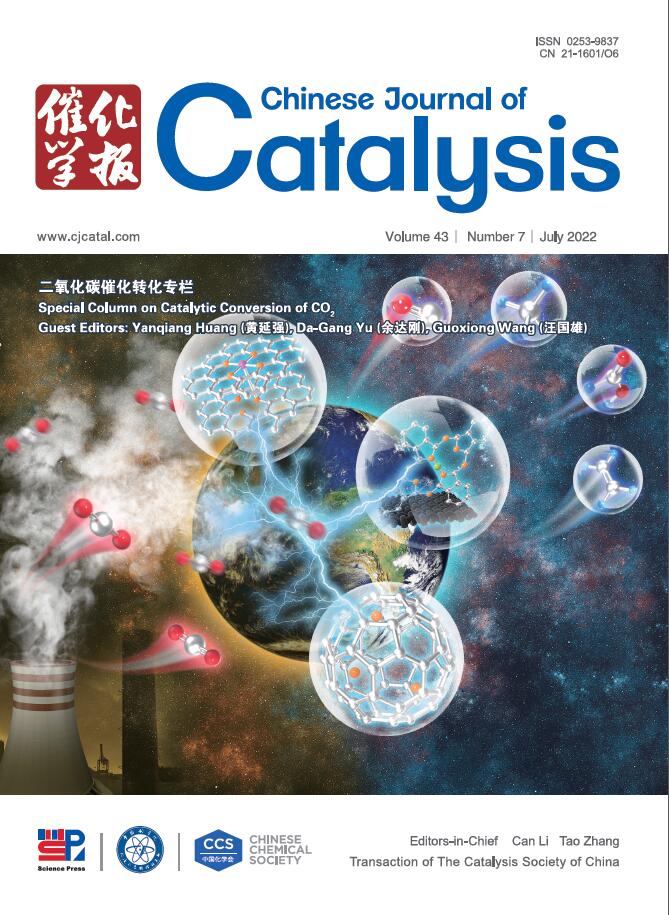
Chinese Journal of Catalysis
工程技术-工程:化工
CiteScore
25.80
自引率
10.30%
发文量
235
审稿时长
1.2 months
期刊介绍:
The journal covers a broad scope, encompassing new trends in catalysis for applications in energy production, environmental protection, and the preparation of materials, petroleum chemicals, and fine chemicals. It explores the scientific foundation for preparing and activating catalysts of commercial interest, emphasizing representative models.The focus includes spectroscopic methods for structural characterization, especially in situ techniques, as well as new theoretical methods with practical impact in catalysis and catalytic reactions.The journal delves into the relationship between homogeneous and heterogeneous catalysis and includes theoretical studies on the structure and reactivity of catalysts.Additionally, contributions on photocatalysis, biocatalysis, surface science, and catalysis-related chemical kinetics are welcomed.
 求助内容:
 应助结果提醒方式:


 京公网安备 11010802042870号


