
Efficient and selective photocatalytic CO2 conversion enabled by FePc nanosheets in a dye-sensitized system
IF 17.2
1区 化学
Q1 CHEMISTRY, APPLIED
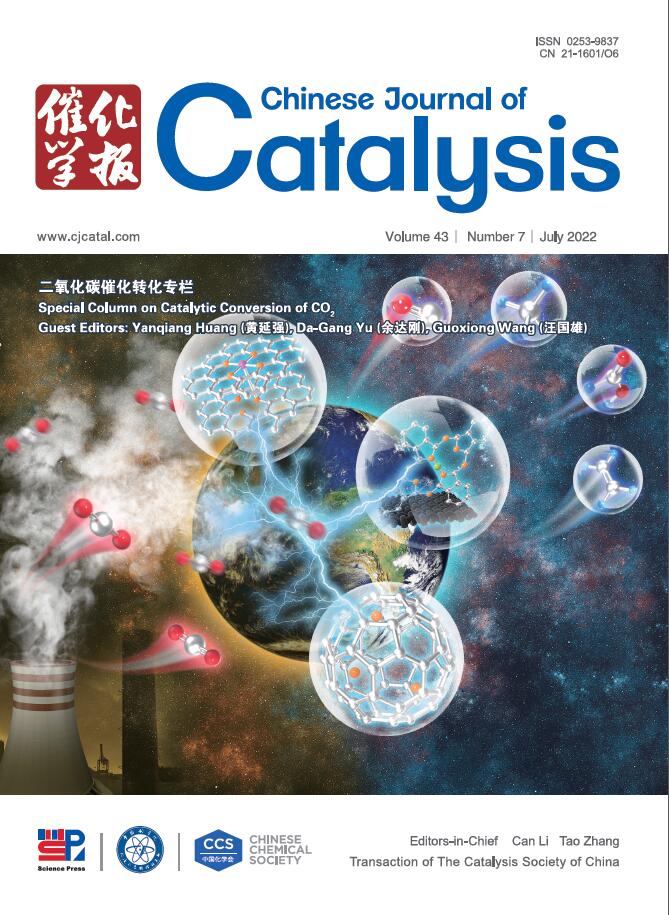
Chinese Journal of Catalysis
Pub Date : 2026-07-01
Epub Date: 2026-07-02
DOI:10.1016/S1872-2067(26)65061-9
引用次数: 0
Abstract
Solar-driven photocatalytic CO2 conversion offers a sustainable solution for greenhouse gas mitigation and renewable energy storage. While metal phthalocyanines (MPc) exhibit excellent CO2 reduction capabilities, their practical application in dispersed photocatalytic systems faces limitations of the stacking of MPc molecules that reduces active site accessibility, and inefficient electron transfer limited by diffusive mass transport. To address these challenges, we developed a bioinspired dye-sensitized RuP-TiO2-FePc nanosheets (NSs) hybrid system, where ultrathin FePc NSs obtained by liquid-phase ultrasonic exfoliation enhance active site exposure and mass transfer, while TiO2 serves as a mediator to facilitate electron transfer between the photosensitizer and FePc NSs. Time-resolved spectroscopic studies demonstrate that TiO2 plays a dual role: it spatially organizes functional components to enable surface electron transfer by shortening intermolecular distances, while also functioning as a semiconductor bridge to facilitate charge transport. This synergistic design achieves a remarkable CO production rate of 27.3 mmol g–1 h–1 (> 98% selectivity) and exceptional stability (TONCO = 1363 over 100 h), outperforming many noble-metal-based systems. Our work demonstrates a robust strategy for optimizing bulk catalysts through 2D exfoliation and controlled heterogenization, offering a versatile platform for efficient and durable artificial photosynthesis.
FePc纳米片在染料敏化系统中实现了高效和选择性的光催化CO2转化
太阳能驱动的光催化二氧化碳转化为温室气体减排和可再生能源储存提供了可持续的解决方案。虽然金属酞菁(MPc)具有出色的CO2还原能力,但其在分散光催化体系中的实际应用面临着MPc分子堆积降低活性位点可及性以及扩散质量传递限制的低效电子传递的限制。为了解决这些问题,我们开发了一种生物染料敏化的rupp -TiO2-FePc纳米片(NSs)混合体系,其中通过液相超声剥离获得的超薄FePc纳米片增强了活性位点暴露和传质,而TiO2作为介质促进光敏剂和FePc纳米片之间的电子传递。时间分辨光谱研究表明,TiO2具有双重作用:它在空间上组织功能组分,通过缩短分子间距离实现表面电子转移,同时也作为半导体桥促进电荷传输。这种协同设计实现了27.3 mmol g-1 h - 1的CO产率(>; 98%选择性)和卓越的稳定性(100 h内TONCO = 1363),优于许多贵金属基体系。我们的工作证明了通过二维剥离和控制异质化来优化体催化剂的强大策略,为高效和持久的人工光合作用提供了一个通用的平台。
本文章由计算机程序翻译,如有差异,请以英文原文为准。
求助全文
约1分钟内获得全文
求助全文
来源期刊
Chinese Journal of Catalysis
工程技术-工程:化工
CiteScore
25.80
自引率
10.30%
发文量
235
审稿时长
1.2 months
期刊介绍:
The journal covers a broad scope, encompassing new trends in catalysis for applications in energy production, environmental protection, and the preparation of materials, petroleum chemicals, and fine chemicals. It explores the scientific foundation for preparing and activating catalysts of commercial interest, emphasizing representative models.The focus includes spectroscopic methods for structural characterization, especially in situ techniques, as well as new theoretical methods with practical impact in catalysis and catalytic reactions.The journal delves into the relationship between homogeneous and heterogeneous catalysis and includes theoretical studies on the structure and reactivity of catalysts.Additionally, contributions on photocatalysis, biocatalysis, surface science, and catalysis-related chemical kinetics are welcomed.
 求助内容:
 应助结果提醒方式:


 京公网安备 11010802042870号


