
Triphasic Bi heterointerfaces drive cycling exceeding 1650 h and high-power zinc-air batteries
IF 17.2
1区 化学
Q1 CHEMISTRY, APPLIED
Chinese Journal of Catalysis
Pub Date : 2026-07-01
Epub Date: 2026-07-02
DOI:10.1016/S1872-2067(26)65052-8
引用次数: 0
Abstract
Rechargeable zinc-air batteries (ZABs) suffer from poor reversibility of Zn anode due to dendrite formation and parasitic side reactions, severely limiting their practical deployment. Here we report an interfacial engineering strategy that integrates three Bi components: metallic Bi0, atomic Bi-Nx sites, and Bi2O3 nanocrystals, anchored within a nitrogen-doped mesoporous carbon framework. This triphasic Bi interphase delivers collective synergistic effects by: (1) homogenizing Zn2+ nucleation, (2) accelerating Zn plating/stripping kinetics, and (3) suppressing hydrogen evolution and interfacial corrosion. Density functional theory calculations confirm that the Bi2O3/Bi heterointerface exhibits strong zincophilicity, markedly lowering the nucleation energy barrier and enabling uniform Zn deposition. Benefiting from these collective interfacial effects, symmetric cells with s-Bi2O3/Bi-NC@Zn anodes sustain dendrite–free cycling for over 520 h at 10 mA cm–2, with negligible polarization growth. When assembled into ZABs, the engineered anodes deliver an ultrahigh power density of 829.3 mW cm–2 and an extended lifetime of 1650 h at 5 mA cm–2 with 80% voltage efficiency. This work establishes a triphasic Bi-based interfacial design as a powerful strategy to achieve highly reversible Zn anodes and offers a generalizable approach for advancing metal–based batteries.
三相铋异质界面驱动循环超过1650小时和大功率锌空气电池
可充电锌空气电池(ZABs)由于枝晶形成和寄生副反应导致锌阳极可逆性差,严重限制了其实际应用。在这里,我们报告了一种界面工程策略,该策略集成了三种铋成分:金属Bi0,原子Bi- nx位点和Bi2O3纳米晶体,锚定在氮掺杂的介孔碳框架内。这种三相双相界面通过:(1)均质化Zn2+成核,(2)加速Zn电镀/剥离动力学,(3)抑制析氢和界面腐蚀,实现了集体协同效应。密度泛函理论计算证实,Bi2O3/Bi异质界面具有很强的亲锌性,显著降低了成核能垒,使锌沉积均匀。得益于这些集体界面效应,具有s-Bi2O3/Bi-NC@Zn阳极的对称电池在10 mA cm-2下维持520小时以上的无枝晶循环,极化生长可以忽略不计。当组装成ZABs时,工程阳极提供829.3 mW cm-2的超高功率密度,在5 mA cm-2下延长寿命1650小时,电压效率为80%。这项工作建立了一种基于三相铋的界面设计,作为一种强大的策略来实现高度可逆的锌阳极,并为推进金属基电池提供了一种通用的方法。
本文章由计算机程序翻译,如有差异,请以英文原文为准。
求助全文
约1分钟内获得全文
求助全文
来源期刊
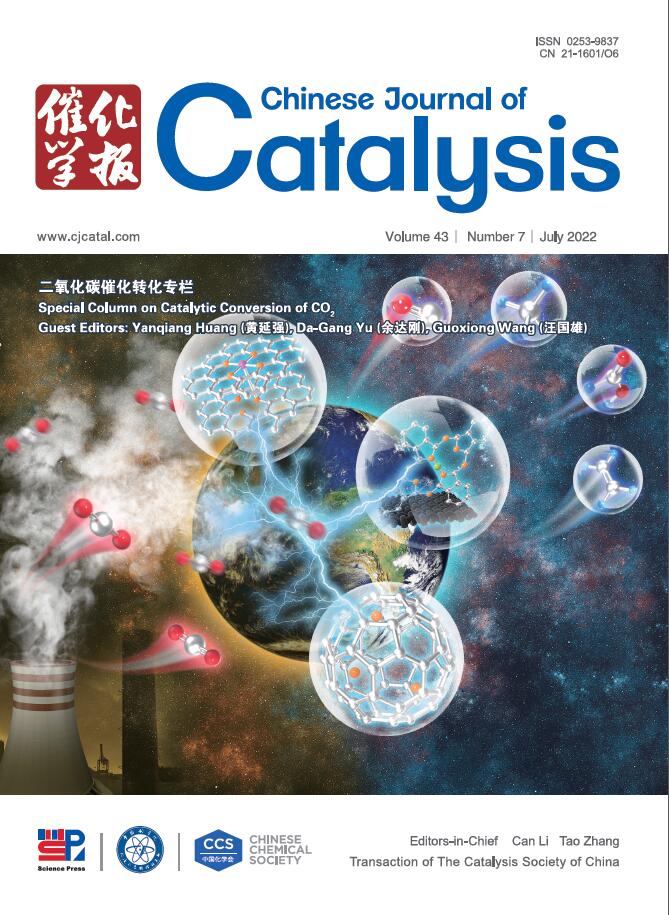
Chinese Journal of Catalysis
工程技术-工程:化工
CiteScore
25.80
自引率
10.30%
发文量
235
审稿时长
1.2 months
期刊介绍:
The journal covers a broad scope, encompassing new trends in catalysis for applications in energy production, environmental protection, and the preparation of materials, petroleum chemicals, and fine chemicals. It explores the scientific foundation for preparing and activating catalysts of commercial interest, emphasizing representative models.The focus includes spectroscopic methods for structural characterization, especially in situ techniques, as well as new theoretical methods with practical impact in catalysis and catalytic reactions.The journal delves into the relationship between homogeneous and heterogeneous catalysis and includes theoretical studies on the structure and reactivity of catalysts.Additionally, contributions on photocatalysis, biocatalysis, surface science, and catalysis-related chemical kinetics are welcomed.
 求助内容:
 应助结果提醒方式:


 京公网安备 11010802042870号


