
Mechanochemical fabrication of a biochar/pyrite nanocomposite for efficient photocatalytic CO2 reduction coupled with biomass valorization
IF 10.6
1区 化学
Q1 CHEMISTRY, MULTIDISCIPLINARY
引用次数: 0
Abstract
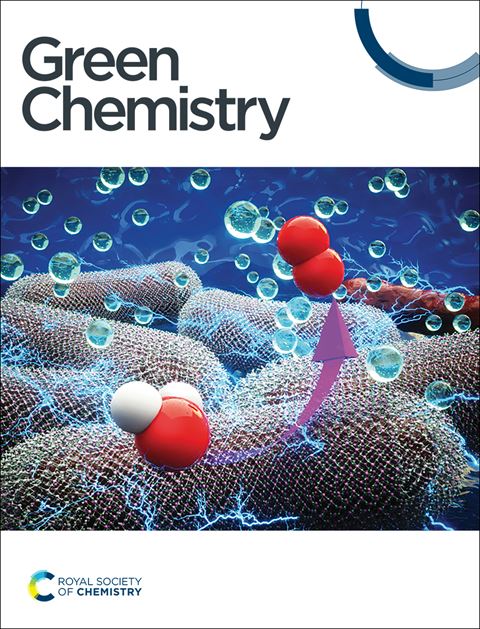
Coupling solar-driven CO2 reduction with the valorization of waste biomass-derived platform chemicals represents a pivotal strategy toward achieving carbon neutrality and sustainable resource utilization. However, the high dissociation energy of the CO bond in CO2 and the complex side reactions involved in biomass conversion often result in low conversion efficiency and poor product selectivity. To address these challenges, herein, a biochar/pyrite nanocomposite was fabricated via a facile mechanical ball-milling method using natural pyrite and biochar derived from waste corn stover. During the ball-milling process, intimate interfacial contact is established between the two components, leading to the formation of a high–low heterojunction that effectively promotes the spatial separation and interfacial migration of photogenerated charge carriers. The optimized 30 wt% biochar/pyrite sample exhibits outstanding photocatalytic performance under simulated visible light irradiation, achieving a CO yield of 320.7 μmol g−1 h−1 with a selectivity of 90.7%, together with a 5-hydroxymethylfurfural conversion of 86.4% and a high 2,5-diformylfuran selectivity of 93.2%. The incorporation of biochar not only enhances the adsorption capacity for the reactants but also substantially boosts the photocatalytic activity of pyrite through facilitated interfacial charge transfer. This work provides a new strategy for constructing efficient photocatalytic systems based on natural minerals and waste biomass, enabling the synergistic coupling of CO2 reduction and biomass valorization.
生物炭/黄铁矿纳米复合材料的机械化学制备,用于高效光催化CO2还原和生物质增值
将太阳能驱动的二氧化碳减排与废弃生物质衍生平台化学品的增值相结合,是实现碳中和和可持续资源利用的关键战略。然而,CO2中CO键的高解离能和生物质转化过程中复杂的副反应往往导致转化效率低,产物选择性差。为了解决这些问题,本研究通过简单的机械球磨方法,利用废弃玉米秸秆中的天然黄铁矿和生物炭制备了生物炭/黄铁矿纳米复合材料。在球磨过程中,两组分之间建立了密切的界面接触,形成了高低异质结,有效地促进了光生载流子的空间分离和界面迁移。优化后的30 wt%生物炭/黄铁矿样品在模拟可见光照射下表现出优异的光催化性能,CO产率为320.7 μmol g−1 h−1,选择性为90.7%,5-羟甲基糠醛转化率为86.4%,2,5-二甲酰呋喃选择性为93.2%。生物炭的掺入不仅提高了对反应物的吸附能力,而且通过促进界面电荷转移,大大提高了黄铁矿的光催化活性。该研究为构建基于天然矿物和废弃生物质的高效光催化体系提供了新的策略,使CO2还原和生物质增值协同耦合。
本文章由计算机程序翻译,如有差异,请以英文原文为准。
求助全文
约1分钟内获得全文
求助全文
来源期刊
Green Chemistry
化学-化学综合
CiteScore
16.10
自引率
7.10%
发文量
677
审稿时长
1.4 months
期刊介绍:
Green Chemistry is a journal that provides a unique forum for the publication of innovative research on the development of alternative green and sustainable technologies. The scope of Green Chemistry is based on the definition proposed by Anastas and Warner (Green Chemistry: Theory and Practice, P T Anastas and J C Warner, Oxford University Press, Oxford, 1998), which defines green chemistry as the utilisation of a set of principles that reduces or eliminates the use or generation of hazardous substances in the design, manufacture and application of chemical products. Green Chemistry aims to reduce the environmental impact of the chemical enterprise by developing a technology base that is inherently non-toxic to living things and the environment. The journal welcomes submissions on all aspects of research relating to this endeavor and publishes original and significant cutting-edge research that is likely to be of wide general appeal. For a work to be published, it must present a significant advance in green chemistry, including a comparison with existing methods and a demonstration of advantages over those methods.
 求助内容:
 应助结果提醒方式:


 京公网安备 11010802042870号


