{"title":"Metastable carbon nanocrystal transformation confined within hydrogel nanocomposites: a pursuit against antimicrobial resistant clinical pathogens.","authors":"Omnarayan Agrawal, Bani Preet Kaur, Sampathkumar Jeevanandham, Vikash Sharma, Arun K Sharma, Ujjawal Sharma, Hitesh Kumar Sharma, Dinesh Kalyansundaram, Monalisa Mukherjee","doi":"10.1039/d6nh00172f","DOIUrl":null,"url":null,"abstract":"<p><p>Hydrogels with tissue-mimetic properties hold immense potential for biomedical engineering, yet they stumble in balancing their mechanical robustness with aqueous variability and inadvertently foster bacterial infections <i>in vivo</i>. Herein, we employed heterogenized carbon nanocrystals (CNH) as multifunctional nanofillers for designing biphasic hydrogel nanocomposites (HNCs) with hierarchically organized, nacre-inspired architectures. The HNC structures were synthesized through free-radical copolymerization with controlled modulation of nanofiller dispersion, interfacial coupling, and mesoscale morphology. At an ultra-low CNH loading (0.05 wt%), the uniform nanofiller dispersion establishes a percolated polymer-nanofiller interphase that restricts chain segmental mobility and promotes the formation of truncated cubic nanodomains, enabling homogeneous stress transfer and mechanical reinforcement. In contrast, increasing the CNH concentration to 0.3 wt% drives a transition toward anisotropic nanofiller aggregation, suppressing intercalation and inducing entropic buckling that yields hexagonally ordered nanocrystalline domains. These concentration-dependent structural transitions optimize interfacial interactions and nanofiller spacing, leading to synergistic enhancements in tensile strength, thermal stability, electrical conductivity, and the development of multiscale porous honeycomb networks. At elevated CNH loadings, the HNC exhibits improved mechanical robustness, electrical conductivity, biocompatibility, and pronounced antimicrobial activity against clinically isolated methicillin-resistant <i>Staphylococcus aureus</i>. Collectively, these results identify CNH-based hydrogels as a promising class of multifunctional biomaterials and highlight a nanostructure-mediated strategy for resistance-free bacterial inactivation.</p>","PeriodicalId":93,"journal":{"name":"Nanoscale Horizons","volume":" ","pages":"2382-2400"},"PeriodicalIF":6.4000,"publicationDate":"2026-09-07","publicationTypes":"Journal Article","fieldsOfStudy":null,"isOpenAccess":false,"openAccessPdf":"","citationCount":"0","resultStr":null,"platform":"Semanticscholar","paperid":null,"PeriodicalName":"Nanoscale Horizons","FirstCategoryId":"88","ListUrlMain":"https://doi.org/10.1039/d6nh00172f","RegionNum":2,"RegionCategory":"材料科学","ArticlePicture":[],"TitleCN":null,"AbstractTextCN":null,"PMCID":null,"EPubDate":"","PubModel":"","JCR":"Q1","JCRName":"CHEMISTRY, PHYSICAL","Score":null,"Total":0}
引用次数: 0
Abstract
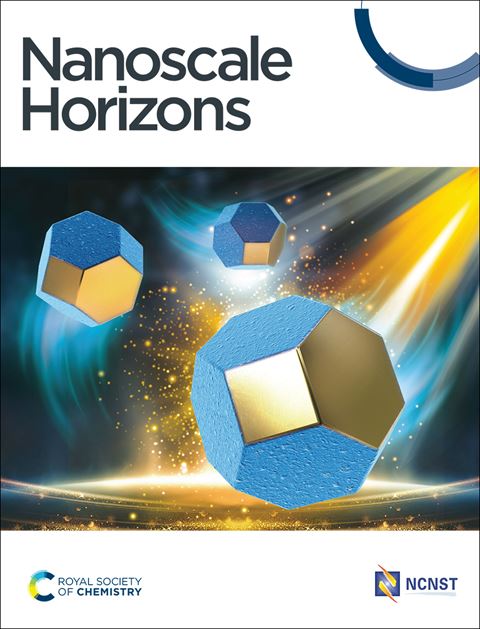
Hydrogels with tissue-mimetic properties hold immense potential for biomedical engineering, yet they stumble in balancing their mechanical robustness with aqueous variability and inadvertently foster bacterial infections in vivo. Herein, we employed heterogenized carbon nanocrystals (CNH) as multifunctional nanofillers for designing biphasic hydrogel nanocomposites (HNCs) with hierarchically organized, nacre-inspired architectures. The HNC structures were synthesized through free-radical copolymerization with controlled modulation of nanofiller dispersion, interfacial coupling, and mesoscale morphology. At an ultra-low CNH loading (0.05 wt%), the uniform nanofiller dispersion establishes a percolated polymer-nanofiller interphase that restricts chain segmental mobility and promotes the formation of truncated cubic nanodomains, enabling homogeneous stress transfer and mechanical reinforcement. In contrast, increasing the CNH concentration to 0.3 wt% drives a transition toward anisotropic nanofiller aggregation, suppressing intercalation and inducing entropic buckling that yields hexagonally ordered nanocrystalline domains. These concentration-dependent structural transitions optimize interfacial interactions and nanofiller spacing, leading to synergistic enhancements in tensile strength, thermal stability, electrical conductivity, and the development of multiscale porous honeycomb networks. At elevated CNH loadings, the HNC exhibits improved mechanical robustness, electrical conductivity, biocompatibility, and pronounced antimicrobial activity against clinically isolated methicillin-resistant Staphylococcus aureus. Collectively, these results identify CNH-based hydrogels as a promising class of multifunctional biomaterials and highlight a nanostructure-mediated strategy for resistance-free bacterial inactivation.
期刊介绍:
Nanoscale Horizons stands out as a premier journal for publishing exceptionally high-quality and innovative nanoscience and nanotechnology. The emphasis lies on original research that introduces a new concept or a novel perspective (a conceptual advance), prioritizing this over reporting technological improvements. Nevertheless, outstanding articles showcasing truly groundbreaking developments, including record-breaking performance, may also find a place in the journal. Published work must be of substantial general interest to our broad and diverse readership across the nanoscience and nanotechnology community.

 求助内容:
 应助结果提醒方式:


 京公网安备 11010802042870号


