
Diversity-Driven Model Ensemble Adaptive Trust Region Policy Optimization
IF 8.4
1区 计算机科学
Q1 AUTOMATION & CONTROL SYSTEMS
IEEE Transactions on Systems Man Cybernetics-Systems
Pub Date : 2026-04-01
Epub Date: 2026-01-23
DOI:10.1109/TSMC.2026.3650850
引用次数: 0
Abstract
Model-based reinforcement learning (MBRL) aims to promote sample efficiency and reduce the number of interactions with the true environment, via learning an environment dynamic model, compared with model-free reinforcement learning (MFRL). However, the success of MBRL heavily relies on two key aspects: model learning and planning. The former refers to learning an accurate model, and the latter aims to improve the behavior policy. In this article, we investigate these two aspects further with model ensemble learning. We design a deep residual attention U-Net (RauNet) with fewer neurons (or weights) than the widely used shallow neural network as our base models and further apply the Hilbert–Schmidt independence criterion (HSIC) as a regularization term to pursue model diversity explicitly for the model ensemble. Furthermore, we propose an adaptive trust region policy optimization (TRPO), in which the parametric Rényi alpha divergence substitutes for the Kullback–Leibler (KL) divergence for measuring the difference between two successive policies, and the alpha value can be adaptively adjusted during TRPO training iterations. This method is called diversity-driven model ensemble adaptive TRPO, or simply diversity-driven model ensemble adaptive trust region policy optimization. Our detailed experiments on six benchmark environments show that our proposed approach is optimal, compared with five state-of-the-art RL techniques.多样性驱动模型集成自适应信任域策略优化
与无模型强化学习(MFRL)相比,基于模型的强化学习(MBRL)旨在通过学习环境动态模型来提高样本效率,减少与真实环境的交互次数。然而,MBRL的成功在很大程度上依赖于两个关键方面:模型学习和规划。前者是指学习一个准确的模型,后者是指改进行为策略。在本文中,我们用模型集成学习进一步研究了这两个方面。我们设计了一个深度剩余注意力U-Net (RauNet),它的神经元(或权重)比广泛使用的浅神经网络更少,作为我们的基本模型,并进一步应用Hilbert-Schmidt独立性准则(HSIC)作为正则化项,以明确地追求模型集成的模型多样性。在此基础上,提出了一种自适应信任域策略优化(TRPO)方法,该方法采用参数化rsamnyi α散度代替Kullback-Leibler (KL)散度来度量两个连续策略之间的差异,并且可以在TRPO训练迭代过程中自适应调整α值。这种方法被称为多样性驱动模型集成自适应TRPO,或简称为多样性驱动模型集成自适应信任域策略优化。我们在六个基准环境上的详细实验表明,与五种最先进的强化学习技术相比,我们提出的方法是最佳的。
本文章由计算机程序翻译,如有差异,请以英文原文为准。
求助全文
约1分钟内获得全文
求助全文
来源期刊
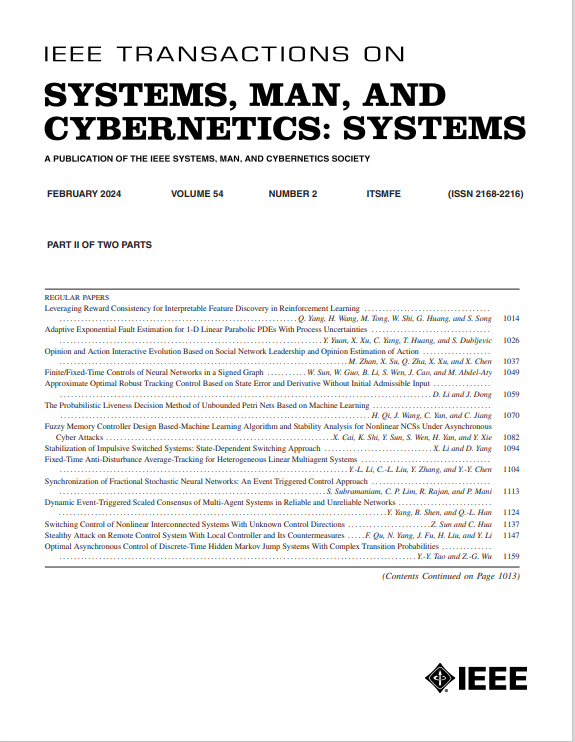
IEEE Transactions on Systems Man Cybernetics-Systems
AUTOMATION & CONTROL SYSTEMS-COMPUTER SCIENCE, CYBERNETICS
CiteScore
18.50
自引率
11.50%
发文量
812
审稿时长
6 months
期刊介绍:
The IEEE Transactions on Systems, Man, and Cybernetics: Systems encompasses the fields of systems engineering, covering issue formulation, analysis, and modeling throughout the systems engineering lifecycle phases. It addresses decision-making, issue interpretation, systems management, processes, and various methods such as optimization, modeling, and simulation in the development and deployment of large systems.
 求助内容:
 应助结果提醒方式:


 京公网安备 11010802042870号


