
Fuzzy Reinforcement Learning-Based Safe Cooperative Control for Nonlinear Multiagent Systems
IF 8.4
1区 计算机科学
Q1 AUTOMATION & CONTROL SYSTEMS
IEEE Transactions on Systems Man Cybernetics-Systems
Pub Date : 2026-04-01
Epub Date: 2026-01-16
DOI:10.1109/TSMC.2025.3650055
引用次数: 0
Abstract
This article investigates safe cooperative control problem for nonlinear multiagent systems (MASs) with composite constraints and multiactuator faults. Specifically, the composite constraints primarily consist of state constraints and terminal time constraints. For the former, state-mapping functions and universal barrier functions are introduced to address asymmetric dynamic delayed constraints, which are further enhanced through state transformation to create new state variables. This approach eliminates the limitations imposed by initial system conditions and the influence of unknown terms, while accommodating both unconstrained and constrained scenarios. The latter introduces terminal time constraints on the basis of the former framework to rapidly satisfy system performance requirements. Furthermore, neural networks (NNs) are employed to approximate the reconstructed multiple fault information and system uncertainties. Then, an actor-critic-identifier architecture based on fuzzy reinforcement learning (RL) is constructed via an optimal backstepping (OB) method, enabling the solution of the Hamilton–Jacobi–Bellman equation within each subsystem without the need for persistent excitation. Finally, by integrating Lyapunov stability theory with graph theory, it is proven that all signals are bounded, and the followers ultimately achieve dynamic consensus with the leader. Simulation results are provided to demonstrate the effectiveness of this control strategy.基于模糊强化学习的非线性多智能体系统安全协同控制
研究了具有复合约束和多执行器故障的非线性多智能体系统的安全协同控制问题。具体来说,复合约束主要包括状态约束和终端时间约束。对于前者,引入状态映射函数和通用屏障函数来解决非对称动态延迟约束,并通过状态变换进一步增强动态延迟约束,生成新的状态变量。这种方法消除了由初始系统条件和未知项的影响所施加的限制,同时适应了非约束和约束情景。后者在前者框架的基础上引入终端时间约束,快速满足系统性能需求。利用神经网络对重构的多故障信息和系统不确定性进行逼近。然后,通过最优反步(OB)方法构建了基于模糊强化学习(RL)的参与者-关键-标识符体系结构,使每个子系统内的Hamilton-Jacobi-Bellman方程的解无需持续激励。最后,将李雅普诺夫稳定性理论与图论相结合,证明了所有信号都是有界的,follower最终与leader达成动态一致。仿真结果验证了该控制策略的有效性。
本文章由计算机程序翻译,如有差异,请以英文原文为准。
求助全文
约1分钟内获得全文
求助全文
来源期刊
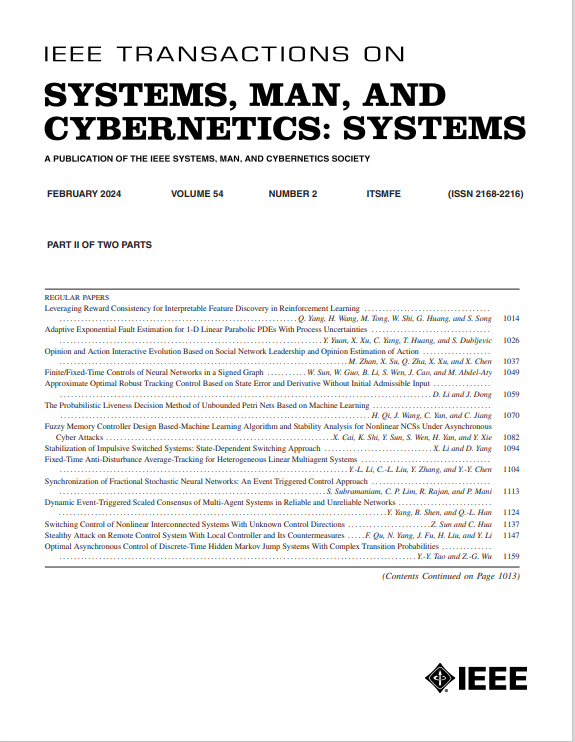
IEEE Transactions on Systems Man Cybernetics-Systems
AUTOMATION & CONTROL SYSTEMS-COMPUTER SCIENCE, CYBERNETICS
CiteScore
18.50
自引率
11.50%
发文量
812
审稿时长
6 months
期刊介绍:
The IEEE Transactions on Systems, Man, and Cybernetics: Systems encompasses the fields of systems engineering, covering issue formulation, analysis, and modeling throughout the systems engineering lifecycle phases. It addresses decision-making, issue interpretation, systems management, processes, and various methods such as optimization, modeling, and simulation in the development and deployment of large systems.
 求助内容:
 应助结果提醒方式:


 京公网安备 11010802042870号


