{"title":"Innovative nano sensors: boron quantum dots for precision detection of folic acid","authors":"Tuna Demirci, Durukan Koç, Erdem Elibol","doi":"10.1007/s11051-026-06713-y","DOIUrl":null,"url":null,"abstract":"<div><p>In this study, heavy-metal-free boron quantum dots (BQDs) were successfully synthesized via a one-pot solvothermal approach using boric acid dissolved in an optimized dimethylformamide (DMF) and monopropylene glycol (MPG) dual solvent system. To establish a highly selective “off-to-on” fluorometric nanosensor, the surfaces of the BQDs were tailored via silver (Ag) modification. The structural, chemical, and optical behaviors of the synthesized nanomaterials were comprehensively validated through HR-TEM, FT-IR, and UV-Vis characterizations. Under optimal conditions, the BQD-Ag sensor exhibited a constant photoluminescence (PL) emission peak within the 446–449 nm range. Benefiting from a rigid linear coordination geometry between the surface silver ions and the pteridine nitrogen of folic acid (FA), the sensor demonstrated outstanding sensitivity with a revised limit of detection (LOD) of 0.058 µM and a limit of quantification (LOQ) of 0.176 µM across a wide linear range. The practical reliability of the platform was successfully evaluated using complex real-world agricultural matrices, including parsley, red lentil, and green lentil. The method yielded exceptional reproducibility with relative standard deviations (%RSD) below 0.60% and satisfactory spike and recovery values ranging between 91.2% and 104.8%. Eliminating the need for hazardous heavy metals while preserving superior optical qualities, this sustainable BQD-based platform offers a cost-effective, precise, and robust alternative for potential biosensing, food safety regulations, and clinical diagnostics.</p></div>","PeriodicalId":653,"journal":{"name":"Journal of Nanoparticle Research","volume":"28 7","pages":""},"PeriodicalIF":3.5000,"publicationDate":"2026-07-14","publicationTypes":"Journal Article","fieldsOfStudy":null,"isOpenAccess":false,"openAccessPdf":"","citationCount":"0","resultStr":null,"platform":"Semanticscholar","paperid":null,"PeriodicalName":"Journal of Nanoparticle Research","FirstCategoryId":"88","ListUrlMain":"https://link.springer.com/article/10.1007/s11051-026-06713-y","RegionNum":4,"RegionCategory":"材料科学","ArticlePicture":[],"TitleCN":null,"AbstractTextCN":null,"PMCID":null,"EPubDate":"","PubModel":"","JCR":"Q3","JCRName":"CHEMISTRY, MULTIDISCIPLINARY","Score":null,"Total":0}
引用次数: 0
Abstract
In this study, heavy-metal-free boron quantum dots (BQDs) were successfully synthesized via a one-pot solvothermal approach using boric acid dissolved in an optimized dimethylformamide (DMF) and monopropylene glycol (MPG) dual solvent system. To establish a highly selective “off-to-on” fluorometric nanosensor, the surfaces of the BQDs were tailored via silver (Ag) modification. The structural, chemical, and optical behaviors of the synthesized nanomaterials were comprehensively validated through HR-TEM, FT-IR, and UV-Vis characterizations. Under optimal conditions, the BQD-Ag sensor exhibited a constant photoluminescence (PL) emission peak within the 446–449 nm range. Benefiting from a rigid linear coordination geometry between the surface silver ions and the pteridine nitrogen of folic acid (FA), the sensor demonstrated outstanding sensitivity with a revised limit of detection (LOD) of 0.058 µM and a limit of quantification (LOQ) of 0.176 µM across a wide linear range. The practical reliability of the platform was successfully evaluated using complex real-world agricultural matrices, including parsley, red lentil, and green lentil. The method yielded exceptional reproducibility with relative standard deviations (%RSD) below 0.60% and satisfactory spike and recovery values ranging between 91.2% and 104.8%. Eliminating the need for hazardous heavy metals while preserving superior optical qualities, this sustainable BQD-based platform offers a cost-effective, precise, and robust alternative for potential biosensing, food safety regulations, and clinical diagnostics.
期刊介绍:
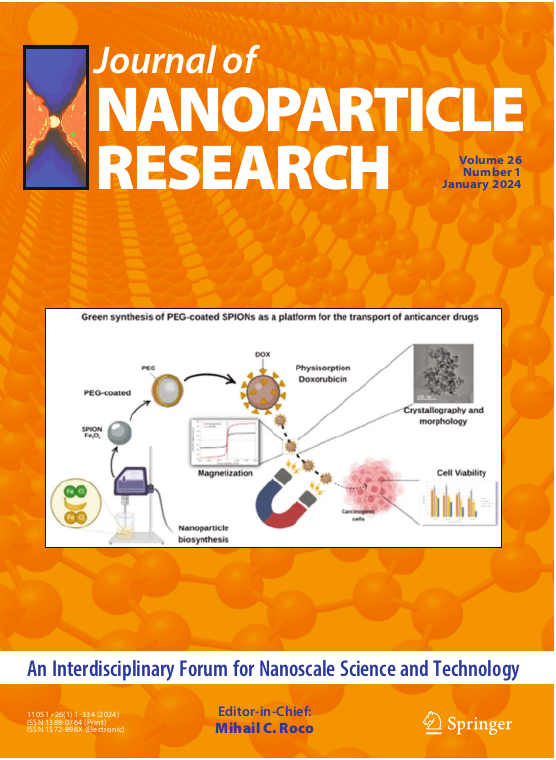
The objective of the Journal of Nanoparticle Research is to disseminate knowledge of the physical, chemical and biological phenomena and processes in structures that have at least one lengthscale ranging from molecular to approximately 100 nm (or submicron in some situations), and exhibit improved and novel properties that are a direct result of their small size.
Nanoparticle research is a key component of nanoscience, nanoengineering and nanotechnology.
The focus of the Journal is on the specific concepts, properties, phenomena, and processes related to particles, tubes, layers, macromolecules, clusters and other finite structures of the nanoscale size range. Synthesis, assembly, transport, reactivity, and stability of such structures are considered. Development of in-situ and ex-situ instrumentation for characterization of nanoparticles and their interfaces should be based on new principles for probing properties and phenomena not well understood at the nanometer scale. Modeling and simulation may include atom-based quantum mechanics; molecular dynamics; single-particle, multi-body and continuum based models; fractals; other methods suitable for modeling particle synthesis, assembling and interaction processes. Realization and application of systems, structures and devices with novel functions obtained via precursor nanoparticles is emphasized. Approaches may include gas-, liquid-, solid-, and vacuum-based processes, size reduction, chemical- and bio-self assembly. Contributions include utilization of nanoparticle systems for enhancing a phenomenon or process and particle assembling into hierarchical structures, as well as formulation and the administration of drugs. Synergistic approaches originating from different disciplines and technologies, and interaction between the research providers and users in this field, are encouraged.

 求助内容:
 应助结果提醒方式:


 京公网安备 11010802042870号


