Syed Tauseef Hassan, Wang Long, Cheng Fei, Kan Wu, Shahid Ali
{"title":"Green economy and artificial intelligence: pathways to better air quality and health in China","authors":"Syed Tauseef Hassan, Wang Long, Cheng Fei, Kan Wu, Shahid Ali","doi":"10.1007/s11869-026-02041-1","DOIUrl":null,"url":null,"abstract":"<div><p>China is under growing pressure from rising healthcare costs, persistent air-pollution exposure, rapid urbanization, and fast digital transformation. While previous studies have examined how pollution, energy production, and technological change affect health expenditure, most rely on average-based methods that overlook how these relationships differ when healthcare spending is low, moderate, or high. This study addresses that gap by treating health expenditure as a nonlinear, distribution-sensitive outcome shaped by artificial intelligence, green growth, energy production, and air quality. The study applies quantile ADF and quantile KPSS stationarity tests, and multivariate quantile-on-quantile regression, with conventional quantile regression used for robustness. The findings show clear nonlinear patterns, stable conditional distributions, and strong quantile-specific differences. Artificial intelligence has a mixed effect: it may increase spending through digital infrastructure and diagnostic investment, but may also reduce cost pressure through efficiency, early detection, and better resource allocation. For long-term policy, China’s health expenditure reflects a complex technology–energy–environment nexus, requiring coordinated policies on AI, green growth, clean energy, urban planning, and air quality improvement.</p><h3>Graphical abstract</h3><div><figure><div><div><picture><source><img></source></picture></div></div></figure></div></div>","PeriodicalId":49109,"journal":{"name":"Air Quality Atmosphere and Health","volume":"19 7","pages":""},"PeriodicalIF":3.1000,"publicationDate":"2026-07-06","publicationTypes":"Journal Article","fieldsOfStudy":null,"isOpenAccess":false,"openAccessPdf":"","citationCount":"0","resultStr":null,"platform":"Semanticscholar","paperid":null,"PeriodicalName":"Air Quality Atmosphere and Health","FirstCategoryId":"93","ListUrlMain":"https://link.springer.com/article/10.1007/s11869-026-02041-1","RegionNum":4,"RegionCategory":"环境科学与生态学","ArticlePicture":[],"TitleCN":null,"AbstractTextCN":null,"PMCID":null,"EPubDate":"","PubModel":"","JCR":"Q3","JCRName":"ENVIRONMENTAL SCIENCES","Score":null,"Total":0}
引用次数: 0
Abstract
China is under growing pressure from rising healthcare costs, persistent air-pollution exposure, rapid urbanization, and fast digital transformation. While previous studies have examined how pollution, energy production, and technological change affect health expenditure, most rely on average-based methods that overlook how these relationships differ when healthcare spending is low, moderate, or high. This study addresses that gap by treating health expenditure as a nonlinear, distribution-sensitive outcome shaped by artificial intelligence, green growth, energy production, and air quality. The study applies quantile ADF and quantile KPSS stationarity tests, and multivariate quantile-on-quantile regression, with conventional quantile regression used for robustness. The findings show clear nonlinear patterns, stable conditional distributions, and strong quantile-specific differences. Artificial intelligence has a mixed effect: it may increase spending through digital infrastructure and diagnostic investment, but may also reduce cost pressure through efficiency, early detection, and better resource allocation. For long-term policy, China’s health expenditure reflects a complex technology–energy–environment nexus, requiring coordinated policies on AI, green growth, clean energy, urban planning, and air quality improvement.
期刊介绍:
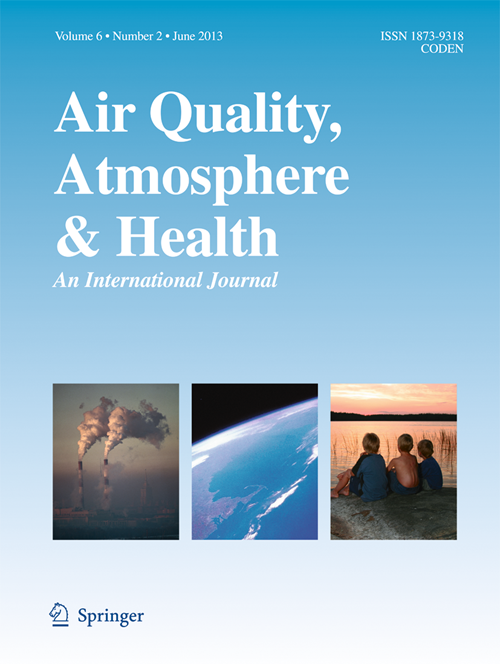
Air Quality, Atmosphere, and Health is a multidisciplinary journal which, by its very name, illustrates the broad range of work it publishes and which focuses on atmospheric consequences of human activities and their implications for human and ecological health.
It offers research papers, critical literature reviews and commentaries, as well as special issues devoted to topical subjects or themes.
International in scope, the journal presents papers that inform and stimulate a global readership, as the topic addressed are global in their import. Consequently, we do not encourage submission of papers involving local data that relate to local problems. Unless they demonstrate wide applicability, these are better submitted to national or regional journals.
Air Quality, Atmosphere & Health addresses such topics as acid precipitation; airborne particulate matter; air quality monitoring and management; exposure assessment; risk assessment; indoor air quality; atmospheric chemistry; atmospheric modeling and prediction; air pollution climatology; climate change and air quality; air pollution measurement; atmospheric impact assessment; forest-fire emissions; atmospheric science; greenhouse gases; health and ecological effects; clean air technology; regional and global change and satellite measurements.
This journal benefits a diverse audience of researchers, public health officials and policy makers addressing problems that call for solutions based in evidence from atmospheric and exposure assessment scientists, epidemiologists, and risk assessors. Publication in the journal affords the opportunity to reach beyond defined disciplinary niches to this broader readership.

 求助内容:
 应助结果提醒方式:


 京公网安备 11010802042870号


